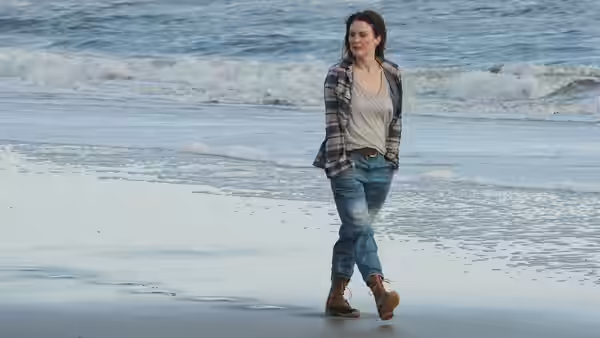
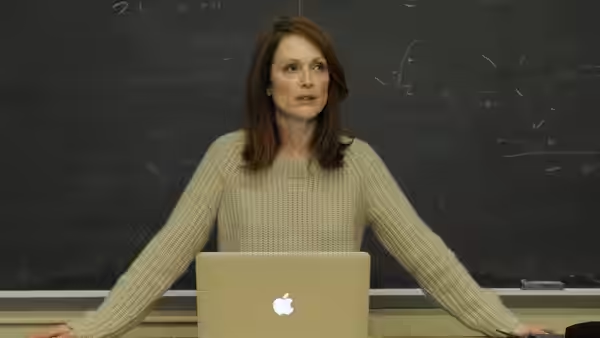
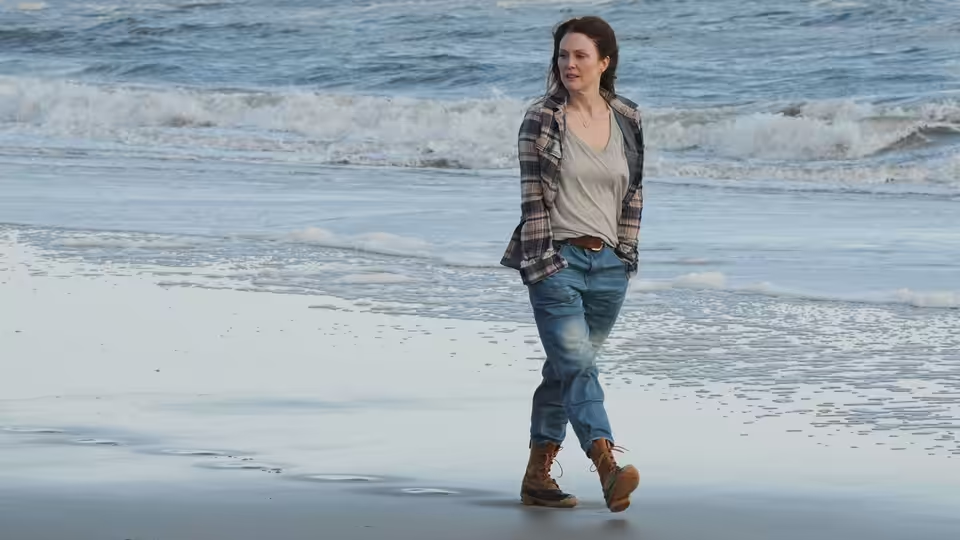
Lydia Howland (Kristen Stewart) walks along the beach beside the surf
Film review

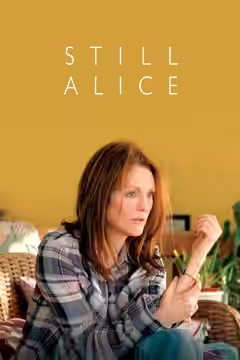
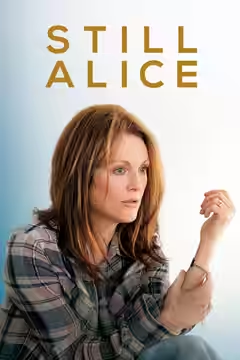
Still Alice

2014 · Directed by Wash Westmoreland, Richard Glatzer · 1h 41m

In a sentenceJulianne Moore needs less help from the music than the music seems to think

Alice Howland (Julianne Moore) begins to experience disorientation. An Alzheimer’s diagnosis threatens the abilities on which her sense of herself depends, and she tries to understand what is happening to her mind. John Howland (Alec Baldwin) is among those responding to the diagnosis, while Alice’s relationship with her daughter, Lydia Howland (Kristen Stewart), comes under new pressure. Their existing difficulties do not disappear because Alice is ill. She wants to keep thinking and communicating as she always has, but the symptoms make that harder for her and force the family to consider what will change.

Plays from YouTube when you press play; nothing loads from them until then.

Fi1m review

Julianne Moore makes Still Alice painfully convincing, even when the filmmaking settles for the familiar. Her scenes with Kristen Stewart give this restrained Alzheimer’s drama enough emotional force to overcome its cautious storytelling.

Still Alice is a moving drama with a conventional script and an unusually attentive central performance. Richard Glatzer and Wash Westmoreland adapt Lisa Genova’s novel with a clear concern for Alice’s experience of Alzheimer’s, keeping her intelligence central to our understanding of what the illness threatens. That matters in a genre which can too easily turn a person into an occasion for everyone else to learn compassion. Here, Alice remains worth listening to when listening becomes difficult.

Julianne Moore makes the first signs of confusion hard to dismiss without making them look like a performance of symptoms. Her face and voice register the work involved in trying to remain composed, and we can sense how much being able to think clearly means to Alice. We were frightened by that early disorientation. The effort to understand what is happening is still there, plainly visible, even as Alice struggles to trust her own mind.

Kristen Stewart helps keep the scenes between mother and daughter from becoming another account of Alice’s symptoms. As Lydia Howland, her exchanges with her mother have the unsettled closeness of people whose relationship did not begin with a diagnosis. Affection does not clear away every difficulty, and the performances allow both women to have feelings that are inconvenient to the other. We would have welcomed more of these exchanges; some of the other characters are too lightly drawn to make the same impression.

Denis Lenoir’s cinematography helps us share Alice’s disorientation, but the visual approach is otherwise rather staid. The images seldom seem as alert to Alice’s changing thoughts as her face does, and the film can look too settled for what she is experiencing. Tommaso Ortino’s production design is similarly discreet, leaving Alice’s surroundings with less character than the people occupying them. Keeping attention on the performances works, but it also makes the film depend on them for almost every moment of interest.

Nicolas Chaudeurge’s editing keeps the progression legible, at some cost to the time we spend with each change. We sometimes need longer to absorb what has happened before the film moves on. Ilan Eshkeri’s score has the opposite problem: it presses the sadness beyond what the acting requires. The added emphasis makes some passages feel more conventional than the performances deserve.

The 101-minute running time should not be mistaken for an easy evening. There is real pleasure in watching acting this attentive, even when the subject is painful. Accept the conventional storytelling, and the exchanges between Alice and Lydia are reason enough to stay. Leave a little quiet afterwards rather than asking the next programme to cheer things up.

Critical consensus AI synthesised

71
Positive
15
Mixed
8
Negative
3

Most critics find Still Alice moving and humane, with praise centred on Julianne Moore’s restrained portrayal of Alzheimer’s and its effect on Alice’s sense of herself. The reviews repeatedly credit her face, voice and small shifts in behaviour with making the illness feel immediate rather than merely explained. Kristen Stewart also draws praise, particularly for the intimacy and unease of the mother-daughter relationship, while supporters value the film’s quiet attention to Alice’s experience.

The spread is wide, though even detractors generally admire Moore. Reservations cluster around familiar plotting, thin supporting characters and filmmaking that some find too cautious or visually plain to match the performances. Empire praises the visual techniques used to convey Alice’s worsening condition, whereas Slant Magazine objects to melodramatic storytelling and an intrusive score. The central division is over whether the film’s restraint gives its subject dignity or softens material that needs a less conventional treatment.

Time Out
19 January 2015 · ★★★★★ · David Ehrlich
100

The review presents Alzheimer’s as a cruel, tragic progression. Its description emphasizes the devastating inevitability of the disease.

Read the full review →
Empire
20 February 2015 · David Hughes
85*

Hughes finds the film stirring, thought-provoking and deeply humane. He especially praises Julianne Moore’s heartfelt performance and the visual techniques used to convey Alice’s worsening condition.

Read the full review →
Evening Standard
25 September 2014 · festival review · David Sexton
85*

Sexton finds the film deeply moving and life-affirming. He singles out Julianne Moore’s harrowing performance as Alice for praise.

Read the full review →
Little White Lies
5 March 2016 · 2/4/4 · Simran Hans
80

Hans finds the film an absorbing, intimate portrait that avoids becoming manipulative despite its bleak subject. She especially praises Kristen Stewart and Julianne Moore’s onscreen chemistry and the film’s focus on Alice’s intellectual identity.

Read the full review →
Total Film
2 March 2015 · ★★★★ · Kevin Harley
80

The review praises the film as a sensitive, controlled portrayal of Alzheimer’s, led by Julianne Moore’s quietly heartbreaking performance. It singles out Moore’s restrained depiction of Alice’s gradual decline as the film’s strength.

Read the full review →
Variety
9 September 2014 · festival review · Peter Debruge
80*

Debruge finds the film sensitive, dignified, and devastating, with a powerful perspective on living with Alzheimer’s. He especially praises Julianne Moore’s restrained performance and the filmmakers’ quiet, emotionally focused approach.

Read the full review →

Straight answers AI written, from our review

Is Still Alice worth watching?
Still Alice is worth watching for Julianne Moore’s painfully convincing performance and her scenes with Kristen Stewart; we score it 77 out of 100. We recommend it to viewers who value attentive acting, with the caveat that the storytelling is conventional and the music sometimes pushes sadness the performances already convey.
How long is Still Alice, and what is it rated?
Still Alice runs 1h 41m. It is a drama film.
Where can I watch Still Alice in Serbia?
Still Alice is not on any streaming or rental service in Serbia at the moment. It is available in 36 other countries; change your country at the top of the page to see where. Availability is checked daily.
How violent or frightening is Still Alice, and is it suitable for children?
Still Alice has a UK 12A certificate, and its portrayal of Alzheimer’s makes it an emotionally difficult choice for children. We find Alice’s early disorientation frightening because Moore makes her struggle to trust her own mind so convincing. The subject calls for care with younger viewers, particularly those affected by dementia in their family.
How does Still Alice compare to Away from Her?
Still Alice stays close to a woman experiencing Alzheimer’s, while Away from Her follows a husband facing his wife’s illness and the limits of what love can preserve. We favour Away from Her for its emotional restraint, though its structure fidgets; Still Alice offers affecting mother-and-daughter scenes but presses the sadness harder through music.
Is Still Alice based on a true story or a book?
Still Alice is adapted from Lisa Genova’s novel, rather than presented as a true story. Richard Glatzer and Wash Westmoreland keep Alice’s intelligence and experience of Alzheimer’s central to the film. We find that focus clear enough for viewers unfamiliar with the book, though the storytelling follows a conventional path.
What should I watch after Still Alice?
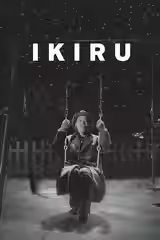
After Still Alice, try Away from Her (2006, Fi1m 82): A spouse faces dementia and the limits of what love can preserve. Then Poetry (2010, Fi1m 87): An ageing woman faces memory loss while discovering an exacting creative purpose; and Ikiru (1952, Fi1m 92): A terminal diagnosis prompts a quiet, stubborn search for something worth doing.

Cast

Awards

Academy Awards, 2015

Won
Best Actress

If you liked this, try…

  1. Away from Her (2006, Fi1m 82)A spouse faces dementia and the limits of what love can preserve.

  2. Poetry (2010, Fi1m 87)An ageing woman faces memory loss while discovering an exacting creative purpose.

  3. Ikiru (1952, Fi1m 92)A terminal diagnosis prompts a quiet, stubborn search for something worth doing.

  4. A Separation (2011, Fi1m 93)Care for an ailing parent becomes tangled in a family’s competing needs.

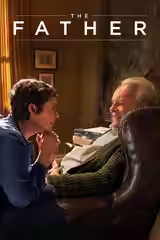
  5. The Father (2020, Fi1m 89)Another account of dementia, with confusion built into the rooms themselves.