A mechanical chicken stands on a counter against a yellow wall decorated with musical notes
Film review

Stroszek

1977 · Directed by Werner Herzog · 1h 48m

In a sentenceTwo Berliners and a pensioner discover that in America nobody kicks you; they just smile and hand you the bill

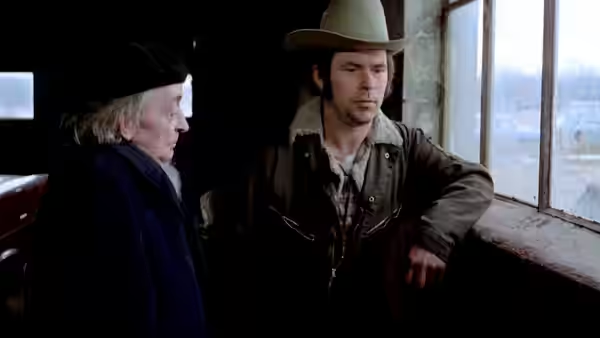
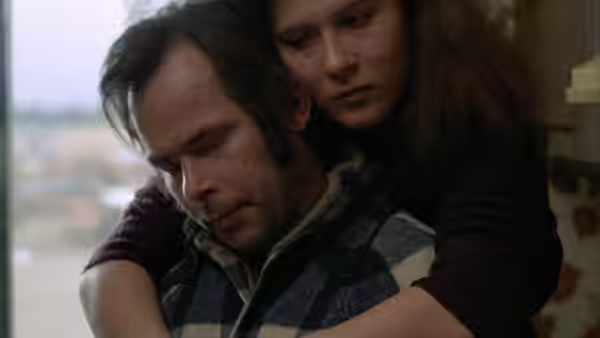
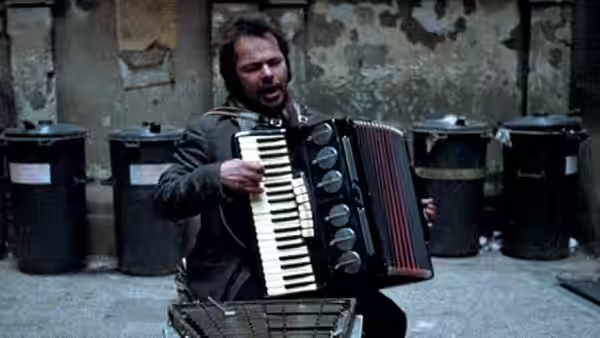
Berlin, the 1970s. Bruno Stroszek (Bruno Schleinstein), a street musician, walks out of prison with his accordion and a warning from the warden (Alfred Edel) to stay off the drink. He goes straight to a bar. Back in his flat he takes in Eva (Eva Mattes), a prostitute whose two pimps (Norbert Grupe and Burkhard Driest) follow her there, beat Bruno and wreck the place. His elderly neighbour Scheitz (Clemens Scheitz) has a nephew in Wisconsin, and the three of them pool what they have and fly to America. They land in Railroad Flats, where the nephew (Clayton Szalpinski) runs a garage, and buy a mobile home on credit from a smiling bank. Bruno wants somewhere nobody kicks him. The payments are due monthly.

Plays from YouTube when you press play; nothing loads from them until then.

Fi1m review

Werner Herzog takes Bruno Schleinstein out of a Berlin prison and puts him in a Wisconsin mobile home, and the result is one of the plainest and kindest films he has made. It is slow, it is odd, and it hurt us more than we expected.

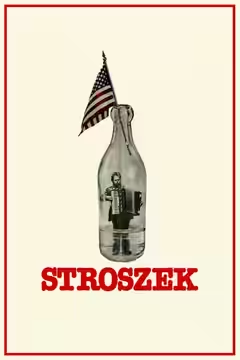
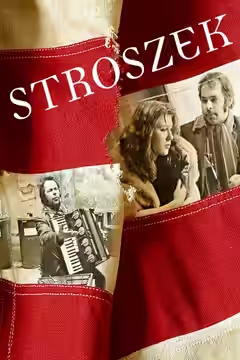
Werner Herzog wrote Stroszek for Bruno Schleinstein, who had played Kaspar Hauser for him three years earlier, and the poster calls it a ballad. That is the right word. It has a few verses, a chorus of bad luck and no moral at the end. It follows a man out of prison in Berlin, across the Atlantic and into a mobile home on a flat piece of Wisconsin, and it watches him lose, slowly and without comment. It is one of the best things Herzog has done, and it is close to the only one in which he plainly likes the person in front of the camera.

Schleinstein does not act in any sense a drama school would recognise. He talks about himself in the third person, delivers lines as if reading them off the inside of his own head, and stops mid-sentence to look at something nobody else has noticed. Herzog lets him. Eva Mattes plays Eva with a tired patience, a woman who has stopped expecting anything and is surprised to find she can still be kind to someone. Clemens Scheitz, small and courteous, carrying a homemade instrument for measuring things nobody else believes in, is the film’s comedy and its saddest sight.

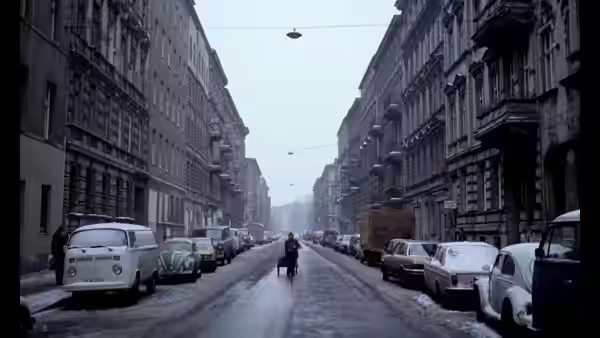
Thomas Mauch shoots Berlin in brown corridors and grey courtyards, and then shoots Wisconsin in a light so wide and flat it has nowhere to hide anyone. The mobile home sits on its plot like something left behind after a move, and the fields run to the edge of the frame in every direction. Beate Mainka-Jellinghaus lets scenes run past the point where most editors would cut, so that a doctor showing off a premature baby’s grip, or two farmers arguing over a boundary from the seats of their tractors, goes on until it stops being an anecdote and becomes the film. Chet Atkins’s guitar comes in when the plane lands, clean and hopeful. Sonny Terry’s harmonica, which sounds like a man laughing through a cold, keeps coming back.

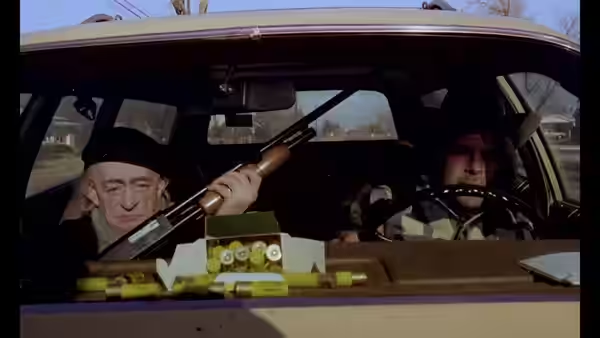
Not all of it works. The Berlin section runs long, and the pimps, played by Norbert Grupe and Burkhard Driest as plain brutes, bring a nastiness the film does not need twice. Some of the American material is Herzog pointing at things, a deer hunter, a bank, a television left on, and leaving us to draw the lesson. The reviews so far are cooler than we are, and more than one finds the culture-clash jokes obvious. They are obvious. We do not think they are jokes. Herzog is not laughing at the bank teller (Scott McKain), who is decent and embarrassed and doing his job; he is watching a system that never once raises its voice.

There is a speech Bruno gives Eva in the mobile home about how in Germany they kicked him in the open, and here they do it with a smile and nobody lays a hand on you. Schleinstein says it looking slightly past her. It moved us more than we thought it would, not because the line is eloquent but because it is not. It is a man working something out aloud, and it is the moment the film says, plainly, what it is about. We sat with it for a long time afterwards.

Against Herzog’s own record this is the quiet one. Aguirre, the Wrath of God (1972) had a madman and a river; Heart of Glass (1976) had a hypnotised cast and a prophecy. Stroszek has a street musician, a prostitute, a pensioner and a garage, and after Heart of Glass it looked to some like a retreat. We think it was a correction. Herzog is at his best when he stops looking for visions and finds one man who cannot help being strange.

The final sequence, which most critics mention first, we will leave alone. Watch it at home, in the evening, with nobody who needs a plot; it runs 108 minutes and moves at the pace of its lead. It will not cheer you up. It may make you kinder to the next person you see busking, which is more than most films manage.


Critical consensus AI synthesised

66
Positive
1
Mixed
4
Negative
0
RogerEbert.com
· Roger Ebert
78*

Ebert presents the film as a bleak, affecting portrait of alienation. He singles out Herzog’s unsettling imagery and the film’s haunting final sequence.

Read the full review →
The New York Times
11 September 1977 · Vincent Canby
66*

The blocked page does not reveal the critic’s verdict. Its headline frames Herzog’s filmmaking as deliberately outside scholarly conventions.

Read the full review →
The New Yorker
25 July 1977 · Penelope Gilliatt
64*

The page identifies a review of “Stroszek” but does not show the critic’s verdict. It provides no accessible details about what the critic praises or criticizes.

Read the full review →
Time Out
· CPe
61*

The review appears to question Herzog's approach after Heart of Glass. Its description singles out the film's apparently difficult surface and simpler reconstruction.

Read the full review →
Radio Times
★★★ · David Parkinson
60

Parkinson finds the film a sobering portrait of America as an unwelcoming wilderness. He praises its visionary surrealism, despite some obvious culture-clash jokes.

Read the full review →

Straight answers AI written, from our review

Is Stroszek worth watching?
Stroszek is worth watching for anyone with patience for a slow, odd, kind film about a man losing quietly, and we scored it 82. It moves at the pace of Bruno Schleinstein's lead and offers no plot to speak of, so it suits an evening at home rather than a crowd. It will not cheer you up, but it may leave you kinder.
How long is Stroszek, and what is it rated?
Stroszek runs 1h 48m. It is a drama film.
Where can I watch Stroszek in Poland?
Stroszek is not on any streaming or rental service in Poland at the moment. It is available in 9 other countries; change your country at the top of the page to see where. Availability is checked daily.
How does Stroszek compare to Umberto D.?
Stroszek and Umberto D. are both about people slowly losing their homes to money that never raises its voice, and both are carried by non-professional leads. Herzog's film is stranger and funnier, with Schleinstein's third-person mutterings and a wide Wisconsin light; De Sica's is more conventionally shaped and occasionally leans on its score. For a tidier drama, take Umberto D.; for the odder, more unguarded film, Stroszek.
What should I watch after Stroszek?
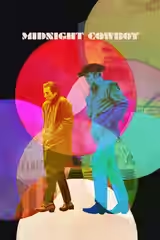
After Stroszek, try Umberto D. (1952, Fi1m 91): A Roman pensioner, a dog and a landlady; the same quiet arithmetic of poverty. Then Midnight Cowboy (1969, Fi1m 85): Two outsiders in a city that has no use for them, and a friendship that holds.

Cast

If you liked this, try…

  1. The Enigma of Kaspar Hauser (1974) · not on Fi1m yetSchleinstein’s first film for Herzog, a foundling among people who think they know better.

  2. Alice in the Cities (1974) · not on Fi1m yetAnother German drifts through America and finds it politer and emptier than promised.

  3. Umberto D. (1952, Fi1m 91)A Roman pensioner, a dog and a landlady; the same quiet arithmetic of poverty.

  4. Midnight Cowboy (1969, Fi1m 85)Two outsiders in a city that has no use for them, and a friendship that holds.

  5. Wendy and Lucy (2008) · not on Fi1m yetA woman, a car and a lost dog in Oregon; small losses that add up.

Stroszek (1977) review: Herzog’s bleak, tender ballad of America (Poland) | Fi1m