Uli Edel’s account of the Red Army Faction is cast to the hilt and reconstructed down to the ashtrays, and it never once slows down. Thrilling for an hour, exhausting after that, and the ideas get lost under the gunfire.
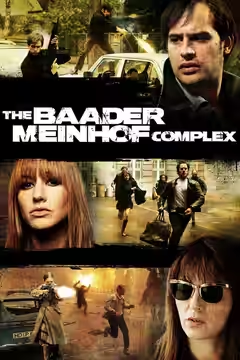
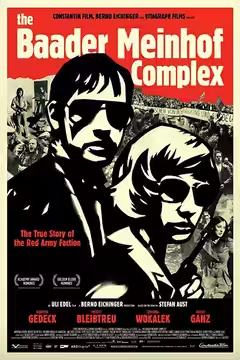
Uli Edel and the producer Bernd Eichinger have taken Stefan Aust’s book on the Red Army Faction and tried to put the whole of it on screen: ten years, three generations of the group, the bombings, the arrests, the prison, the trial. It runs 149 minutes and there is not a slow one in it. That is the film’s chief quality and its chief fault. It is superbly acted and it never gives anyone, on screen or on the sofa, time to think.
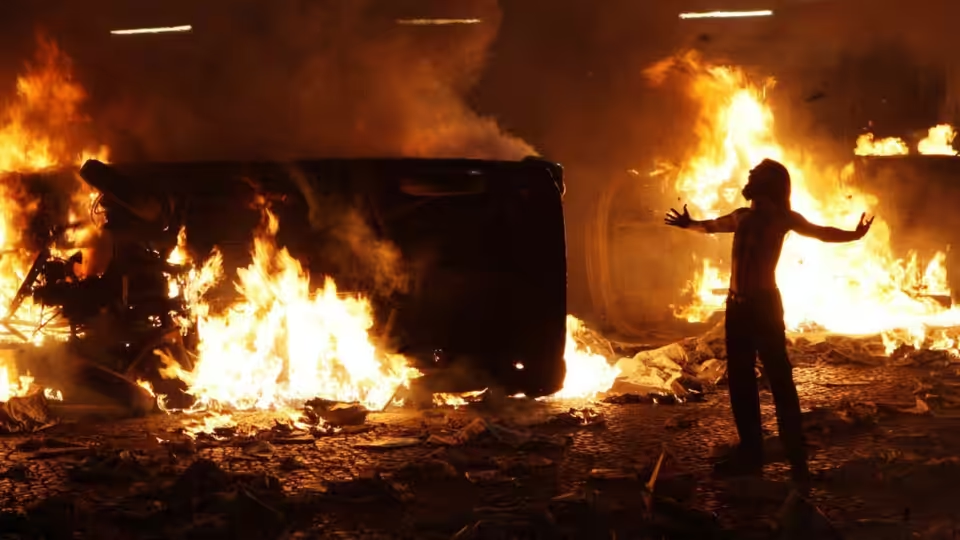
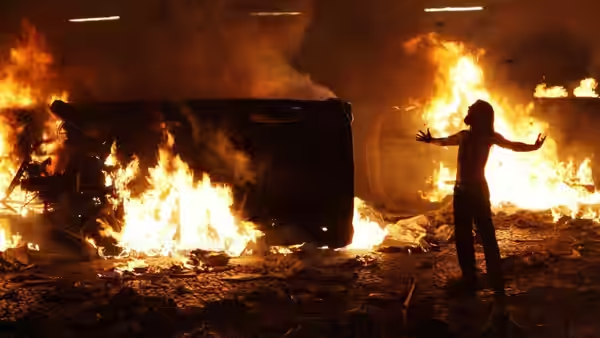
The first hour is the strong part. Rainer Klausmann puts his camera inside the crowd at the 1967 demonstration against the Shah, so that when the police wade in with batons we see it at shoulder height, between heads, and cannot tell which way to run. We were properly frightened, and we knew how the scene ended. It is the one sequence in which the film shows us, rather than tells us, why these particular young people decided the state was the enemy. Bernd Lepel’s late-sixties Germany is brown and orange and full of ashtrays, and the newspaper office, the Frankfurt flats and the Berlin streets are built with the sort of care that makes you forget they were built.
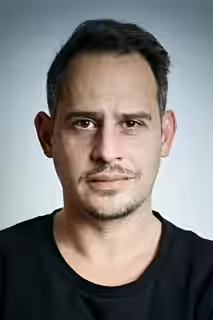
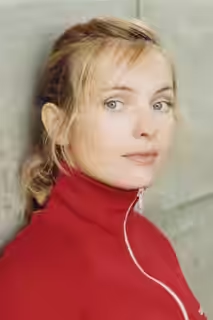
Then there is the cast. Martina Gedeck plays Meinhof as a woman who talks herself into things, a writer more at home describing the barricade than standing on it, and the film’s best scenes are the ones in which she watches Baader and Ensslin and wishes she were braver. Moritz Bleibtreu’s Baader is a loudmouth in sunglasses who likes fast cars more than Marx and never pretends otherwise; Bleibtreu makes him funny, vain and restless, and lets us see how little is underneath. Johanna Wokalek is the quiet, frightening one. Her Ensslin leaves her baby and does not look back, and Wokalek plays the certainty without a flicker. Birgit Missal dresses them beautifully, leather and short skirts and fur collars, and the film knows exactly how good they look. That is an honest observation about why people followed them, and it is also a problem the film never quite faces.
Bruno Ganz, as Horst Herold, is the film’s adult. He sits in offices with Heino Ferch as his assistant and says, calmly, that you cannot beat these people without understanding what made them, and Ganz delivers it as plain sense rather than a sermon. His scenes are short and few. We wanted more of him, because he is the only character asking the question the film was presumably made to answer.
The second half is where it goes wrong. Alexander Berner cuts the years of bombings and arrests as a run of short scenes with dates stamped on them, and somewhere after the ninety-minute mark we realised we had lost track of who the new faces were. Nadja Uhl’s Brigitte Mohnhaupt and Daniel Lommatzsch’s Christian Klar arrive as the second generation and the film has no time to tell us anything about them except that they shoot people. By the end we were tired and, more worryingly, a little numb, and the film seemed to take the numbness as a response.
The script by Eichinger and Edel is scrupulous about what happened and nearly silent about why. The group’s politics come out as slogans shouted across tables, which may well be accurate, but a film can choose to stop and listen and this one keeps driving. The East, the Wall a few streets away and what was being done on the other side of it, barely comes up. Some critics think the film glamorises its subjects. We do not: it shows them as attractive and then shows them as brutal and deluded. What it does not do is choose a place to stand and look at either.
Worth an evening for the cast and the first hour, and for anyone who knows the history and wants to see it staged with this much conviction. If you do not know it, keep a pencil handy, because the film will not stop to tell you who anyone is. It carries an 18 certificate and earns every minute of it.