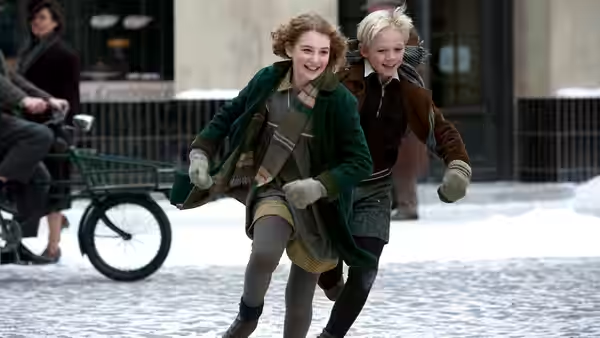
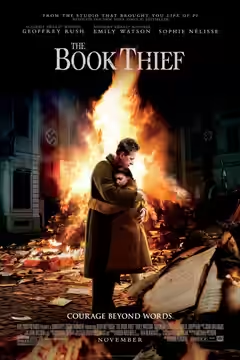
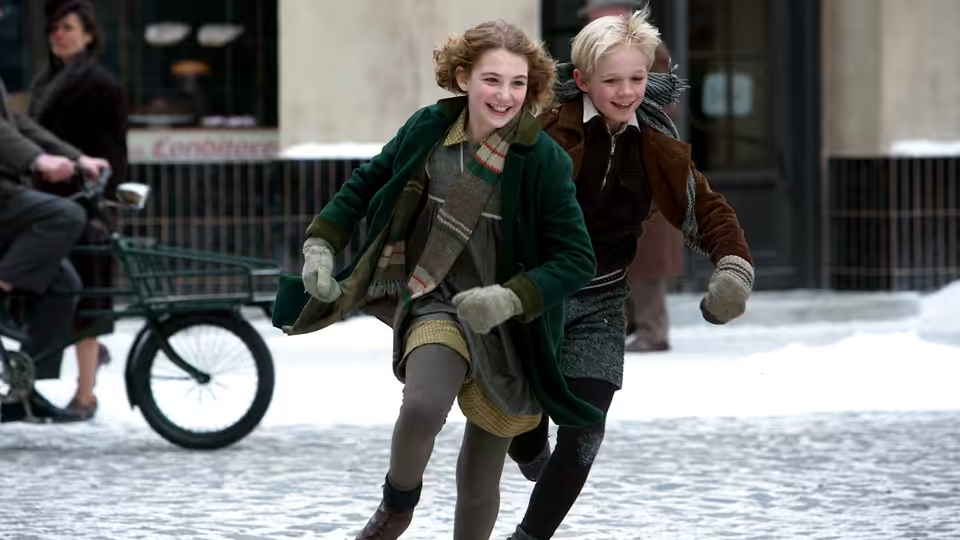
Liesel Meminger (Sophie Nélisse) and Rudy Steiner (Nico Liersch) run through a snowy street
Film review

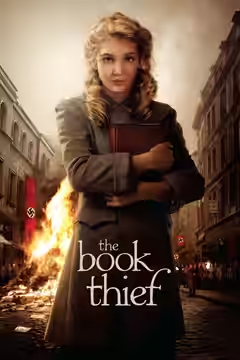
The Book Thief

2013 · Directed by Brian Percival · 2h 11m

In a sentenceEven Death sounds as though he would rather not upset anyone

In wartime Germany, Liesel Meminger (Sophie Nélisse) finds affection with Hans Hubermann (Geoffrey Rush) and Rosa Hubermann (Emily Watson), while Nazi propaganda reaches into ordinary life. Books become important to Liesel as she tries to understand the people around her and the country they live in. The adults in her life face the demands of a regime that expects obedience, and must decide what decency requires of them. Death (Roger Allam) narrates her story, following a child drawn to words and the Germans who resist the messages they are told to believe.

Plays from YouTube when you press play; nothing loads from them until then.

Fi1m review

Geoffrey Rush and Sophie Nélisse bring welcome warmth to Brian Percival’s adaptation, but the film is too cosy for its subject. Its treatment of wartime Germany needs danger that the handsome images and reassuring sentiment keep softening.

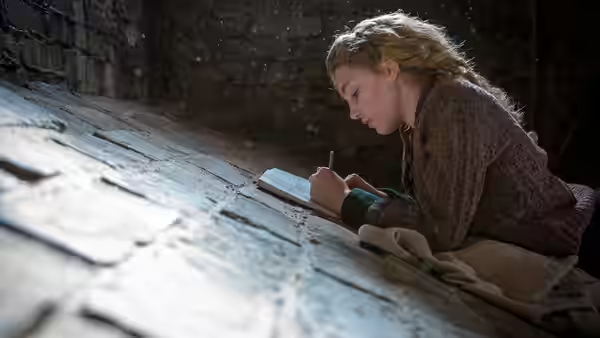
Brian Percival makes The Book Thief too comfortable to do its subject justice. His adaptation of Markus Zusak’s novel looks at ordinary Germans resisting Nazi propaganda, with books and a young girl’s attachment to them at its centre. There is room here for a drama about how people learn to think for themselves when obedience is demanded. Too often, however, the film seems content to establish that its principal characters are good people and wait for us to love them.

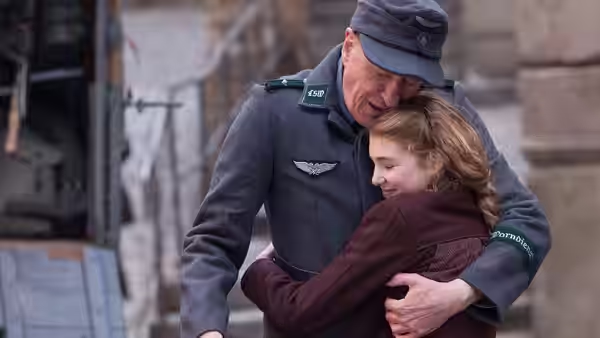
Sophie Nélisse gives Liesel Meminger enough watchfulness to hold our attention even when the storytelling slows. Geoffrey Rush makes Hans Hubermann warm and funny without turning every exchange into an appeal for affection. We were moved by their scenes together, because his easy manner gives her guarded performance somewhere to relax. Their company is the film’s strongest reason to stay, and for a while their relationship provides the interest that the wider story lacks.

Emily Watson is another reason to persist, giving Rosa Hubermann a firmness the film could use more often. She gives the character the weight of an adult with her own concerns, and makes the surrounding sweetness easier to accept. Ben Schnetzer gives Max Vandenburg an appealing directness. Yet Michael Petroni’s screenplay arranges these sympathetic people so tidily that there is little room for awkwardness or doubt, even when either might have made their decency more convincing.

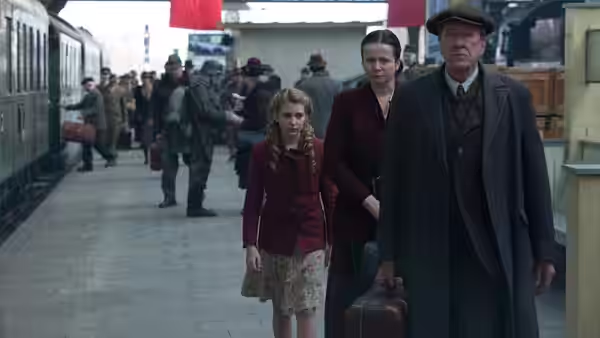
Florian Ballhaus’s use of natural light makes the affectionate exchanges look warm and inviting. Simon Elliott’s polished production design is easy to admire, but the setting feels too carefully presented to make the threat around these people immediate. John Williams supplies a sensitive score, though its reassurance adds to the problem. The image, the music and the performances keep making the drama comfortable to sit through. That becomes a serious limitation in a story set in wartime Germany.

Then there is Death, voiced by Roger Allam, whose recurring narration gives the film another way to explain itself. The whimsical delivery is an awkward choice: the subject is already difficult enough without a narrator making it sound manageable. His interruptions also weaken the cast’s work by telling us how to regard a story they are capable of carrying. We kept wishing the voice would leave them alone long enough for a feeling to arrive without an introduction.

John Wilson’s editing leaves the drama moving at much the same measured pace for too long. At 131 minutes, there is ample time to develop tension, yet the stretches between the stronger performances drag. Against the demands of a wartime childhood drama, this is a substantial failure. We do not need graphic suffering, but we do need to believe that the people on screen cannot count on being safe.

Brian Percival’s restraint is understandable, and making room for kindness in this setting is worth the effort. The problem is that fear has been reduced so far that the kindness begins to seem easier than it should. The cast can sustain individual scenes, but we would hesitate to recommend the whole 131 minutes on their account. Come for the performances only if a reassuring wartime drama is something you want.

Critical consensus AI synthesised

48
Positive
5
Mixed
5
Negative
13

Most critics find The Book Thief too cautious and sentimental for its subject, though the performances earn praise across the divide. Sophie Nélisse’s poise and expressiveness and Geoffrey Rush’s warmth and humour are recurring strengths; several reviews also value Emily Watson’s work. The period presentation attracts admiration, but its polish is often part of the complaint: critics who appreciate the lighting and production design still find the danger muted and the drama short of urgency.

The spread is wide, with a small enthusiastic minority finding the emotional force that most reviews miss. Den of Geek praises a devastating emotional payoff, while the Evening Standard condemns the film’s treatment of the Holocaust as historically misleading. Elsewhere, reservations cluster around the slow pace, Death’s intrusive narration and a preference for reassuring uplift over difficult questions. Even sympathetic reviews acknowledge sentimentality or awkward storytelling.

Slant Magazine
7 November 2013 · ★★★/4 · R. Kurt Osenlund
75

Osenlund finds the film compassionate and lyrical despite some schmaltz and a near-derailing final act. He praises its warm natural light and imagery that makes books a symbol of loss and possibility.

Read the full review →
Variety
4 October 2013 · festival review · Dennis Harvey
75*

Harvey finds the adaptation quietly effective and engaging, though its restraint and slow pace may limit its emotional impact. He praises the performances, especially Geoffrey Rush’s warmth and humor and Ben Schnetzer’s appealing portrayal of Max.

Read the full review →
The AV Club
7 November 2013 · B- · Ben Kenigsberg
70

Kenigsberg finds the film an absorbing melodrama despite its clumsy narration and occasional sentimentality. He singles out Sophie Nélisse’s performance, especially her scenes with Geoffrey Rush, for praise.

Read the full review →
Screen Daily
30 October 2013 · John Hazelton
64*

The review text is inaccessible, so the critic’s verdict cannot be determined. No specific praise or complaint is visible in the page text.

Read the full review →
The New York Times
8 November 2013
64*

The page could not be accessed, so the critic’s verdict is unavailable. I can’t verify what the review singled out for praise or complaint.

Read the full review →
Radio Times
★★★ · Trevor Johnston
60

Johnston gives the adaptation a three-star verdict. He singles out its emphasis on ordinary Germans who resisted Nazi propaganda.

Read the full review →

Straight answers AI written, from our review

Is The Book Thief worth watching?
The Book Thief earns 49/100 from us: its warm performances offer some reward, but we hesitate to recommend it beyond viewers who want a reassuring wartime drama. Geoffrey Rush and Sophie Nélisse are moving together, yet the slow storytelling and persistent sweetness make wartime Germany feel too comfortable.
How long is The Book Thief, and what is it rated?
The Book Thief runs 2h 11m. It is a drama film.
Where can I watch The Book Thief in Serbia?
The Book Thief is streaming on Disney+ in Serbia. Availability is checked daily; the links above go straight to each service.
How violent or frightening is The Book Thief, and is it suitable for children?
The Book Thief has a UK 12A certificate, so it is not an unrestricted choice for children, although we find its treatment of wartime danger more reassuring than frightening. Nazi propaganda and Death’s recurring narration give parents reasons to consider a younger child’s sensitivity; children under 12 require an accompanying adult at the cinema.
How does The Book Thief compare to The Spirit of the Beehive?
The Book Thief is warmer and more reassuring than The Spirit of the Beehive, which we recommend as the stronger film about a child’s imagination in an authoritarian world. The former offers affectionate performances but too little danger; the latter is quietly unsettling and affecting, provided we give its patient storytelling the attention it asks for.
Is The Book Thief based on a true story or a book?
The Book Thief is adapted from Markus Zusak’s novel, rather than presented as a true-story account. We find Brian Percival’s adaptation too reassuring in its treatment of wartime Germany, but that criticism concerns the film’s tone, not its fidelity to the book. Prior reading is unnecessary to follow a story whose narration repeatedly explains how to regard it.
What should I watch after The Book Thief?
After The Book Thief, try The Spirit of the Beehive (1973, Fi1m 87): A child’s imagination makes an authoritarian world feel strange and frightening. Then Au revoir les enfants (1987, Fi1m 90): Childhood friendship under occupation, with the danger allowed to remain painfully close; and The Lives of Others (2006, Fi1m 84): Books, music and private decency under surveillance, with considerably more tension.

Cast

Awards

Academy Awards, 2014

Nominated
Best Original Score

If you liked this, try…

  1. The Spirit of the Beehive (1973, Fi1m 87)A child’s imagination makes an authoritarian world feel strange and frightening.

  2. Au revoir les enfants (1987, Fi1m 90)Childhood friendship under occupation, with the danger allowed to remain painfully close.

  3. The Secret Garden (1993) · not on Fi1m yetAnother guarded child finds difficult adults and affection that takes time to develop.

  4. The Railway Children (1970) · not on Fi1m yetLiterary childhood, adult worries and family affection handled with patience and humour.

  5. The Lives of Others (2006, Fi1m 84)Books, music and private decency under surveillance, with considerably more tension.