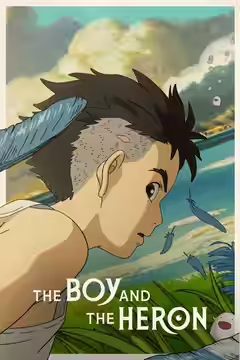
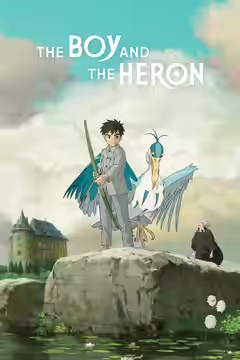
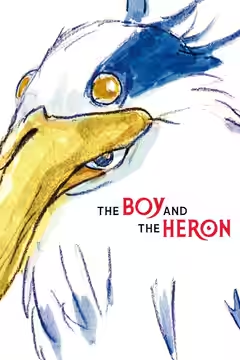
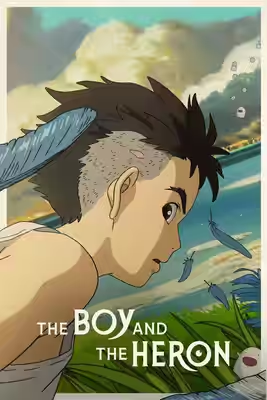
The Boy and the Heron poster

The Boy and the Heron

2023 · Directed by Hayao Miyazaki
2h 04mAnimationFantasyDrama12A
81
Fi1m score
86
Critics · 15
Audience · not yet

Where to watch in the UK

Checked 10 September at 22:29. Prices and availability change; the service’s page is the last word.

Synopsis

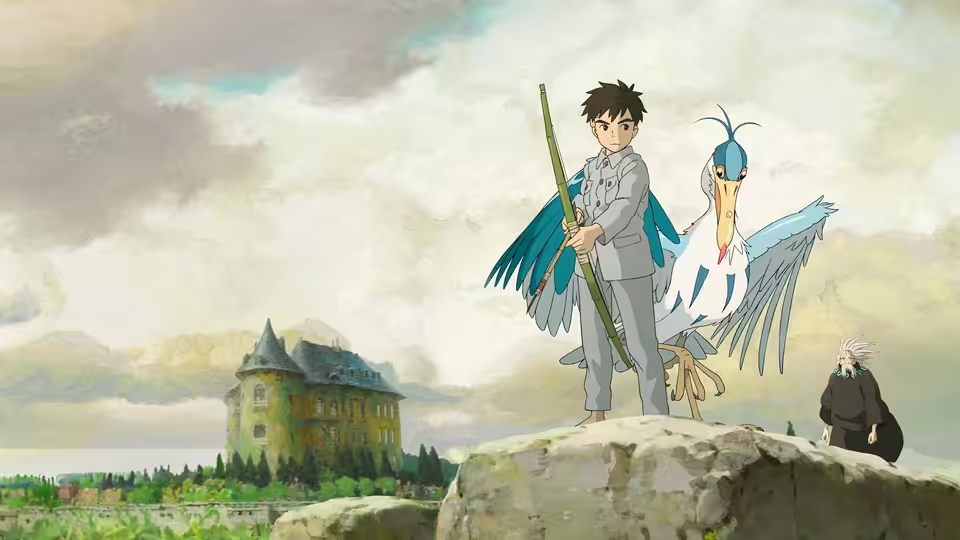
Tokyo, during the war. Mahito Maki (voiced by Soma Santoki) loses his mother when the hospital where she is staying burns. His father Shoichi (Takuya Kimura) moves them to the countryside, to the estate of Natsuko (Yoshino Kimura), his late wife’s younger sister, who is pregnant and is to become Mahito’s new mother. The house comes with a staff of elderly maids, a sealed tower in the grounds, and a grey heron (Masaki Suda) that follows the boy and speaks to him. When Natsuko walks into the woods and does not return, Mahito goes after her, with the maid Kiriko (Ko Shibasaki) and the heron, into the tower and the world beneath it. Hayao Miyazaki writes and directs; Joe Hisaishi composes.

Fi1m review

In a sentenceThe heron has a man’s teeth, the parakeets have knives and forks, and the boy would still rather go home

Hayao Miyazaki, back from retirement, sends a grieving boy down a tower into a world of herons, parakeets and spirits. The first hour is as controlled as anything he has made; the second is crowded and given to speeches. We recommend it warmly.

Hayao Miyazaki said he had retired after The Wind Rises, and has come back with a film whose Japanese title is a question: How Do You Live? Mahito Maki (Soma Santoki) is a boy in wartime Tokyo whose mother dies in a hospital fire. His father Shoichi (Takuya Kimura) moves them to the country, to a house belonging to Natsuko (Yoshino Kimura), his late wife’s younger sister, who is pregnant and is to be Mahito’s new mother. There is a sealed tower in the grounds, a staff of bent old maids, and a grey heron (Masaki Suda) that will not leave the boy alone. The first hour is Miyazaki at his most disciplined; the second is too full and keeps stopping to explain itself. We recommend it warmly, and with that caveat.

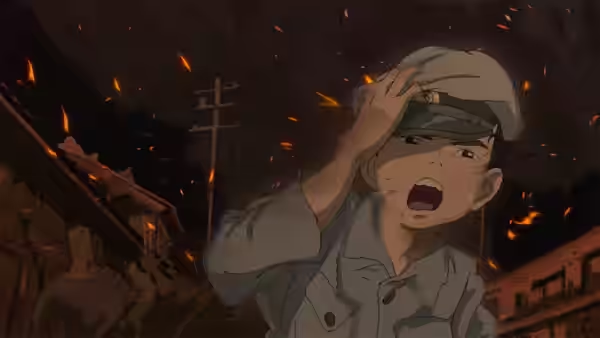
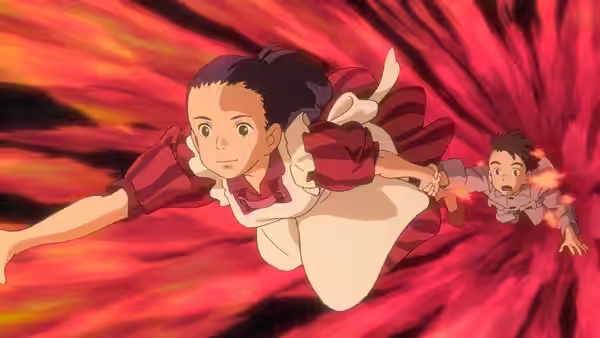
The fire is the first thing you see, and it is why the film carries a 12A. Mahito runs through the streets towards the hospital, and the crowd and the flames are drawn as smears, as though the paint were still wet, so that people melt into sparks and the boy’s own outline breaks up as he pushes through them. There is almost no music. We were shaken, and it took us a while to work out why: the picture itself seems to be burning, and the boy is inside it.

Then the country, and the quietest hour Miyazaki has made. Mahito says almost nothing and lies on his bed. Atsushi Okui keeps the house in soft greens and clean, hard daylight. After a fight on his first day at the new school, the boy picks up a stone on the walk home and strikes his own head with it. The blood is drawn thick and dark, and we flinched. It is the first thing he does of his own accord, and the film does not comment on it.

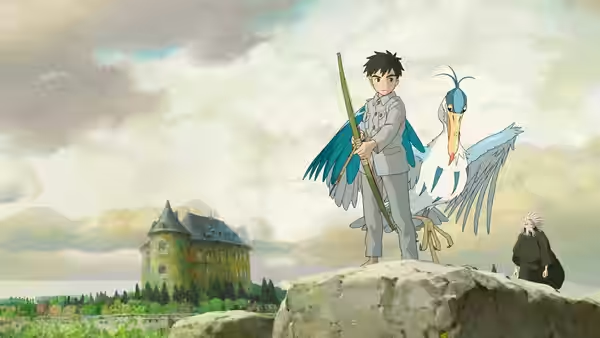
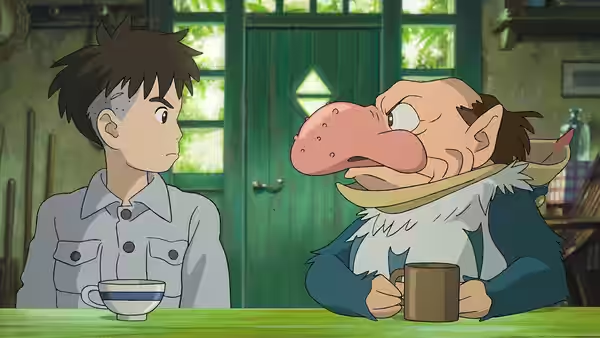
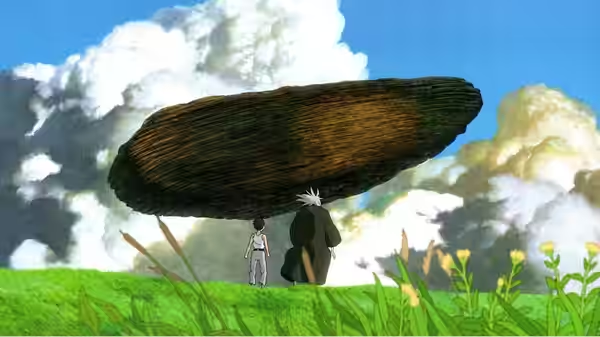
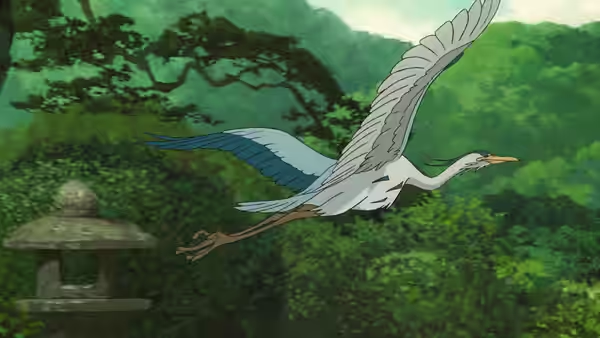
Suda’s heron is a fine piece of grotesquerie. It wheedles and gargles, taunts the boy with his dead mother, and when it opens its beak there is a man’s face inside with a full set of teeth. Then Natsuko walks into the woods and does not come back, and Mahito follows her into the tower with Kiriko (Ko Shibasaki), one of the maids. Below is a sea, a stone gate, pelicans, and the warawara, small white spirits like puffballs that rise at night in their hundreds and drift upwards to be born. We had not expected to be moved by a swarm of dumplings, and we were.

Joe Hisaishi’s score is his most held-back for Miyazaki: mostly piano, single notes, long stretches of nothing, and the strings arrive late. The editing, credited to Takeshi Seyama, Akane Shiraishi and Rie Matsubara, lets the house scenes run long. In the tower it starts to jump. There is Himi (Aimyon), a girl who throws fire. There are parakeets the size of men, in aprons, with knives and forks, ruled by a Parakeet King (Jun Kunimura) of enormous self-regard. Every ten minutes there is a new rule, and the rules come in speeches.

That is the problem. The second half becomes a story about inheritance that we will not describe, and Miyazaki, who has spent a career trusting children to keep up, twice has a character stand still and tell Mahito what this world is and what it wants from him. The parakeets are funny, and there are a great many of them, and by the third crowd scene we wanted to get back to the boy. Santoki plays Mahito flat and watchful, which is right for the first hour and gives the second less to hold on to.

It borrows openly from itself. The tower has the bathhouse of Spirited Away in it, and the country house, the move from the city and the absent mother all come from My Neighbour Totoro. Most critics have taken this as a summing-up and scored it close to his best. We would put it below those two and above Howl’s Moving Castle and Ponyo, which is not a complaint. At 124 minutes it could lose a parakeet or two.

See it in Japanese, on the biggest screen you can find, with a child of ten or over who does not need everything explained. Adults will want more explanation than the film gives, and less than it gives when it finally does.
Critical consensus AI synthesised

86
Positive
14
Mixed
1
Negative
0

Most critics take The Boy and the Heron as a farewell, whether or not Miyazaki means it as one, and they review it in that spirit. The praise gathers around two things: the hand-drawn animation, which nearly every review dwells on, and the personal weight of a story about a grieving boy shaped by the director’s own wartime childhood. Many hear echoes of his earlier films and treat that as a virtue rather than repetition. The reservations are consistent and mild: the fantasy world gets crowded, the storytelling stalls in places, and several reviewers warn it is darker and harder to follow than parents may expect. The spread is narrow. Variety calls it a mid-range entry rather than a summing-up, and Deadline goes further, finding the thinnest story in his filmography beneath the visual spectacle. Nobody else is that far from the crowd, and the one mixed notice stands alone against fourteen positive ones.

Little White Lies
24 December 2023 · 5/5/5 · Mark Asch
100

The film is a richly self-synthesising and achingly sentimental message of hope for the future from the Japanese maestro. It is a mind-mangling explosion of poetry, philosophy and pure emotion that feels like the end of something yet points forward.

Read the full review →
Los Angeles Times
24 November 2023 · Justin Chang
90*

The critic calls the film Miyazaki at his most beautifully elegiac and a hauntingly personal story of grief, loss and perseverance. He singles out the simplest, loveliest final image as a quietly shattering reminder of the imaginative wonders that spring from memory.

Read the full review →
The AV Club
7 December 2023 · A- · Luke Y. Thompson
90

The review likens it to the animator playing his greatest hits in a new combination, praising how he spins familiar elements into gold with dreamlike fantasy, cuteness mixed with danger, and a plea for successors through art.

Read the full review →
Radio Times
★★★★ · Jayne Nelson
80

This is an exquisite work of art and a fitting farewell from Miyazaki, with gorgeous hand-painted animation and surreal elements. It is not quite in the league of his greatest classics and may be too dark for younger viewers.

Read the full review →
Time Out
28 November 2023 · ★★★★ · India Lawrence
80

Miyazaki returns with a visually stunning and seriously imaginative swansong full of breathtaking landscapes and philosophical themes. Jaw-dropping visuals, tender moments and comedy make it a perfect Christmas treat, though it can be tricky to follow for younger viewers.

Read the full review →
Total Film
8 September 2023 · festival review
80*

Miyazaki proves he's still a master of the medium in this Toronto premiere review of the film.

Read the full review →

Cast

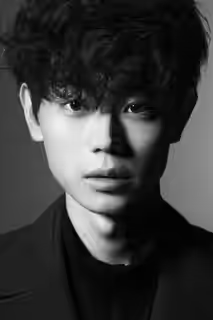
Soma Santoki
Mahito Maki (voice)
Masaki Suda
Gray Heron (voice)
Ko Shibasaki
Kiriko (voice)
Aimyon
Lady Himi (voice)
Yoshino Kimura
Natsuko (voice)
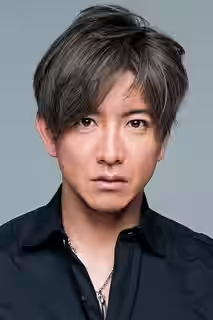
Takuya Kimura
Shoichi Maki (voice)
Keiko Takeshita
Izumi (voice)
Jun Fubuki
Utako (voice)

Stills

Awards

Academy Awards, 2024

Won
Best Animated Feature

Annie Award for Best Animated Feature, 2023

Nominated
Annie Award for Best Animated Feature

BAFTA Film Awards, 2023

Won
Best Animated Film

Chicago Film Critics Association Award for Best Animated Film, 2023

Won
Chicago Film Critics Association Award for Best Animated Film

Critics' Choice Awards, 2023

Nominated
Best Animated Feature

Dallas-Fort Worth Film Critics Association Award for Best Animated Film, 2023

Won
Dallas-Fort Worth Film Critics Association Award for Best Animated Film

Florida Film Critics Circle Award for Best Animated Film, 2023

Won
Florida Film Critics Circle Award for Best Animated Film

Golden Globes, 2023

Won
Best Animated Feature Film

Los Angeles Film Critics Association Award for Best Animated Film, 2023

Won
Los Angeles Film Critics Association Award for Best Animated Film

New York Film Critics Circle Award for Best Animated Film, 2023

Won
New York Film Critics Circle Award for Best Animated Film

San Francisco Film Critics Circle Award for Best Animated Feature, 2023

Won
San Francisco Film Critics Circle Award for Best Animated Feature

If you liked this, try…

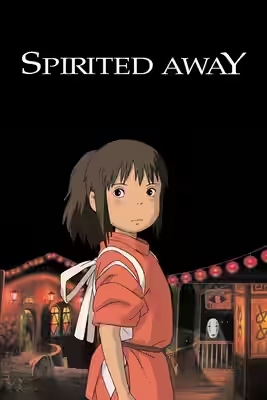
Spirited Away poster

Spirited Away

2001 · The bathhouse this tower borrows from, and a girl who has to work her way home.

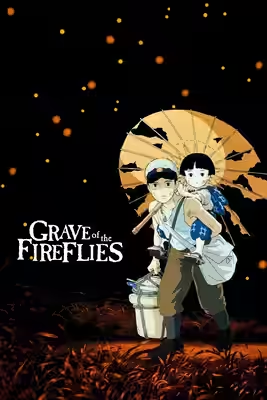
Grave of the Fireflies poster

Grave of the Fireflies

1988 · Ghibli’s other wartime children, drawn by Isao Takahata, and no tower to escape into.

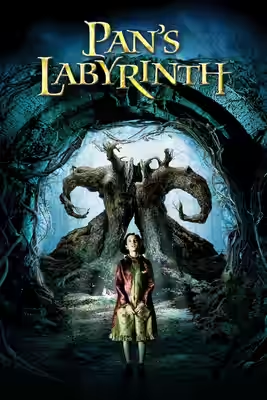
Pan's Labyrinth poster

Pan's Labyrinth

2006 · A girl, a war, a stepparent and a faun who cannot be trusted either.

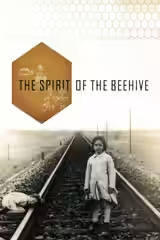
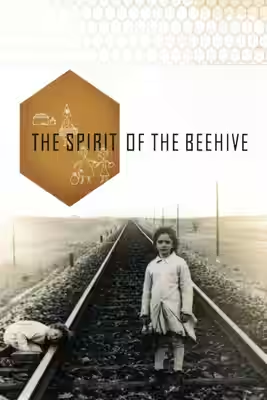
The Spirit of the Beehive poster

The Spirit of the Beehive

1973 · Spain after its war, a small girl, and a monster she decides to believe in.

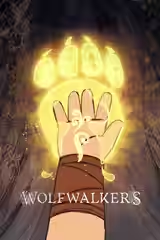
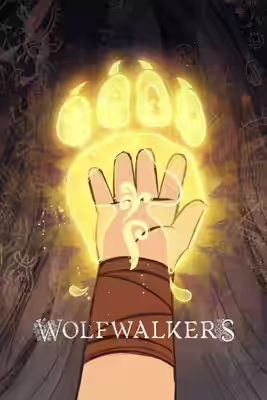
Wolfwalkers poster

Wolfwalkers

2020 · Irish hand-drawn animation with the same faith that children see what adults will not.