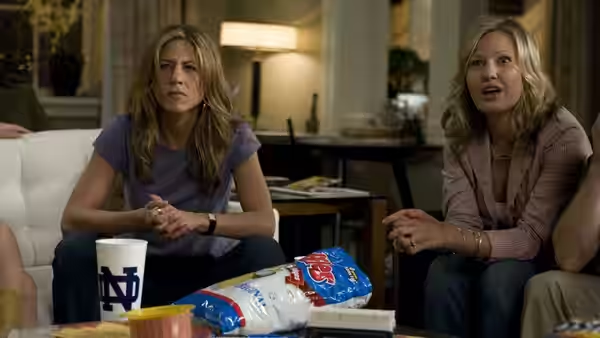
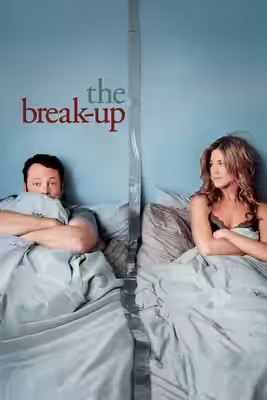
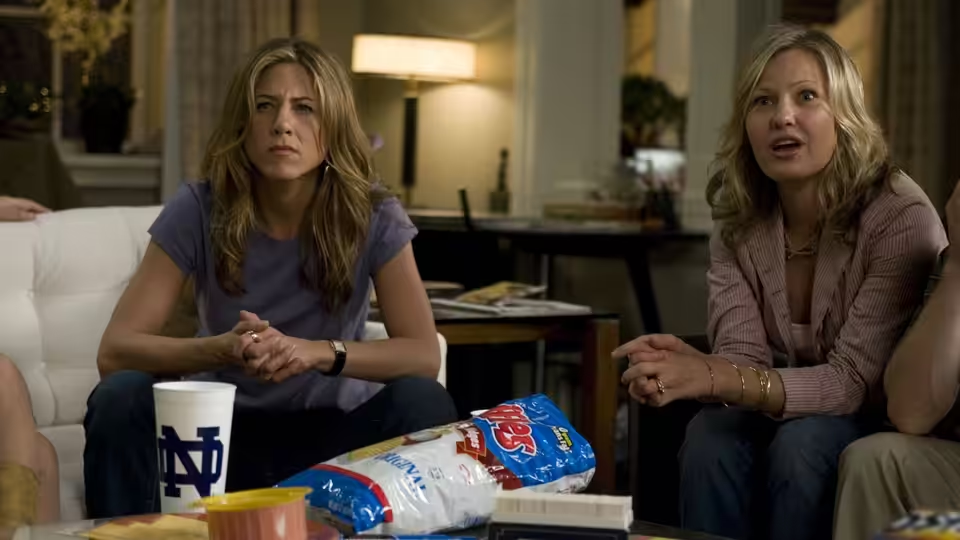
Brooke (Jennifer Aniston) and Addie (Joey Lauren Adams) sit on a couch beside snacks
Film review

The Break-Up

2006 · Directed by Peyton Reed · 1h 46m

In a sentenceThe dishes have a better chance of being sorted out than this relationship

Gary Grobowski (Vince Vaughn) and Brooke Meyers (Jennifer Aniston) share a home, but an argument about the dishes exposes how hard they find it to understand one another. Each wants to be heard; neither seems able to get through. When they call time on the relationship, they still have to deal with the house and the difficulty of occupying it together. Johnny O (Jon Favreau) is among the people around them as they face the practical consequences of separating. Ending the relationship does not settle who belongs where, or make their conversations any easier.

Fi1m review

Peyton Reed’s sour romantic comedy finds something painful in an argument about the dishes, helped by Jennifer Aniston and Vince Vaughn. The performances deserve attention; the repetitive quarrelling and uncertain comedy make a whole evening with them harder to recommend.

The arguments in The Break-Up hurt, and for a while that makes up for the shortage of laughs. Peyton Reed approaches romantic comedy through the unpleasant business of sharing a home when affection has worn thin. There is something worth watching in that, especially when a minor disagreement exposes a much larger grievance. The film loses us through repetition. Once the grievance is clear, it keeps finding reasons to have the disagreement again.

The argument about the dishes gets closest to what works. We felt miserable watching it, because Jennifer Aniston makes Brooke Meyers’s effort to be understood look exhausting, while Vince Vaughn’s Gary Grobowski keeps the quarrel moving. Aniston gives the complaint enough hurt to make the household task matter; Vaughn makes argument sound like a habit he cannot interrupt. We can recognise these people without particularly wanting to spend another hour with them. For this scene, that discomfort seems entirely earned.

The casting makes sense even when the chemistry fails. Vaughn’s quickness gives the quarrels some comic energy, and Aniston’s hurt is persuasive enough to stop us dismissing them as bickering. Yet the film offers too little sense of the pleasure these two might once have taken in each other. That matters in a romantic comedy built around their separation: without that earlier affection, there is little reason to hope they can get through to each other. Jon Favreau, playing Johnny O, provides comic relief with less apparent effort.

Screenwriters Jay Lavender and Jeremy Garelick understand how an argument can continue after both people have stopped listening. They struggle to find much else for these exchanges to tell us. Too often, another failure to communicate merely confirms what the previous exchange established, and a joke interrupts the pain without changing our view of either person. Dan Lebental and David Rosenbloom’s editing does not solve that repetition. The shifts between broad comedy and distress can feel abrupt even while the film itself feels slow.

The house gives the dispute a useful physical limit. Andrew Laws’s production design makes the shared space credible as somewhere difficult to surrender, although the struggle to occupy it together ought to generate more comic friction. Eric Alan Edwards’s cinematography keeps the domestic setting readable, but does little to sharpen the comedy of sharing it under these circumstances. The actors supply most of the tension. We kept attending to Aniston rather than to the space around her.

Jon Brion’s score is agreeable enough, but the music does not make the move from quarrel to comedy feel any less awkward. The unhappiness is difficult to shrug off when another laugh is required. Supporting turns from Judy Davis as Marilyn Dean and John Michael Higgins as Richard Meyers offer welcome changes of company. They also expose how little variety there is in the central dispute.

A romantic comedy can be miserable company and still be worth watching. The problem here is how little we learn from staying with these particular disagreements. At 106 minutes, this is a wearying watch despite the flashes of recognisable hurt. Try it for Aniston and Vaughn if domestic friction is your subject; choose something else if tonight needs cheering up.

Critical consensus AI synthesised

48
Positive
1
Mixed
4
Negative
5

The reviews lean negative on The Break-Up, with most critics finding too few laughs to make its sour relationship drama work. Praise centres on individual performances: some reviews appreciate Jennifer Aniston and Vince Vaughn’s rawness, Vaughn’s comic agility, and supporting players who provide occasional relief, particularly Jon Favreau. There is some appreciation for its departure from romantic-comedy convention, though little agreement that the darker approach succeeds.

Reservations cluster around the script’s awkward shifts between comedy and drama, the couple’s poor chemistry and their frustrating inability to communicate. The spread is wide: some critics find it watchable or intermittently funny, while the harshest see an unpleasant relationship offering little insight or effective comedy. The New Yorker supplies the clearest dissent, praising the staging of mutual incomprehension and finding sharp social observation in the very romantic discord that others regard as a failing.

The New Yorker
28 May 2015 · Richard Brody
90*

Brody calls the film terrific and praises its inversion of romantic-comedy conventions into romantic disaster. He singles out its comic choreography of mutual incomprehension and its sharp social perceptions.

Read the full review →
Empire
1 July 2006 · Tony Horkins
65*

The review finds the film a mildly successful, darker-than-usual romantic comedy. It praises the raw performances of Jennifer Aniston and Vince Vaughn.

Read the full review →
Time Out
18 July 2006 · Anna Smith
64*

The page identifies this as Anna Smith’s review, but its verdict is unavailable in the accessible material. The visible description only signals a formula-bucking structure, without enough text to identify a specific praise or complaint.

Read the full review →
Total Film
21 July 2006 · ★★★ · Total Film
60

The review finds the film watchable but too sour and short on laughs to balance its unpleasant relationship drama. It singles out Jon Favreau’s comic improvisation as the film’s secret weapon.

Read the full review →
Los Angeles Times
2 June 2006 · Carina Chocano
50*

Chocano finds the film alternately funny and painful, but says it is easier to enjoy in the moment than to praise on reflection. She praises Vince Vaughn’s nimble humor while faulting the script for shutting down communication between the couple.

Read the full review →
Radio Times
★★ · Stella Papamichael
40

The review criticizes the film’s disjointed script and awkward shifts between comedy and drama. It also faults the story for offering little insight into the couple’s relationship dynamics.

Read the full review →

Straight answers AI written, from our review

Is The Break-Up worth watching?
The Break-Up is worth considering for Jennifer Aniston and Vince Vaughn’s painfully recognisable domestic quarrels, but we score it 55 out of 100 and struggle to recommend a whole evening with them. The performances make the hurt believable; repetitive arguments and awkward shifts into comedy make it a poor choice for anyone wanting a cheerful romantic comedy.
How long is The Break-Up, and what is it rated?
The Break-Up runs 1h 46m. It is a romance and comedy film.
Where can I watch The Break-Up in Czechia?
The Break-Up is streaming on Netflix in Czechia, and it is also available to rent from Amazon Prime Video and Apple TV from Kč 49.00. Availability is checked daily; the links above go straight to each service.
How violent or frightening is The Break-Up, and is it suitable for children?
The Break-Up has a UK 12A certificate, so children under 12 need an accompanying adult at the cinema. Its domestic arguments are emotionally uncomfortable: we found the dispute about the dishes miserable because Brooke’s effort to be understood feels exhausting. That relationship distress makes it a doubtful choice for a light family evening; we cannot give a detailed violence or fright assessment.
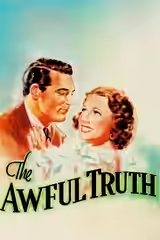
How does The Break-Up compare to The Awful Truth?
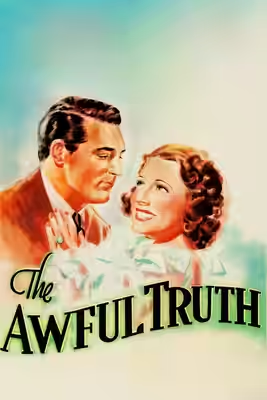
The Break-Up is the sourer, more wearying choice; we recommend The Awful Truth for separating lovers whose comic timing makes their attraction believable. Aniston and Vaughn give the domestic hurt weight, but their film repeats its quarrels without establishing much lost affection. The Awful Truth offers the warmer, faster comedy, provided contrived plotting does not spoil the pleasure.
What should I watch after The Break-Up?
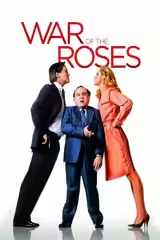
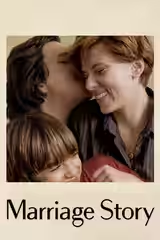
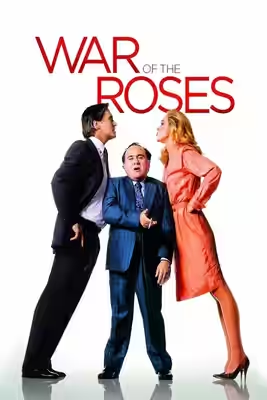
After The Break-Up, try The Awful Truth (1937, Fi1m 89): For separating lovers whose comic timing makes their attraction easy to believe. Then The War of the Roses (1989, Fi1m 75): For a much nastier domestic dispute, with more reliable comic purpose; and Marriage Story (2019, Fi1m 84): For arguments that keep revealing the people doing the damage.

Cast

If you liked this, try…

  1. The Awful Truth (1937, Fi1m 89)For separating lovers whose comic timing makes their attraction easy to believe.

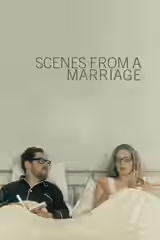
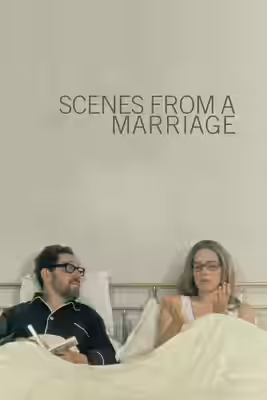
  2. Scenes from a Marriage (1973) · not reviewed yetFor sustained attention to the hurt that accumulates between two people.

  3. The War of the Roses (1989, Fi1m 75)For a much nastier domestic dispute, with more reliable comic purpose.

  4. Le Week-End (2013) · not reviewed yetFor a couple whose mutual irritation still leaves room for affection.

  5. Marriage Story (2019, Fi1m 84)For arguments that keep revealing the people doing the damage.

Free account

Know what to watch tonight

Two lists that know where things are streaming, collections you can share, your own score beside ours, and Discover that remembers what you have seen.

  • Want to see, sorted by what is streaming now
  • Seen, with your score out of ten
  • No adverts, ever