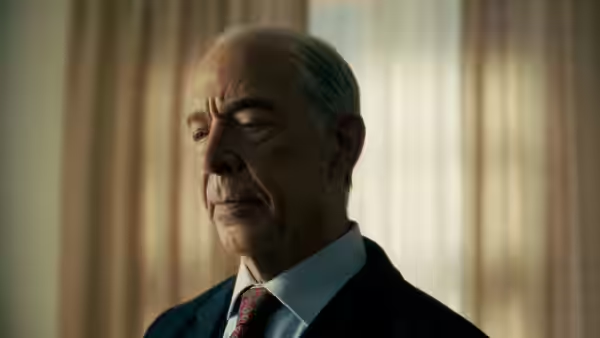
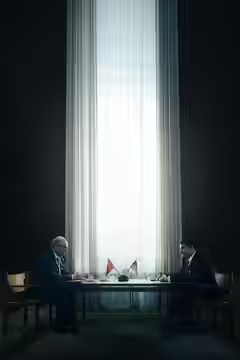
Ronald Reagan (Jeff Daniels) sits at a desk beside American and Soviet flags
Film review

The Brink of War

2026 · Directed by Michael Russell Gunn · 1h 57m · MPA PG

In a sentenceTwo men could end the Cold War over a weekend, if only the script would let them stop explaining it

Reykjavik, October 1986. Ronald Reagan (Jeff Daniels) and Mikhail Gorbachev (Jared Harris) arrive in Iceland for two days of talks that neither side expected to matter, in a white house by a grey sea. Reagan wants his Strategic Defense Initiative left alone and the Soviets to cut their missiles anyway; Gorbachev wants the missiles cut and the space shield stopped, and has come with more to offer than the Americans anticipate. Between them sit George Shultz (J.K. Simmons) and Edward Shevardnadze (Tim Dutton), the arms men Paul Nitze (Stephen Brennan), Richard Perle (Jóhannes Haukur Jóhannesson) and Ken Adelman (John Ross Bowie), and the interpreters. Raisa Gorbachev (Branka Katić) has come with her husband; Nancy Reagan (Hope Davis) has not. The first day is spent finding out how much each man is prepared to say out loud.

Plays from YouTube when you press play; nothing loads from them until then.

Fi1m review

Michael Russell Gunn’s account of the Reykjavik summit has Jared Harris, some fine Icelandic weather and not much else. It explains the Cold War to us for 117 minutes and dramatises almost none of it, and we were bored well before the second day.

The Reykjavik summit is a good idea for a film. Two men who between them could end the world sit in a small house by the sea for a weekend and come closer to giving up their nuclear weapons than anyone has before or since. It is short, it is contained, it has a clock, and it has two leads who did not much like each other and found, over two days, that they could talk. Michael Russell Gunn, who wrote, directed and produced The Brink of War, has seen all of this and then written a film in which people describe it to one another rather than do it. The result is poor, and slow, and most critics have already said so. We are largely with them.

The trouble is the script. Every position is stated, then restated by an aide, then summarised by a third person for the benefit of anyone who came in late. Reagan explains the space shield. Shultz explains Reagan. Nitze, Perle and Adelman explain the numbers, in a hotel room, more than once. Aya Cash and Guy Burnet, as Cleo and Alexander, are the names you will not find in the history books, and the film uses them to tell us what the men at the table are feeling, in case their faces had not. By the end of the first day we had stopped listening for what anyone would do next, because nobody does anything; they inform each other. We were bored, and then we were cross about it, because the material does not need this help.

Jared Harris is the reason the film is not a write-off. His Gorbachev is quick, impatient and slightly amused, a man who has brought a bigger offer than the room is ready for and cannot understand why nobody will take it. He listens well, which nobody else in the film is asked to do, and when Branka Katić’s Raisa is on screen with him there is a marriage there, brisk and affectionate, in about four lines. Jeff Daniels has the harder job and does less with it. His Reagan is a warm, unhurried man who says gentle things about peace and never once seems to be calculating, and a Reagan who is not calculating is not Reagan. Daniels plays the anecdote and not the actor telling it.

J.K. Simmons gives Shultz a dry, tired authority, and his scenes with Daniels are the closest the film comes to two people actually negotiating. Hope Davis has a handful of telephone calls as Nancy and makes them count. Tim Dutton’s Shevardnadze is mostly required to nod.

Magdalena Górka has shot Iceland properly. The exteriors are low grey light, wet tarmac, a sea the colour of pewter, and the house itself stands out against all of it like a tooth. When the delegations walk between cars and doorways with their coats flapping, the film briefly has weather and a place, and we sat up. Indoors she does what she can with lamps and a small table, but there is only so long two men in armchairs can be lit before it looks like the same shot again. Laura Steiger and Michael L. Sale cut between the two delegations in their separate rooms as if that were suspense; it is not, when both rooms are saying what the other has just said. Austin Wintory’s score is strings and a slow pulse under nearly everything, and it does the film no favours, because it keeps promising that something is about to happen.

There is also the matter of who the film thinks was right. Gunn has a clear view, and it is Reagan’s, and he is entitled to it. What he is not entitled to is a Gorbachev who is more interesting than his hero in every scene they share and a script that has not noticed. The film is admiring where it needed to be curious.

How the weekend ended is a matter of record, and we will leave the film to get there. Anyone with a settled fondness for the man in the armchair will find him gently played and may be content. Anyone who wants to see what happened in that house is better off with a good history and a rainy afternoon, which will be shorter than 117 minutes and have more weather in it.

Critical consensus AI synthesised

35
Positive
0
Mixed
1
Negative
3

With only 4 reviews in so far, the early word is poor. Most critics find this Reagan and Gorbachev drama talky, slow and politically one-sided, with the Reagan portrayal drawing the sharpest complaints. What praise there is clusters on the cast: Jared Harris’s Gorbachev is singled out more than once, and The Wrap credits both leads with gravitas and admires the Iceland photography. The Hollywood Reporter is kinder to Harris than to Jeff Daniels, whom it finds unconvincing. The AV Club is the harshest, judging the film dull and propagandistic. One review could not be fully assessed, so the picture may yet shift.

The New York Times
13 August 2026
64*

The page is blocked, so the critic’s verdict cannot be determined. No specific praise or complaint is visible in the supplied text.

Read the full review →
The Hollywood Reporter
12 August 2026 · Frank Scheck
35*

Scheck finds the historical drama talky and slow, with history only intermittently coming to life. He singles out Jared Harris’s compelling performance as Gorbachev, while finding Jeff Daniels unconvincing as Reagan.

Read the full review →
The AV Club
14 August 2026 · B. Panther
10*

The critic strongly condemns the film as dull and propagandistic. They single out its one-note Reagan portrayal and repetitive political dialogue as especially hollow.

Read the full review →
The Wrap
15 August 2026
30*

The critic finds the drama politically one-sided and less compelling than its subject deserves, despite some virtues. Jeff Daniels and Jared Harris bring gravitas, while the film’s striking Iceland photography stands out amid the criticism of its shallow treatment.

Read the full review →

Straight answers AI written, from our review

Is The Brink of War worth watching?
The Brink of War is not worth an evening for most people, and we scored it 38. Jared Harris makes a quick, impatient Gorbachev and Magdalena Górka shoots Iceland well, but the script has everyone explain the summit rather than play it, and we were bored before the first day was out. Only a settled admirer of Reagan is likely to be content.
How long is The Brink of War, and what is it rated?
The Brink of War runs 1h 57m and is rated PG by the MPA in the US. It is a drama and history film.
Where can I watch The Brink of War in the US?
The Brink of War is available to rent from Amazon Prime Video from $19.99. Availability is checked daily; the links above go straight to each service.
What should I watch after The Brink of War?
After The Brink of War, try Bridge of Spies (2015, Fi1m 75): Cold War haggling done as craft, with Berlin in the snow and a lawyer’s patience. Then The Death of Stalin (2017, Fi1m 83): Kremlin politics played for terror and laughs, and closer to the truth for it; and Deutschland 83 (2015, Fi1m 74): A young East German spy in the West; the missiles, the music, the fear.

Cast

If you liked this, try…

  1. Thirteen Days (2000) · not on Fi1m yetThe Cuban missile crisis as rooms, clocks and men who actually argue.

  2. Bridge of Spies (2015, Fi1m 75)Cold War haggling done as craft, with Berlin in the snow and a lawyer’s patience.

  3. The Death of Stalin (2017, Fi1m 83)Kremlin politics played for terror and laughs, and closer to the truth for it.

  4. Deutschland 83 (2015, Fi1m 74)A young East German spy in the West; the missiles, the music, the fear.

  5. The Lives of Others (2006, Fi1m 84)What the Soviet system did to the people inside it, one flat at a time.