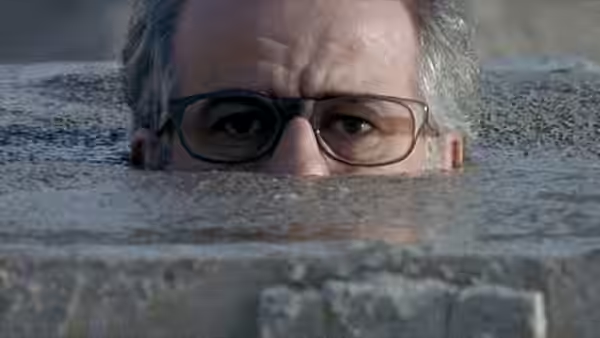
Titta Di Girolamo (Toni Servillo) reclines in a hospital chair beside an intravenous drip
Film review

The Consequences of Love

2004 · Directed by Paolo Sorrentino · 1h 40m

In a sentenceToni Servillo makes hotel life look exhausting without appearing to expend any energy

Titta Di Girolamo (Toni Servillo) inhabits a hotel and keeps other people at a distance. Sofia (Olivia Magnani) and Valerio (Adriano Giannini) are among those around him, but Titta’s controlled manner makes his private life difficult to read. His existence appears suspended, with the hotel enclosing him rather than offering a change of scene. Maintaining his reserve takes precedence over joining the life around him. Within this contained setting, the question is what could reach him, and what might happen if his composure stopped keeping everyone else away.

Fi1m review

Paolo Sorrentino makes a tense character study anchored by Toni Servillo. Its slow pace and insistent styling sometimes keep us at a distance, but the hotel-bound unease earns much of the patience it asks for.

The Consequences of Love is a good, sometimes over-managed thriller about a man whose hotel-bound existence has begun to feel oppressive. Paolo Sorrentino is interested in how long we will watch that man before demanding an explanation, and the answer depends largely on Toni Servillo. His controlled performance gives us enough to study while the story takes its time. The film rewards patience, though there are passages where Sorrentino tests it more than he needs to.

As Titta Di Girolamo, Servillo lets us suspect that being this reserved takes practice. His restraint matters because the film needs someone we can keep watching without immediately understanding him. We felt shut in by the hotel, and Servillo’s refusal to make Titta easy company made that feeling more uncomfortable. His remoteness never becomes particularly enviable. We are left wondering what it costs him to maintain it.

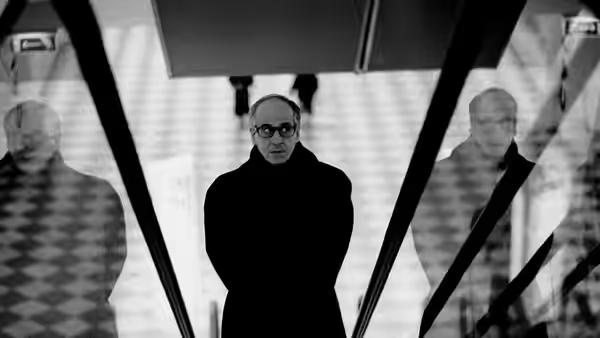
Luca Bigazzi’s widescreen photography and deliberate camera movement give that discomfort a physical setting. The hotel remains insistently present around its occupant; the images encourage us to look at the space as much as the man. Lino Fiorito’s production design helps make somewhere intended for a stay feel oppressively permanent. The precision is pleasurable, but it can also distract us from Titta: occasionally we notice the framing before we register the unease.

Giogiò Franchini’s editing gives Servillo room to sustain the performance without hurrying us towards an explanation. That patience is necessary, and at first it makes the smallest suggestion of change seem significant. The slow pace does, however, start to repeat an effect we have already understood. Sorrentino could shorten those passages without making Titta less difficult to read. Some of the film’s mannerisms would trouble us less if the stretches between developments were shorter.

Pasquale Catalano’s music contributes to the pressure of the hotel setting, keeping the atmosphere uneasy when the drama pauses. It works, although the combined insistence of soundtrack and image sometimes feels excessive. Servillo can hold our attention without quite so much assistance. When the film presses the mood too hard, we become conscious of the effort going into something the performance has already established.

Sorrentino’s screenplay uses the thriller to examine a life that seems to have stopped moving. Uncertainty about a person can be as absorbing as uncertainty about what will happen next, and the film understands that. It also places a burden on the writing that careful composition cannot carry indefinitely. We remain interested in Titta, but Sorrentino occasionally seems too pleased with how little he is telling us.

At 100 minutes, this is not an especially long film, but it asks for attention of a kind that makes duration noticeable. Anyone hoping for a brisk thriller should look elsewhere. For those who enjoy studying a difficult character, the deliberate pace is a worthwhile bargain, with occasional grounds for complaint. Choose it for an evening when nobody is likely to keep asking when something is going to happen.

Critical consensus AI synthesised

71
Positive
4
Mixed
2
Negative
0

Most critics respond favourably to The Consequences of Love, with praise clustering around Sorrentino’s visual control and Toni Servillo’s restrained performance. The reviews repeatedly pick out the camera work, from elegant movement and widescreen compositions to the claustrophobic atmosphere of the hotel setting. Several find an absorbing character study beneath the polished surfaces, with Servillo’s controlled acting giving them a reason to stay involved even when the direction draws attention to itself.

The reservations concern pace and mannerism: the same stylistic confidence that impresses some critics threatens to distance others. Little White Lies finds the film frustratingly slow, although it judges the eventual rewards worth the wait and admires Servillo. Eye for Film is considerably more enthusiastic, praising the tension and tragic feeling. The spread therefore runs from qualified appreciation to strong endorsement, rather than dividing into supporters and outright detractors.

The Guardian
29 May 2005 · Philip French
75*

French finds the film poised and knowing, praising its stylish, elliptical approach. He singles out the elegant camera movement and memorable widescreen images, noting the influence of Antonioni and Melville.

Read the full review →
Time Out
23 May 2005 · GA
70*

The review’s opening impression is that Sorrentino’s second feature is impressively confident, though potentially over-stylized. It suggests the film’s style may initially seem too insistent.

Read the full review →
Variety
13 May 2004 · festival review · David Rooney
70*

Rooney finds the film a stylish, absorbing character study, though its mannered touches may distance some viewers. He singles out Sorrentino’s precise visual direction and Toni Servillo’s remarkable performance for praise.

Read the full review →
Screen Daily
17 May 2004 · festival review · Jonathan Romney
64*

The accessible page does not reveal the critic’s verdict. The review’s specific praise or complaint is also unavailable in the paywall shell.

Read the full review →
Little White Lies
25 May 2005 · 1/3/3 · David Jenkins
60

The review finds the film frustratingly slow but ultimately rewarding, with a memorable finale. It praises Toni Servillo’s understated performance and the beautiful cinematography.

Read the full review →
Eye for Film
4 November 2005 · Anton Bitel
95*

Bitel calls the film a tense, tragic portrait of a life suspended and deems it unmissable. He praises Toni Servillo’s controlled performance and the claustrophobic atmosphere shaped by the hotel setting, camera work, and soundtrack.

Read the full review →

Straight answers AI written, from our review

Is The Consequences of Love worth watching?
The Consequences of Love is worth watching for patient viewers who enjoy tense character studies, and we score it 76 out of 100. Toni Servillo makes a guarded hotel resident absorbing company, although the slow pace and insistent styling sometimes keep us at a distance; anyone wanting a brisk thriller should look elsewhere.
How long is The Consequences of Love, and what is it rated?
The Consequences of Love runs 1h 40m. It is a drama and thriller film.
Where can I watch The Consequences of Love in Slovenia?
The Consequences of Love is not on any streaming or rental service in Slovenia at the moment. It is available in 4 other countries; change your country at the top of the page to see where. Availability is checked daily.
How violent or frightening is The Consequences of Love, and is it suitable for children?
The Consequences of Love has no UK or US certificate supplied here, so we cannot give a firm age recommendation or assess its violence. We find its hotel-bound atmosphere oppressive and uneasy, but that does not establish how graphic or frightening it becomes; there is too little content information to recommend it for children.
How does The Consequences of Love compare to Le Samouraï?
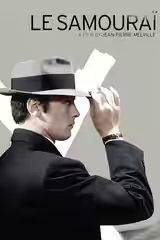
The Consequences of Love is the slower, more withholding character study beside Le Samouraï, which we recommend more readily for a gripping thriller. Both make a solitary man’s guarded habits uncomfortable to watch, but Sorrentino dwells on hotel-bound inertia while Melville builds tension around a killer and the police effort to catch him.
What should I watch after The Consequences of Love?
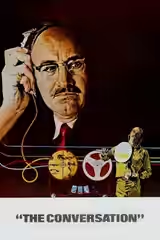
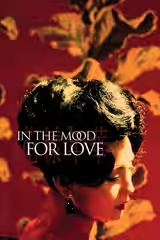
After The Consequences of Love, try Le Samouraï (1967, Fi1m 88): Another solitary man whose precise habits make his isolation increasingly uncomfortable. Then The Conversation (1974, Fi1m 92): A reserved professional discovers how poorly his routines protect him from other people; and In the Mood for Love (2000, Fi1m 91): Enclosed spaces and controlled performances make the smallest emotional movement matter.

Cast

Awards

David di Donatello for Best Actor, 2005

Won
David di Donatello for Best Actor

David di Donatello for Best Director, 2005

Won
David di Donatello for Best Director

David di Donatello for Best Film, 2005

Won
David di Donatello for Best Film

David di Donatello for Best Supporting Actor, 2005

Nominated
David di Donatello for Best Supporting Actor

European Film Award - People's Choice Award for Best Director, 2005

Nominated
European Film Award - People's Choice Award for Best Director

Jameson People's Choice Award for Best Actor, 2005

Nominated
Jameson People's Choice Award for Best Actor

If you liked this, try…

  1. Le Samouraï (1967, Fi1m 88)Another solitary man whose precise habits make his isolation increasingly uncomfortable.

  2. The Conversation (1974, Fi1m 92)A reserved professional discovers how poorly his routines protect him from other people.

  3. The Match Factory Girl (1990) · not on Fi1m yetSevere restraint, dry humour and a lonely life observed without comforting distractions.

  4. In the Mood for Love (2000, Fi1m 91)Enclosed spaces and controlled performances make the smallest emotional movement matter.

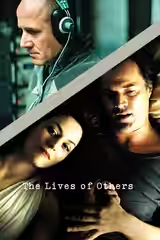
  5. The Lives of Others (2006, Fi1m 84)For another controlled performance tracing the disturbance of a carefully restricted life.

The Consequences of Love (2004) review: A slow film worth a look (Slovenia) | Fi1m