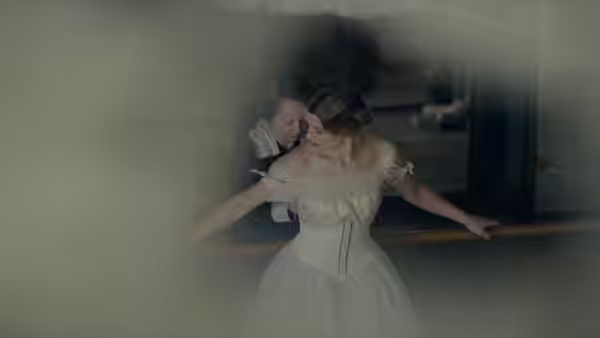
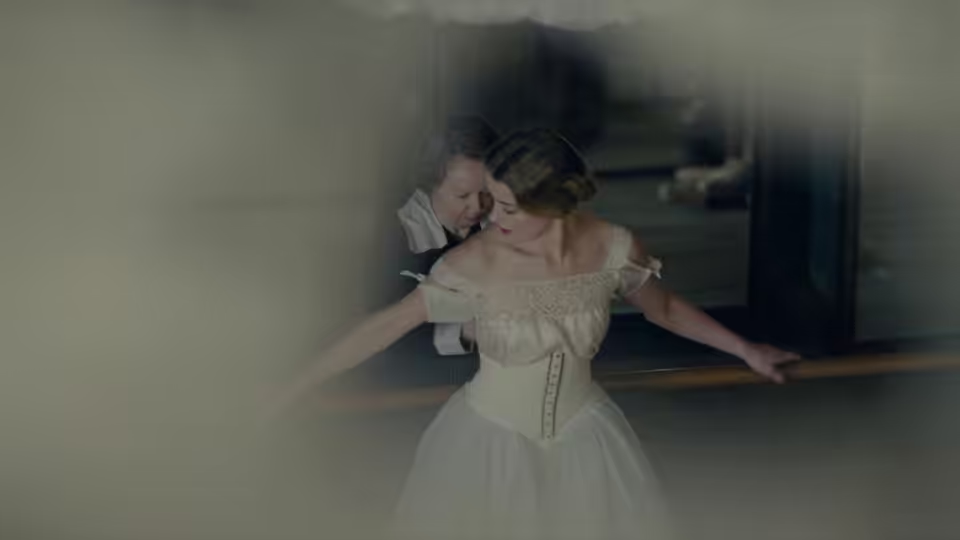
Lili (Eddie Redmayne) wears a white gown as Gerda (Alicia Vikander) helps her pose
Film review

The Danish Girl

2015 · Directed by Tom Hooper · 1h 59m

In a sentenceEveryone is beautifully dressed and nobody is allowed to be difficult

Copenhagen, 1926. Einar Wegener (Eddie Redmayne) paints the same bog and five trees from his childhood, over and over, and sells them. His wife Gerda (Alicia Vikander) paints portraits and cannot get a gallery to look at them. When the dancer Ulla (Amber Heard) is late for a sitting, Gerda asks Einar to pull on her stockings and shoes and hold the pose, and something in him goes very still. A joke follows: Einar goes to an artists’ party dressed as Gerda’s cousin Lili, and Henrik (Ben Whishaw) comes over to talk to her. Gerda starts drawing Lili instead of Einar, and the drawings sell. Hans (Matthias Schoenaerts), an old friend of Einar’s now dealing art in Paris, wants to see more of them.

Plays from YouTube when you press play; nothing loads from them until then.

Fi1m review

Tom Hooper’s film about the painter Lili Elbe is handsome, kind and well acted, and far too tidy for the life it is telling. Eddie Redmayne is at his best in the quiet early scenes; Alicia Vikander carries the rest.

Tom Hooper’s film, from Lucinda Coxon’s screenplay of David Ebershoff’s novel, tells the story of Lili Elbe, the Danish painter who in the 1920s became one of the first people to transition medically. It is a kind film, a handsome one and a well acted one, and it is too careful by half. Every room is lit for a portrait and every scene ends on the right face. We left admiring it and not quite believing it.

The early scenes are the good ones. Gerda asks Einar to stand in for a late model, and Redmayne’s foot finds the satin shoe, and his hand goes to the stocking at the knee, and for a few seconds the film stops being a biopic and becomes a person discovering something. We were moved, properly, before the film had decided to be moving, and it was all in Redmayne’s hands and the way he does not look at Vikander. Later, when he studies women through the glass of a Paris peep show and copies their gestures, he is doing the same work and it is just as good.

The trouble comes when the film asks him to be Lili in full. Hooper shoots her in mirrors, through doorways, at the far end of corridors, always slightly posed, and Coxon’s dialogue starts telling us what the face has already shown. Lili is lovely to look at and we rarely learn what she wants on a given afternoon beyond being Lili. She is admired by the camera more than she is known by it, and that is the film’s central failure.

Vikander is the reason to stay. Her Gerda is practical, funny, jealous, frightened, and in love with someone who is leaving by degrees while still in the house. She gets the one marital scene that stings, a row in which Gerda says she needs her husband and Lili cannot give him back, and Vikander plays it without raising her voice. Ben Whishaw is tender and sly in his two or three scenes as Henrik. Matthias Schoenaerts is warm as Hans and has almost nothing to do but be warm. Sebastian Koch, as the surgeon Warnekros, is sober and decent, which is what the part needs.

It is beautifully made. Danny Cohen shoots Copenhagen in pale greys and ochres, with the figures pushed to one side of wide frames and a lot of wall above their heads, the way Hooper likes. Eve Stewart gives the Wegeners a studio of tall windows and leaning canvases, and a Paris flat of green panelling and gilt. Paco Delgado’s clothes do real work: Gerda in trousers and a bob, Lili in drop-waisted dresses and cloche hats, and the film’s whole argument about who is becoming whom is in the wardrobe before anyone says it aloud. Alexandre Desplat’s score, piano over soft strings, is handsome and insistent, and it arrives at every emotional turn to make sure we have noticed it.

Melanie Oliver cuts the second half as a run of lovely, dissolving scenes, and the effect is of a very expensive photograph album. Nearly everyone Lili meets is understanding. The one doctor who is not is dealt with in a scene and gone. The film has sanded off whatever was hard or strange or awkward about these lives, and by the last half hour we were watching the light on the water and waiting to be told it was over.

Hooper made The King’s Speech (2010) and Les Misérables (2012), and this has the same decorum, the same conviction that good taste and a crying close-up are the same thing. Redmayne was freer in The Theory of Everything (2014) because that film let him be difficult. Here he is only ever allowed to be brave.

See it for Vikander, for the stockings scene and for Delgado’s frocks. Watch it at home, where its stateliness becomes gentleness and the score can be turned down. It runs 119 minutes and carries a 15.

Critical consensus AI synthesised

60
Positive
10
Mixed
12
Negative
5

Most critics find The Danish Girl sincere, handsome and well acted, and most also find it too careful. The praise clusters almost entirely on the two leads. Eddie Redmayne’s gradual transformation into Lili is singled out again and again, and a good number of reviews say Alicia Vikander’s Gerda is the film’s real centre, the performance that gives it whatever feeling it has.

Careful is also the complaint. The mixed and negative reviews agree that Tom Hooper has prettified a prickly story, keeping Lili’s desires offscreen and smoothing the harder facts of her life into something safe and decorous. The spread is wide, from the full marks of Den of Geek to the Evening Standard, which finds Redmayne unconvincing and the account of Lili’s life inaccurate. The AV Club puts the common objection plainly: Lili is a beautiful image rather than a fully realised person.

Little White Lies
29 December 2015 · 2/4/4 · David Ehrlich
80

Ehrlich finds the film a humane, nuanced story of love, loss and gender identity, despite its melodramatic excesses. He particularly praises Alicia Vikander’s performance and the film’s tender portrayal of complex queer experience.

Read the full review →
Radio Times
★★★★ · Damon Wise
80

The critic calls it an emotionally powerful biopic, while noting that its treatment is sanitised. They single out Alicia Vikander’s Gerda as the story’s focus.

Read the full review →
Empire
4 January 2016 · Ian Freer
78*

Freer finds the film touching, timely and exquisite despite its conventional approach. He singles out Alicia Vikander’s compassionate performance as the element that steals the show.

Read the full review →
Variety
5 September 2015 · festival review · Peter Debruge
75*

Debruge praises the film as a sensitive, significant portrait, led by Redmayne’s career-best performance. He singles out Redmayne’s gradual embodiment of Lili for praise, while criticizing the film for smoothing over some of its story’s pricklier details.

Read the full review →
Los Angeles Times
25 November 2015 · Kenneth Turan
70*

Turan finds the film slow to unfold but ultimately affecting, with its intimate love story drawing the viewer in. He especially praises Eddie Redmayne and Alicia Vikander’s nuanced, sensitive performances.

Read the full review →
Screen Daily
5 September 2015 · festival review · Jonathan Romney
70*

The review is positive, presenting the film as a strong awards-season contender. It singles out Eddie Redmayne’s performance as its key strength.

Read the full review →

Straight answers AI written, from our review

Is The Danish Girl worth watching?
The Danish Girl is worth watching for Alicia Vikander and for Eddie Redmayne's quiet early scenes, and we scored it 57. It is handsome, kind and well acted, but far too tidy for the life it tells, and the second half settles into a run of lovely dissolving scenes. Watch it at home, where its stateliness becomes gentleness.
How long is The Danish Girl, and what is it rated?
The Danish Girl runs 1h 59m. It is a drama film.
Where can I watch The Danish Girl in Canada?
The Danish Girl is available to rent from Apple TV and Amazon Prime Video from CA$4.99. Availability is checked daily; the links above go straight to each service.
How violent or frightening is The Danish Girl, and is it suitable for children?
The Danish Girl carries a 15 in the UK and an R in the US, and it is a drama, not a frightening or violent one. There is nothing in it to scare anyone; the certificate reflects adult themes and some nudity rather than anything alarming. It is not for children, but older teenagers interested in the subject will find it gentle.
How does The Danish Girl compare to Orlando?
The Danish Girl and Orlando both follow someone changing sex, but Sally Potter's film does it with wit where Tom Hooper's does it with tears. Orlando is the better film: Tilda Swinton moves through four centuries barely raising an eyebrow, and the pleasure of her company carries it. The Danish Girl suits viewers who want a handsome, earnest period drama.
Is The Danish Girl based on a true story or a book?
The Danish Girl is based on David Ebershoff's novel, which is itself drawn from the life of Lili Elbe, the Danish painter who in the 1920s became one of the first people to transition medically. Lucinda Coxon's screenplay keeps the story kind and careful, and the film sands off whatever was hard or strange in those lives. You do not need to know the book or the history to follow it.
What should I watch after The Danish Girl?
After The Danish Girl, try Orlando (1992, Fi1m 81): Tilda Swinton changes sex across four centuries and barely raises an eyebrow; wit instead of tears. Then Tangerine (2015, Fi1m 84): Shot on phones over one Los Angeles Christmas Eve; everything this film is too tidy to be; and Portrait of a Lady on Fire (2019, Fi1m 89): Another painter and her sitter; the looking is the love story, and nothing is explained.

Cast

Awards

Academy Awards, 2016

Nominated
Best Actor
Nominated
Best Costume Design
Nominated
Best Production Design
Won
Best Supporting Actress

European Film Award – People's Choice Award for Best European Film, 2016

Nominated
European Film Award – People's Choice Award for Best European Film

If you liked this, try…

  1. A Fantastic Woman (2017) · not reviewed yetA trans woman grieves a lover in Santiago; angrier, sharper and far less polite than this.

  2. Orlando (1992, Fi1m 81)Tilda Swinton changes sex across four centuries and barely raises an eyebrow; wit instead of tears.

  3. Laurence Anyways (2012) · not reviewed yetDolan’s ten-year love story about a transition, loud and messy where Hooper is hushed.

  4. Tangerine (2015, Fi1m 84)Shot on phones over one Los Angeles Christmas Eve; everything this film is too tidy to be.

  5. Portrait of a Lady on Fire (2019, Fi1m 89)Another painter and her sitter; the looking is the love story, and nothing is explained.