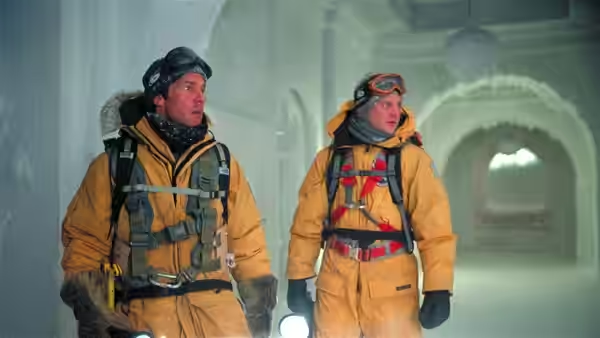
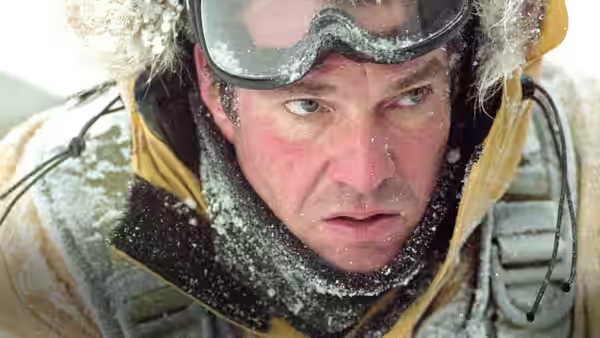
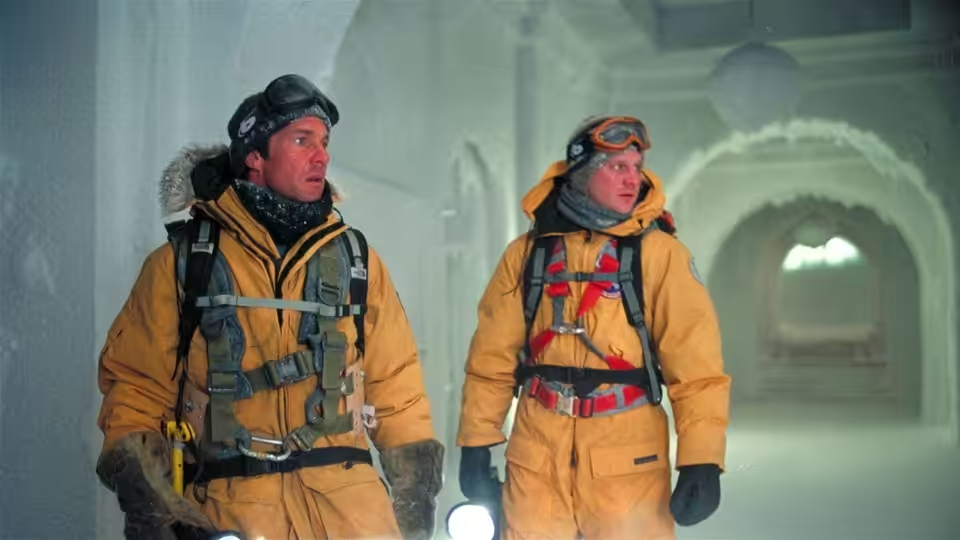
Jack Hall (Dennis Quaid) and a colleague in yellow parkas inside an icy corridor
Film review

The Day After Tomorrow

2004 · Directed by Roland Emmerich · 2h 04m · KAVI K-11

In a sentenceTornadoes flatten Los Angeles, the sea comes up Fifth Avenue, and still nobody has anything to say

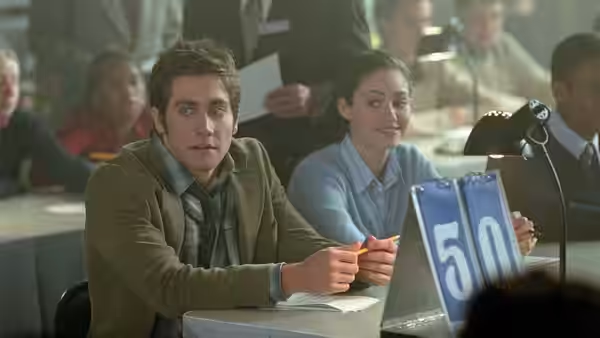
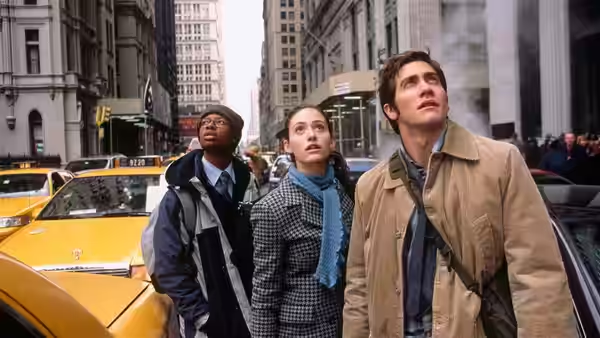
Jack Hall (Dennis Quaid) is a climatologist drilling ice cores on an Antarctic shelf when the ice splits open beneath his camp. At a conference in New Delhi he warns that melting polar ice could shut down the North Atlantic current and bring on a new ice age; Vice President Becker (Kenneth Welsh) tells him the economy cannot afford his theory. In Scotland, the oceanographer Terry Rapson (Ian Holm) watches his buoys record the sea temperature falling. Jack’s son Sam (Jake Gyllenhaal) flies to New York for a school quiz competition alongside Laura Chapman (Emmy Rossum). Then hail the size of grapefruit falls on Tokyo, tornadoes tear through Los Angeles, and a storm the width of a continent forms over the Atlantic, with New York in its path.

Plays from YouTube when you press play; nothing loads from them until then.

Fi1m review

Roland Emmerich’s disaster film freezes the northern hemisphere in a week, and for an hour the destruction is frightening enough to forgive the writing. Then the weather settles, the people start talking, and there is not much left to watch.

Roland Emmerich has already blown up the White House with a spaceship and marched a lizard through Manhattan. For The Day After Tomorrow he needs nothing from outer space; the weather will do. Jack Hall (Dennis Quaid) is a climatologist drilling ice cores in Antarctica when the shelf splits under his camp. He tells a conference of delegates that the melting ice will shut down the ocean currents and freeze the north, and Vice President Becker (Kenneth Welsh) tells him the economy comes first. Within a week the currents stop. The film’s point is that Jack was right, and it makes the point for 124 minutes.

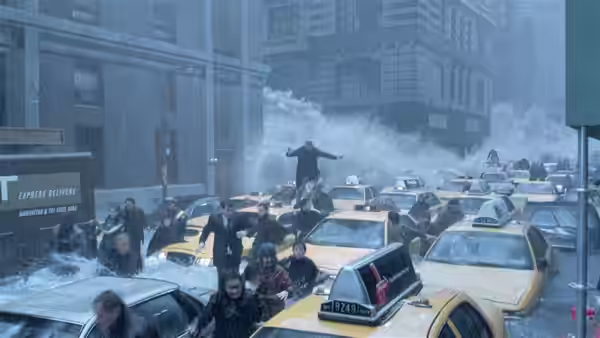
For its first hour it is a frightening film, and the fright is earned by pictures. Hail comes through the windscreens in Tokyo. Three or four tornadoes cross Los Angeles at once, filmed by Ueli Steiger in ordinary afternoon light rather than storm-dark, which makes them look like something that could happen on a Tuesday. Then the sea arrives in New York, a wall of grey water moving between the buildings at about walking pace, faster than the people, and Steiger holds the shot long enough for us to count the taxis it picks up. David Brenner cuts between the three cities and the two Halls without losing us. Harald Kloser’s score swells where you expect, but under the flood he pulls it back and lets the water make the noise.

We had seen the trailer and knew the water was coming, and it still got us. We were properly frightened, gripping the arm of the chair while cars went past the windows of a second floor. Forty minutes later Quaid was walking through snow and we were bored, and then cross about it, because a film that can frighten us that well ought to have somewhere to put the fear afterwards. This one puts it down and starts talking.

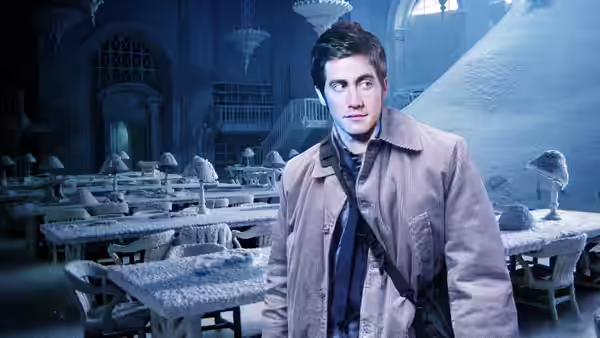
The talking is the trouble. Emmerich and Jeffrey Nachmanoff have written a script in which nearly every scene is a briefing, and the person being briefed is usually Becker, who exists to be wrong so that Quaid can be right at him. Quaid does the square-jawed decent father; he has nothing else to do. Jake Gyllenhaal, as his son Sam, spends the film looking damp and apologetic, and his courtship of Emmy Rossum’s Laura Chapman is conducted in whispers in a public library. Sela Ward, as Sam’s mother Lucy, a doctor, is given a sick child to sit beside and a telephone to hold. Ian Holm is the one who gets out clean. As Terry Rapson, the Scottish oceanographer watching his buoys go cold with Adrian Lester’s Simon beside him, he talks like a person, and the film’s one quiet scene belongs to him.

Barry Chusid’s sets do more storytelling than the dialogue. Rapson’s weather station is a cramped room of monitors and cardigans, and the library reading room becomes a camp of desks and burning books. The second half lives in these rooms and on a long walk north, and once the storm has settled into a steady white there is nothing left for the camera to do. Emmerich fills the gap with a lecture about the climate that arrives with the subtlety of the hail, and one dry joke about who ends up crossing which border, which comes late and which we will leave where it is.

The old disaster films knew the trick. The Towering Inferno (1974) had one building and thirty stars, and it kept the stars in the building. Emmerich has a hemisphere and half a dozen thin people, and he sends them off in different directions, so that by the end we are watching a man in a parka and hoping for another tornado. Independence Day (1996) knew it was silly and enjoyed it. This one thinks it is serious, and the seriousness is where the enjoyment leaks out.

Watch the first hour with the sound up and the curtains drawn. How long you stay for the second depends on how much you like snow. It carries a 12 and runs 124 minutes, about half of which are weather.
Critical consensus AI synthesised

56
Positive
7
Mixed
5
Negative
6
Empire
· Colin Kennedy
80*

The critic calls it arguably Emmerich's best film, praising its focus on the disaster genre and three standout sequences of destruction (LA tornados, New York flooding, and superfreeze) that showcase his flair for spectacle with a chilling subtext. He notes it sustains interest better than prior works despite some clichés.

Read the full review →
Radio Times
★★★★ · Sloan Freer
80

This is praised as a jaw-dropping spectacle that surpasses Emmerich's earlier films, delivering thrilling weather effects and entertainment value despite cheesy dialogue and melodramatic performances. The focus on global warming and superstorms makes it a cautionary tale worth the Hollywood excess.

Read the full review →
The Telegraph
28 May 2004 · Tim Robey
80*

The film is both sillier and more enjoyable than Emmerich's prior works, with gleeful political satire and special effects that reach a high-water mark, especially the icy Manhattan transformation.

Read the full review →
RogerEbert.com
28 May 2004 · Roger Ebert
75*

The critic finds the movie profoundly silly but also very scary due to its awesome special effects, which make it work despite cornball plotting. He singles out the stupendous effects and amusing moments like Americans becoming illegal immigrants in Mexico.

Read the full review →
Screen Daily
24 May 2004
75*

The film is called a superior blockbuster that delivers visceral thrills and spectacle through Emmerich's B-movie style, with gleeful unreality in its effects. It praises the fun diversion and strong box-office potential while noting the formulaic plot holes.

Read the full review →
The Times
30 May 2004 · Cosmo Landesman
70*

The special effects are genuinely impressive and deliver the disaster spectacle well, but the human drama and characters lack depth and emotional impact.

Read the full review →

Straight answers AI written, from our review

Is The Day After Tomorrow worth watching?
The Day After Tomorrow is worth watching for its first hour of tornadoes and flood, and we scored it 57. Once the storm settles into steady snow the film becomes a run of briefings and a long walk north, with Dennis Quaid given nothing to do but be right. Watch the destruction with the sound up; how long you stay after that depends on how much you like snow.
How long is The Day After Tomorrow, and what is it rated?
The Day After Tomorrow runs 2h 04m and is rated K-11 by the KAVI in Finland. It is a science fiction and thriller film.
Where can I watch The Day After Tomorrow in Finland?
The Day After Tomorrow is streaming on Amazon Prime Video and Disney+ in Finland, and it is also available to rent from Amazon Prime Video and Apple TV from €3.99. Availability is checked daily; the links above go straight to each service.
How violent or frightening is The Day After Tomorrow, and is it suitable for children?
The Day After Tomorrow carries a 12A in the UK and is frightening for its first hour rather than violent. The fear comes from scale: hail through windscreens, tornadoes across Los Angeles in daylight, and a wall of grey water moving up the streets of New York with taxis in it. Older children who can take a city drowning should be fine; younger or nervous ones may find the flood too much.
How does The Day After Tomorrow compare to Take Shelter?
The Day After Tomorrow is the louder film and Take Shelter the more frightening one. Emmerich freezes a hemisphere and fills the second half with lectures; Jeff Nichols keeps his storm inside one man's head and lets Michael Shannon carry the dread, though the slow pacing sometimes gives us too long with a fear we already understand. Choose Emmerich for spectacle and Nichols for a film that stays with you.

Cast

If you liked this, try…

  1. The Poseidon Adventure (1972) · not on Fi1m yetOne upturned ship, a dozen stars, and nobody stops to lecture anyone.

  2. Twister (1996) · not on Fi1m yetThe tornadoes are the whole film, and the film is honest about it.

  3. Take Shelter (2011, Fi1m 83)A storm that may only be in one man’s head, and far more frightening.

  4. The Impossible (2012) · not on Fi1m yetA real wave, a real family, and the water shot from inside it.

  5. The Wandering Earth (2019) · not on Fi1m yetChina freezes the planet on purpose and has more fun doing it.