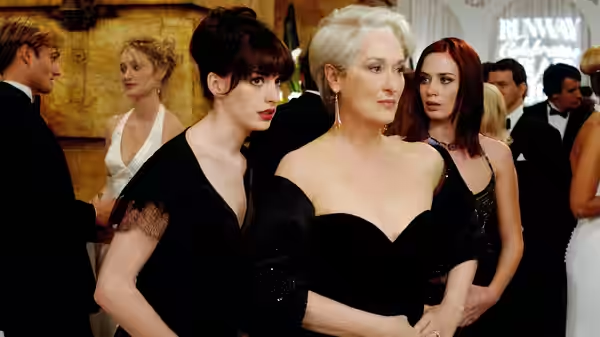
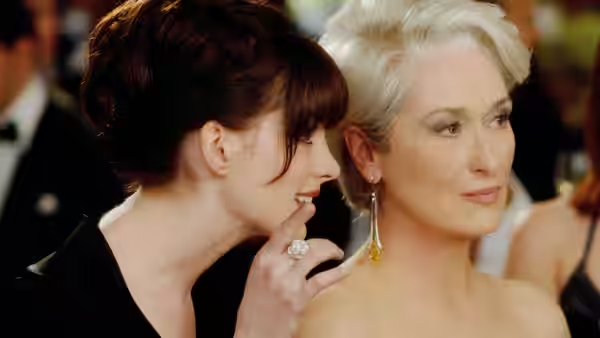
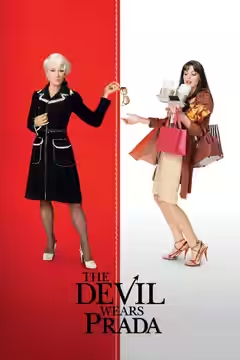
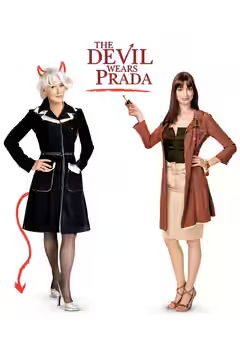
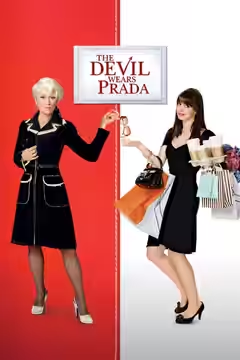
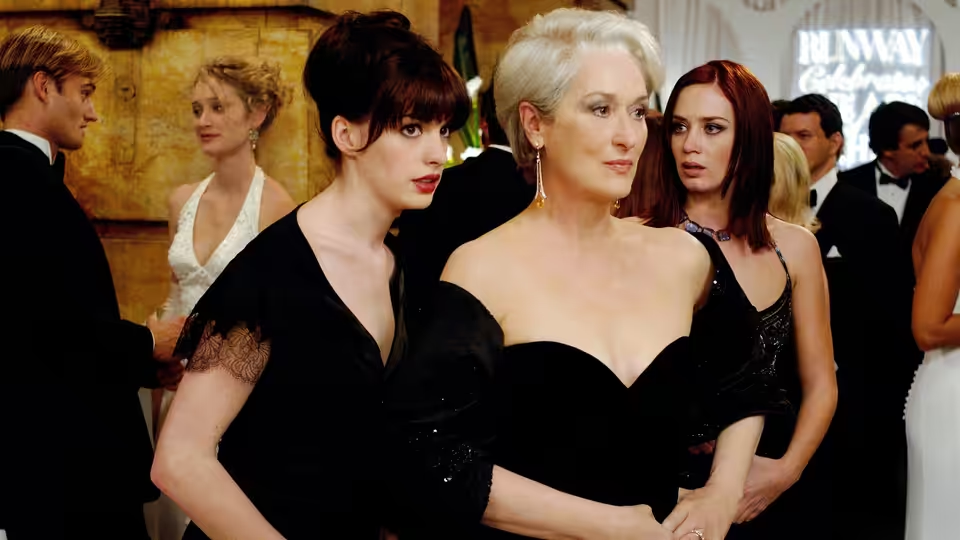
Miranda Priestly (Meryl Streep) and Andy Sachs (Anne Hathaway) at a formal event
Film review

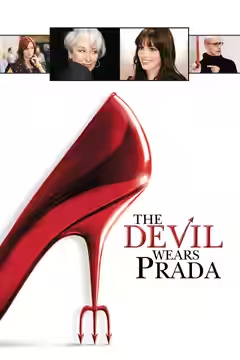
The Devil Wears Prada

2006 · Directed by David Frankel · 1h 49m

In a sentenceSell your soul, the film warns, over a hundred minutes of lovingly photographed reasons to do it

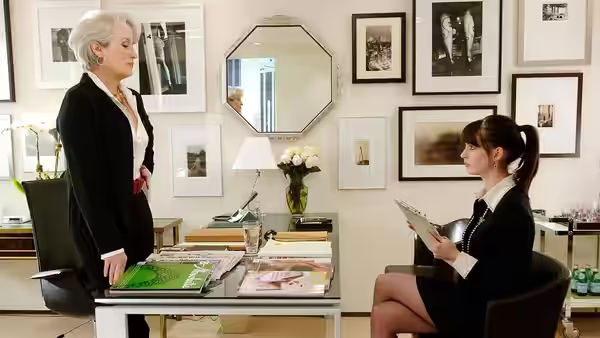
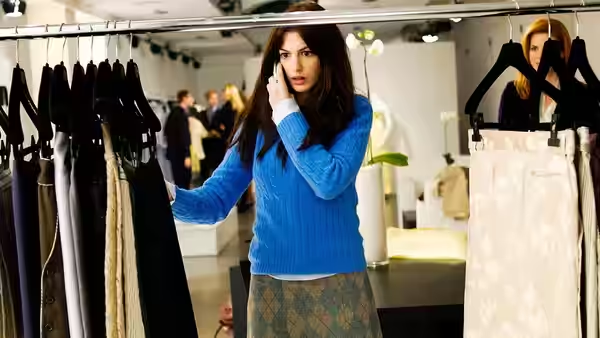
New York. Andy Sachs (Anne Hathaway), a fresh graduate who wants to write serious journalism and cannot get a newspaper to hire her, takes the only interview on offer: second assistant to Miranda Priestly (Meryl Streep), editor of Runway, the fashion magazine that decides what everyone else will wear. Andy has never read it and turns up in a lumpy blue jumper. Miranda hires her anyway, hands her a phone that must always be answered, and sets about explaining, in a short lecture on the colour cerulean, why Andy’s indifference to clothes is itself a choice someone else made for her. First assistant Emily (Emily Blunt) despises her on sight; Nigel (Stanley Tucci), Miranda’s right hand, takes pity and opens the wardrobe. At home, her boyfriend Nate (Adrian Grenier) starts to wonder where she has gone.

Plays from YouTube when you press play; nothing loads from them until then.

Fi1m review

Meryl Streep’s Miranda Priestly, delivered almost entirely in a murmur, is a screen monster we could have watched for twice the length, and Emily Blunt steals whatever she is left. The film around them is tidy, formulaic and never quite sure whether it disapproves of the clothes.

David Frankel’s film, from Lauren Weisberger’s novel and a screenplay by Aline Brosh McKenna, is an old story in new shoes. A nice girl takes a job in a cruel and glittering place, finds she is good at it, and has to decide how much of herself to leave at the door. The film knows exactly what it is and runs it in 109 minutes without a wasted scene. What makes it worth an evening is not the moral, which is thin, but the two women on either side of it, who are not.

Meryl Streep plays Miranda Priestly against every expectation the title sets up. She does not shout. She barely lifts her voice above a conversational murmur, dismisses people with two words, and lets a long silence do the work a lesser performance would hand to a tantrum. The scene that announced the film to us comes early: Andy snorts at two near-identical belts, and Miranda, without a flicker of temper, explains that the lumpy blue jumper Andy is so proud of not caring about was chosen for her, years earlier, by the people in this room. We sat up. It is the one moment where the film’s case that fashion matters actually gets made, and Streep makes it with contempt so quiet it sounds like patience.

Emily Blunt, as the first assistant Emily, is the film’s second engine. She is hungry in every sense, living on nothing until the Paris trip she treats as a pilgrimage, and she looks at Andy the way a cat looks at a vacuum cleaner. We laughed harder at her than at anything else in the film, mostly at the sniff. Stanley Tucci’s Nigel is kind in a place that does not reward kindness, and he gets the one speech about what the job costs and why people pay it, delivered with the weariness of a man who has given it before.

Florian Ballhaus shoots New York in a hard, clean morning light, all glass and taxi yellow, and Jess Gonchor’s Runway offices are white corridors and white desks that make Andy’s first outfit look like a stain. Patricia Field and Molly Rogers dress the cast so that the clothes do half the storytelling: Blunt’s Emily in armour, Streep in silver and fur, Hathaway going from frumpy to fabulous over a single walk to work that Mark Livolsi cuts as a sequence of doorways, a new outfit through each. Theodore Shapiro’s score is light and quick and stays out of the way. The pop songs laid over the montages are louder and have aged less well.

The trouble is everything outside the office. Anne Hathaway is good at being flustered and less good at being tempted, which is a problem, because the film needs us to believe Andy is falling for this world and she mostly looks like a nice girl in borrowed clothes. Adrian Grenier’s Nate, the boyfriend who makes grilled cheese and sulks about missed birthdays, is the dullest person in the film, and the script keeps asking us to prefer him. Tracie Thoms and Rich Sommer, as the friends Lily and Doug, are there to disapprove. Simon Baker’s Christian Thompson arrives as a temptation of a different kind and is about as tempting as a hotel bar. Every scene in the flat we were waiting to get back to work, which may be the film’s point about Andy but is certainly not its point about us.

Which leaves the moral. The film says this world hollows out the people in it, then photographs the handbags with real love, and it never settles the two. The boss-from-hell comedy usually gives us a monster who is also a fool, and McKenna’s best idea is a monster who is right more often than not. The film does not quite know what to do with that idea, but it is a better one than most of the genre bothers with.

See it for Streep and Blunt, who between them account for every scene we would watch again. It carries a PG and barely needs it. It warns you off the job and sends you out wanting the coat, which is roughly where most of us end up.

Critical consensus AI synthesised

62
Positive
2
Mixed
5
Negative
1

Most critics land in the same place: an entertaining, good-looking comedy that is thinner than it ought to be, and that owes most of its appeal to Meryl Streep. The praise clusters almost entirely on her Miranda Priestly, described again and again as restrained, quietly cutting and nuanced rather than monstrous; several reviews say she alone lifts the film above adequacy. Emily Blunt’s comic work earns a mention too.

The reservations are about everything around her. Critics fault a predictable plot, formulaic lines, clumsy montages and an irritating pop soundtrack, and Total Film finds Anne Hathaway’s lead pedestrian beside Streep. The spread is narrow, with five of eight reviews mixed and only two clearly positive, and two reviews are too partially available to add much. The one firm dissent comes from Eye for Film, which calls it a muddled morality tale that glamorises the fashion industry it promises to satirise.

Empire
29 September 2006 · Helen O'Hara
75*

O'Hara finds the film fresh, stylish, smart and funny, despite some forced plot elements and formulaic lines. She especially praises Meryl Streep's nuanced, charismatic performance and Emily Blunt's comic work.

Read the full review →
Variety
22 June 2006 · festival review · Todd McCarthy
70*

McCarthy finds the adaptation entertaining but uneven, with Meryl Streep’s performance elevating it. He praises Streep’s restrained, quietly cutting portrayal of Miranda, while faulting clumsy montages and irritating pop music.

Read the full review →
Time Out
2 October 2006 · Ben Walters
65*

The available page metadata identifies this as a film review, but the review text is unavailable. Its description focuses on the demanding world surrounding Miranda Priestly and Runway magazine, without providing enough of the critic’s verdict to summarize it.

Read the full review →
Screen Daily
23 June 2006 · Brent Simon
64*

The page identifies this as a review, but the paywall hides the critic’s verdict. No praise or complaint from the review itself is visible.

Read the full review →
Slant Magazine
22 June 2006 · ★★½/4 · Dan Callahan
62

Callahan finds the film predictable and thin, though amiably made and well acted. He especially praises Meryl Streep’s restrained performance, singling out a scene where Miranda briefly reveals her regret.

Read the full review →
Total Film
6 October 2006 · ★★★ · Total Film
60

The review finds the film shallow but entertaining, with Streep elevating it into a one-woman show. It praises her nuanced performance, while faulting Anne Hathaway’s comparatively pedestrian turn.

Read the full review →

Straight answers AI written, from our review

Is The Devil Wears Prada worth watching?
The Devil Wears Prada is worth watching for Meryl Streep's murmuring Miranda Priestly and Emily Blunt's hungry first assistant, and we scored it 70. The office scenes are tight and often funny; everything in the flat, with the sulking boyfriend and disapproving friends, is a wait for the film to get back to work.
How long is The Devil Wears Prada, and what is it rated?
The Devil Wears Prada runs 1h 49m. It is a drama and comedy film.
Where can I watch The Devil Wears Prada in Thailand?
The Devil Wears Prada is not on any streaming or rental service in Thailand at the moment. It is available in 49 other countries; change your country at the top of the page to see where. Availability is checked daily.
How does The Devil Wears Prada compare to Working Girl?
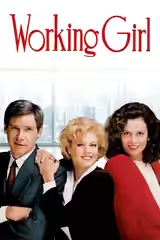
The Devil Wears Prada and Working Girl are both Manhattan comedies about a woman under a monstrous boss, but the earlier film is the warmer and sharper of the two. Mike Nichols cares about the office manoeuvring; David Frankel cares about the clothes. Choose Working Girl for a heroine with real ambition, The Devil Wears Prada for the boss.
Is The Devil Wears Prada based on a true story or a book?
The Devil Wears Prada is adapted from Lauren Weisberger's novel of the same name, with a screenplay by Aline Brosh McKenna; it is not presented as a true story. You do not need to have read the book, and the film's best idea, a boss who is right more often than not, plays whether or not you know the source.
What should I watch after The Devil Wears Prada?
After The Devil Wears Prada, try Working Girl (1988, Fi1m 80): Melanie Griffith takes on a Manhattan boss from hell with better hair and worse manners. Then Absolutely Fabulous (1992, Fi1m 81): The fashion world again, this time with nobody pretending to disapprove of it; and Phantom Thread (2017, Fi1m 87): Another tyrant of taste, another young woman who turns out to be made of sterner stuff.

Cast

Awards

Academy Awards, 2007

Nominated
Best Actress
Nominated
Best Costume Design

If you liked this, try…

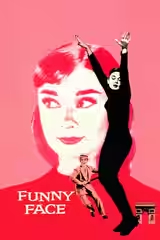
  1. Funny Face (1957) · not on Fi1m yetA fashion magazine, a bookish girl made over, and Astaire doing the photography.

  2. Working Girl (1988, Fi1m 80)Melanie Griffith takes on a Manhattan boss from hell with better hair and worse manners.

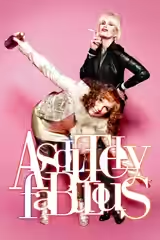
  3. Absolutely Fabulous (1992, Fi1m 81)The fashion world again, this time with nobody pretending to disapprove of it.

  4. The September Issue (2009) · not on Fi1m yetThe real editor, the real office, and a creative director who out-Nigels Nigel.

  5. Phantom Thread (2017, Fi1m 87)Another tyrant of taste, another young woman who turns out to be made of sterner stuff.