Spielberg’s account of his own childhood is honest about his parents, generous to almost everyone and finely acted by Michelle Williams and Paul Dano. It is also 151 minutes long and knows exactly how it wants to be remembered. Worth your evening, with reservations.
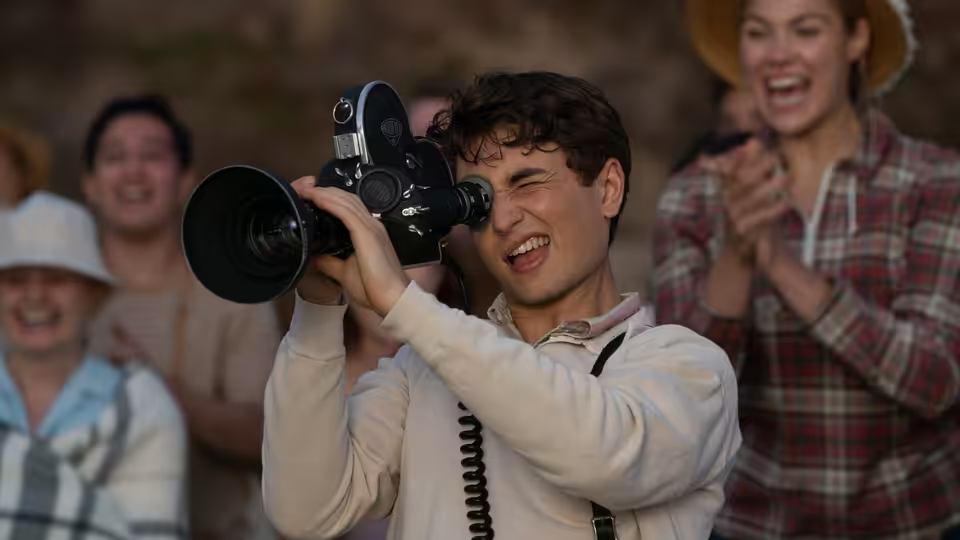
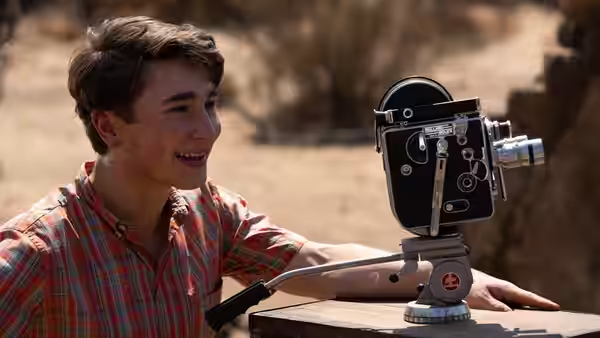
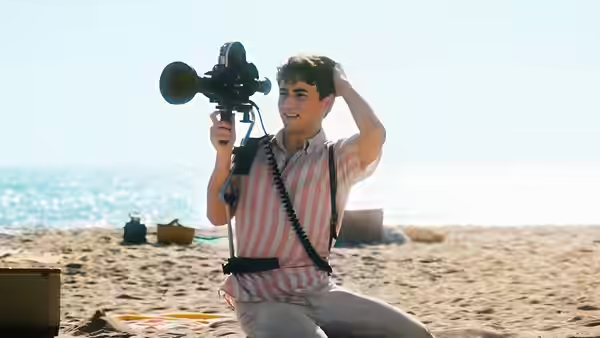
Steven Spielberg, writing with Tony Kushner, is telling his own story with the names changed, and he does not pretend otherwise. Sammy Fabelman is a boy in New Jersey in 1952 who sees a train crash at the pictures and cannot sleep until he has staged it himself with a toy train and his father’s camera. That is the film’s first idea and its best: a child discovers that if he films the frightening thing he can control it. Everything that follows tests whether that is true, and The Fabelmans is honest enough to answer that it is not, quite.
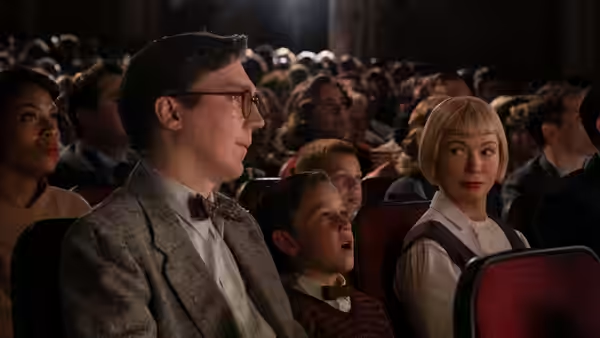
The parents are the film. Michelle Williams plays Mitzi as a woman who gave up the piano for a family and has never stopped performing, in white dresses, in the headlights of the family car, at the keyboard at two in the morning while the children listen from the stairs. Paul Dano’s Burt is an engineer who loves her and speaks to her in the tone he would use to a circuit that has stopped working. Rick Carter’s Phoenix house is open-plan, glass and low walls, so that nobody in this family can ever quite get out of anybody else’s sight. Seth Rogen’s Benny, Burt’s best friend, is in every room too, and he is better fun than Burt, and the film lets us see that before Sammy does.
We expected Judd Hirsch’s Uncle Boris to be a warm turn by an old pro and instead found the scene frightening. Boris arrives for one night, sits on the boy’s bed and tells him, without softening it, what art will do to his family and what his family will do to his art. Hirsch delivers it like a sentence being passed. Spielberg, who has spent a career being liked, has put in his own film the argument that this may not have been worth it, and he does not cut away from it.
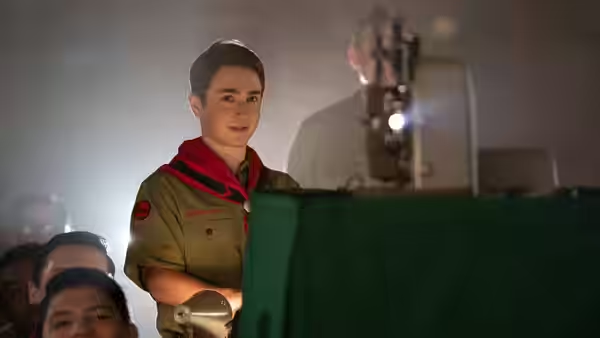
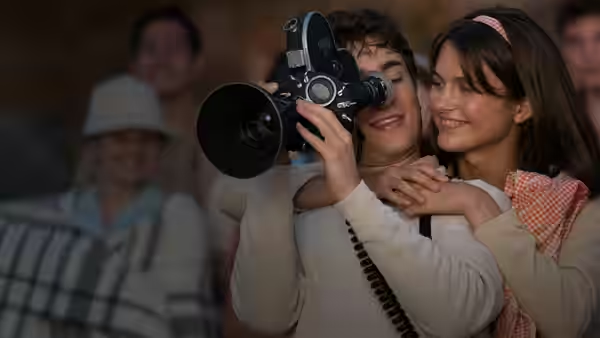
Janusz Kamiński lights the whole thing in the colour of a lamp left on in another room. The New Jersey cinema is amber, Arizona is bleached, and the beam of a projector falls across almost every important face. The film’s happiest stretch is the boy’s own films, a western and a war picture shot with his scout troop, and Spielberg shows the tricks: pinholes pricked in the celluloid so the rifles flash, dust kicked up for a stagecoach. Michael Kahn and Sarah Broshar cut the boy’s footage into the adult film so that we watch him learn to edit while they edit him, and the sequence in which he runs the camping-trip reels alone in his room, over and over, moved us more than anything with an orchestra behind it. We will not say what he finds. John Williams’s score is sparing, mostly piano, and knows to stay out of that room.
Then the family moves again and the film goes slack. The high-school stretch that follows belongs to a broader, jokier picture, and it runs for the best part of half an hour. We were bored, and we noticed we were bored, which in a Spielberg film is a rare and unhappy sensation. The whole is 151 minutes and would lose nothing at 125.
There is a harder complaint. Spielberg is candid about his mother and clear-eyed about his father, and he is kind to the boy. Sammy does some ugly things with his camera and with what it shows him, and each time the film forgives him within a scene. Every anecdote is also cut so that it teaches him something he will plainly use later, and after a while you can feel the lesson being lined up before the scene starts.
Set against his own work, this is the film he has been circling since Close Encounters of the Third Kind and E.T., the divorce he kept putting into other families’ houses. Here it is in his own, and it is the better for it. Watch it with a parent if you have one to hand. You will disagree afterwards about who Mitzi really was, and that is the point.