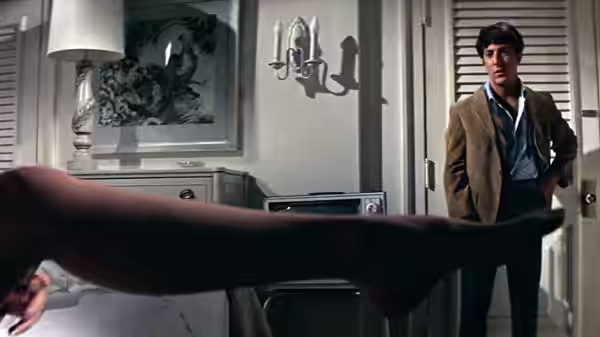
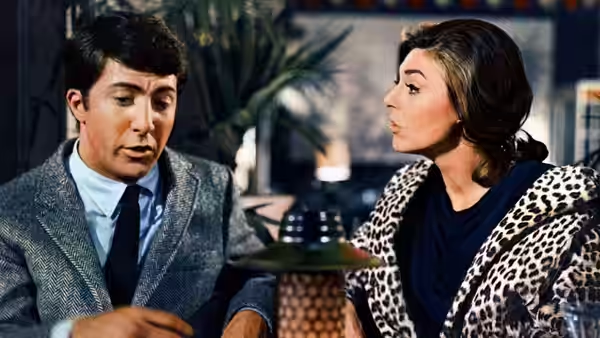
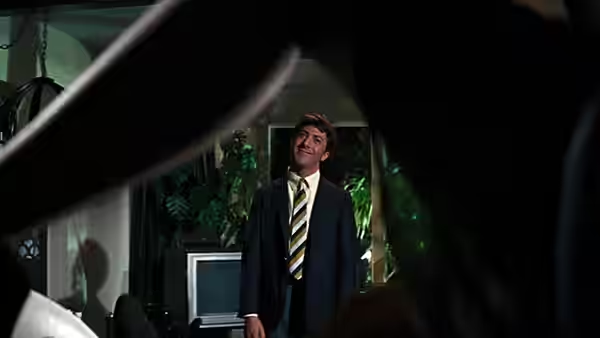
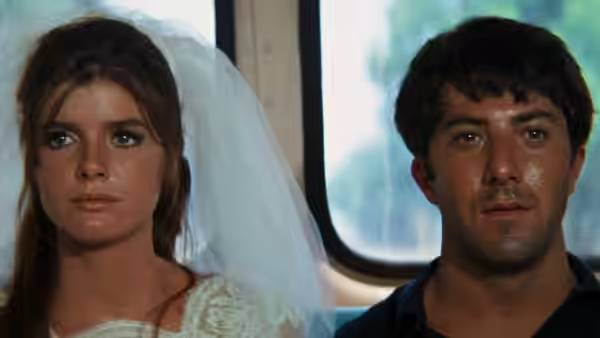
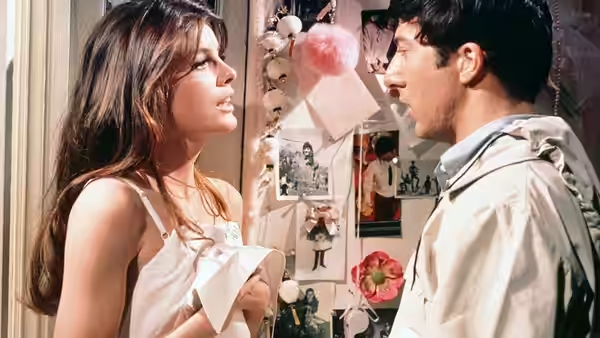
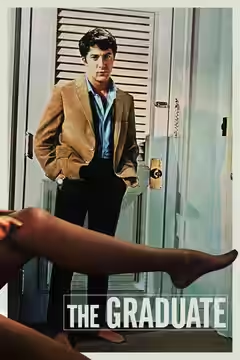
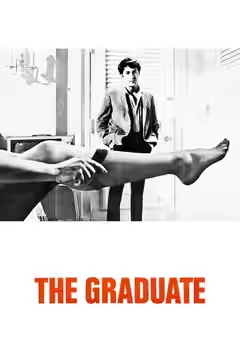
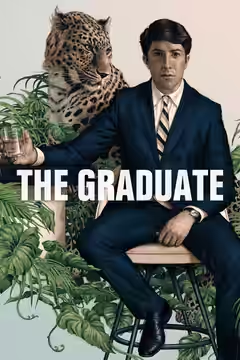
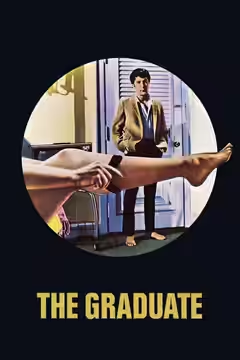
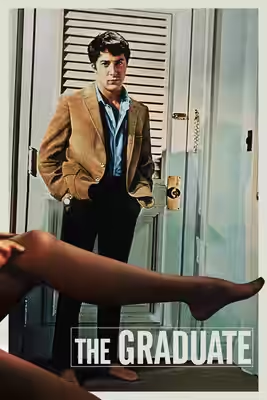
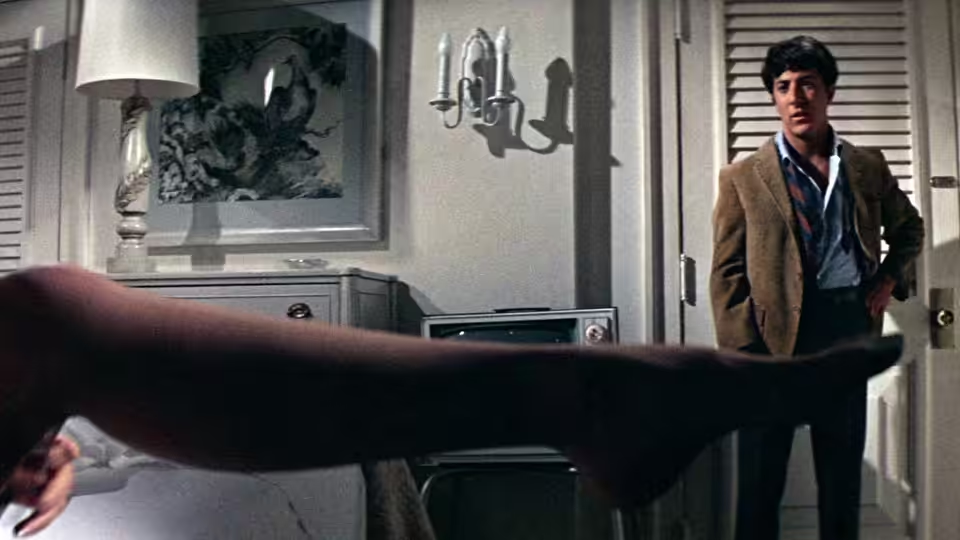
Ben Braddock (Dustin Hoffman) standing in a bedroom looking toward a leg on the bed
Film review

The Graduate

1967 · Directed by Mike Nichols · 1h 47m

In a sentenceHe has a degree, a sports car and a pool, and no idea what any of them are for

Ben Braddock (Dustin Hoffman) comes home to his parents’ house having just finished college, and does not know what to do next. His father (William Daniels) and mother (Elizabeth Wilson) throw a party to show him off to their friends, one of whom, Mr. McGuire (Walter Brooke), takes him aside to give him career advice. Mrs. Robinson (Anne Bancroft), the wife of his father’s business partner Mr. Robinson (Murray Hamilton), asks Ben to drive her home, pours him a drink and makes him an offer. He panics and leaves, then telephones her a few days later from a hotel. The affair that follows is conducted in hotel rooms and near silence, while his parents keep asking why he never takes out the Robinsons’ daughter, Elaine (Katharine Ross).

Plays from YouTube when you press play; nothing loads from them until then.

Fi1m review

Mike Nichols’s comedy about a graduate who drifts into an affair with a family friend is still funny and still sharp, and Anne Bancroft is the best thing in it. It goes softer once it stops being about her, though not by enough to spoil it.

Ben Braddock (Dustin Hoffman) rides an airport walkway at the start of The Graduate with his face set, and for the next hour and three quarters he is carried along by other people in much the same way. Mike Nichols’s film, adapted by Calder Willingham and Buck Henry from Charles Webb’s novel, is a comedy about a young man who has done everything that was asked of him and finds there is nothing waiting at the end of it. The first hour is about as good as American comedy gets. The second is good, and we will come to the difference.

The party that opens the film is the sharpest thing in it. Ben’s parents (William Daniels and Elizabeth Wilson) have filled the house with their friends, and Nichols shoots them close and slightly too bright, so every face is a mask of goodwill with something else behind it. Walter Brooke’s Mr. McGuire takes Ben aside by the pool and gives him career advice with the gravity of a man passing on a family secret. Then Anne Bancroft’s Mrs. Robinson asks for a lift home. Patricia Zipprodt puts her in animal prints and Robert L. Surtees frames Ben through the arch of her raised leg, and yet Bancroft plays none of it as a hunt. She is bored. She has been bored for years. Ben is simply what came through the door.

Hoffman was not the obvious casting for a Californian golden boy and that is the joke Nichols builds the film on. He stammers, he over-explains, he says “Mrs. Robinson” as if it were a form of address he has been practising. Buck Henry, playing a hotel clerk who watches Ben fail to book himself in, gets more out of a raised eyebrow than most actors get from a speech. And Sam O’Steen’s editing keeps making the point the dialogue is too polite to make, cutting between the family pool and the hotel until they feel like one place. His parents think he is resting. He is drowning in comfort.

We laughed hardest at the scene in which Ben, in diving gear, walks into the family pool in front of the neighbours. Then Surtees puts the camera inside the mask, the faces above mouthing at him through the water, and Ben sinks to the bottom and stays there. The laugh went out of us and did not come straight back. Richard Sylbert’s Braddock house, all glass, fish tank and pale carpet, is a place where a person could be watched at every moment and never once seen.

What moved us more than we expected was the night in the hotel when Ben insists, for once, that they talk, and asks about the life she had before she was married. Bancroft lets the question land and then lets the light go out of her face, and for a minute the film is about a woman who gave up a life she can barely remember wanting. Nichols holds on her and does not cut away for a gag. It is the best scene in the film and the one Bancroft should be remembered for.

The second half belongs to Elaine, and we will say only that Ben decides what he wants and goes after it. The trouble is that the film’s interest in Mrs. Robinson drops away the moment she stops being useful to the plot, and she is turned from a person into an obstacle. Katharine Ross is bright and likeable and has very little to play; Elaine is mostly a face Ben looks at. Ben’s pursuit reads less like love than like the first idea he has ever had on his own. Paul Simon and Art Garfunkel’s songs, which sit so well over the hotel scenes early on, are asked to carry more than they should late.

Nichols has a good ear for the actors’ timing and, occasionally, a fondness for the clever shot for its own sake. Against that, he ends the film on a held image that we will not describe, except to say that staying on it a few seconds longer than expected changes the meaning of everything before it. Most critics have loved this film for fifty years and we are, broadly, with them, though we would rate the hour with Bancroft a good deal above the hour without her.

It runs 107 minutes and is a 12A. Watch it with someone at the wrong age for it, either far younger than Ben or far older than Mrs. Robinson, and see which of the two they end up on the side of.

Critical consensus AI synthesised

83
Positive
15
Mixed
2
Negative
0
Radio Times
★★★★★ · Tom Hutchinson
100

This landmark satire on America's bourgeoisie thrust Dustin Hoffman into the limelight and won a best director Oscar for Mike Nichols. The critic highlights Hoffman's sensational performance, the biting screenplay, innovative camerawork and the perfect Simon and Garfunkel soundtrack.

Read the full review →
The Independent
21 June 2017 · ★★★★★
100

The re-released classic remains beguiling fifty years on, largely thanks to Dustin Hoffman's breakthrough performance as the awkward, panicked Benjamin, which mixes humour, boredom and vulnerability in equal measure.

Read the full review →
The Times
11 September 2025 · ★★★★★ · Kevin Maher
100

Mrs Robinson emerges as the sympathetic heroine in this reappraisal of the classic, far more dignified and complex than Hoffman's spoilt, creepy Benjamin. Nichols's direction and the performances highlight her conflicted humanity amid the film's generational and marital tensions.

Read the full review →
Time Out
19 June 2017 · ★★★★★ · Tom Huddleston
100

Mike Nichols’s near-flawless class satire still feels as sly, modern and bracing as it must have in 1967. The critic praises the iconic scenes that have entered the culture and the magnificent chase-to-the-church finale with its unnerving closing shot.

Read the full review →
RogerEbert.com
26 December 1967 · Roger Ebert
90*

Ebert calls it the funniest American comedy of the year with a clear subversive point of view against upper-middle-class conformity. He praises Mike Nichols as a major new director, Dustin Hoffman's awkward ethical performance, and Anne Bancroft's sexy, shrewish turn.

Read the full review →
Slant Magazine
10 April 2012 · Budd Wilkins
90*

The review highlights the film's formal experimentation, use of long takes, pop music soundtrack, and examination of discomfort and anomie over typical teen sex comedy tropes. It praises the performances, especially Hoffman, Bancroft, and Ross, and Nichols and Surtees' inventive cinematography and editing.

Read the full review →

Straight answers AI written, from our review

Is The Graduate worth watching?
The Graduate is worth watching for anyone who likes sharp American comedy about people who have everything and want none of it, and we scored it 86. The first hour, built around Anne Bancroft's bored and unhurried Mrs. Robinson, is about as good as the form gets; the second half, once it turns to her daughter Elaine, is good rather than remarkable.
How long is The Graduate, and what is it rated?
The Graduate runs 1h 47m. It is a drama and romance film.
Where can I watch The Graduate in the Philippines?
The Graduate is not on any streaming or rental service in the Philippines at the moment. It is available in 6 other countries; change your country at the top of the page to see where. Availability is checked daily.
How violent or frightening is The Graduate, and is it suitable for children?
The Graduate is a 12A in the UK and contains no violence to speak of; its adult content is an affair conducted in hotel rooms and mostly in near silence. There is nothing frightening in it, but the subject and the dry, grown-up humour make it a film for teenagers and adults rather than younger children, who will find little to hold them.
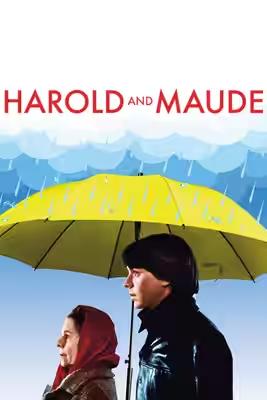
How does The Graduate compare to Harold and Maude?
The Graduate and Harold and Maude both follow a lost young man drawn to an older woman, but Mike Nichols's film keeps its comedy at Ben's expense while Hal Ashby's is on Harold's side. The Graduate is the sharper and better-made of the two, especially in its first hour; Harold and Maude is warmer and more openly touching, if sometimes too pleased with its own disregard for convention.
Is The Graduate based on a true story or a book?
The Graduate is based on a novel by Charles Webb, adapted for the screen by Calder Willingham and Buck Henry; it is not a true story. You do not need to have read the book to follow it, and the film's best moments, from the pool scene to the hotel conversation about Mrs. Robinson's past, work entirely on their own terms.
What should I watch after The Graduate?
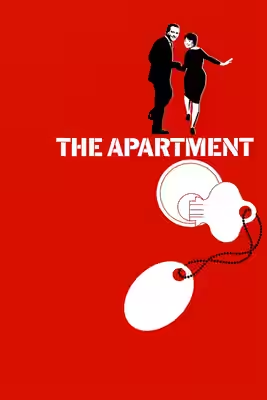
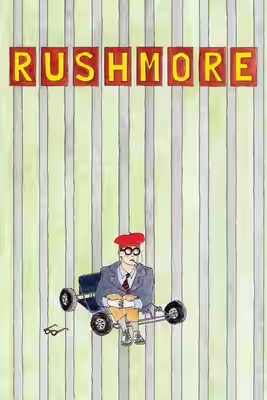
After The Graduate, try Harold and Maude (1971, Fi1m 81): Another lost young man, another older woman; this time the comedy is on his side. Then The Apartment (1960, Fi1m 91): Wilder’s comedy of adultery, lifts and loneliness, sadder and tighter than this one; and Rushmore (1998, Fi1m 83): Anderson borrows the deadpan and the songs and hands them to a schoolboy.

Cast

Awards

Academy Awards, 1968

Nominated
Best Actor
Nominated
Best Actress
Nominated
Best Cinematography
Nominated
Best Picture
Nominated
Best Supporting Actress
Nominated
Best Writing, Adapted Screenplay
Won
Best Director

If you liked this, try…

  1. Harold and Maude (1971, Fi1m 81)Another lost young man, another older woman; this time the comedy is on his side.

  2. Billy Liar (1963) · not reviewed yetBradford instead of California, but the same boy who cannot leave and cannot stay.

  3. The Apartment (1960, Fi1m 91)Wilder’s comedy of adultery, lifts and loneliness, sadder and tighter than this one.

  4. Rushmore (1998, Fi1m 83)Anderson borrows the deadpan and the songs and hands them to a schoolboy.

  5. The Worst Person in the World (2021, Fi1m 84)Oslo, thirty years old, still no plan; the drift as seen from her side.

Free account

Know what to watch tonight

Two lists that know where things are streaming, collections you can share, your own score beside ours, and Discover that remembers what you have seen.

  • Want to see, sorted by what is streaming now
  • Seen, with your score out of ten
  • No adverts, ever