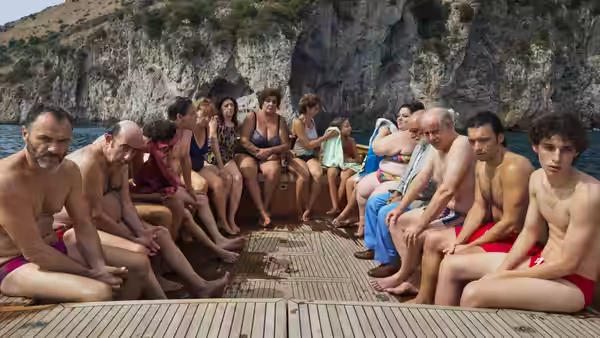
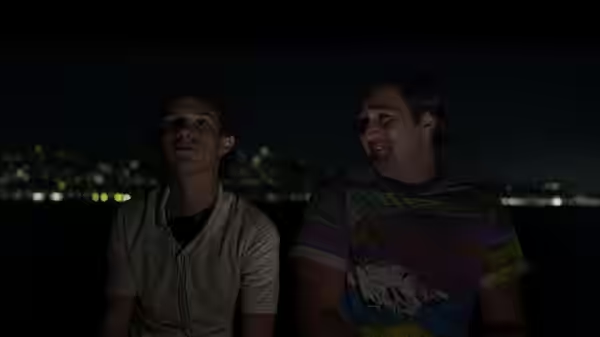
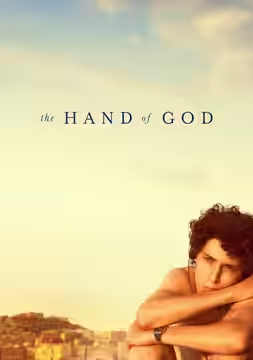
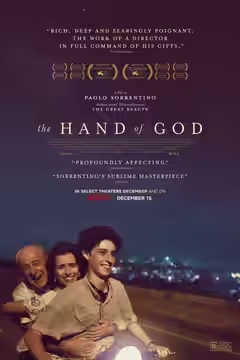
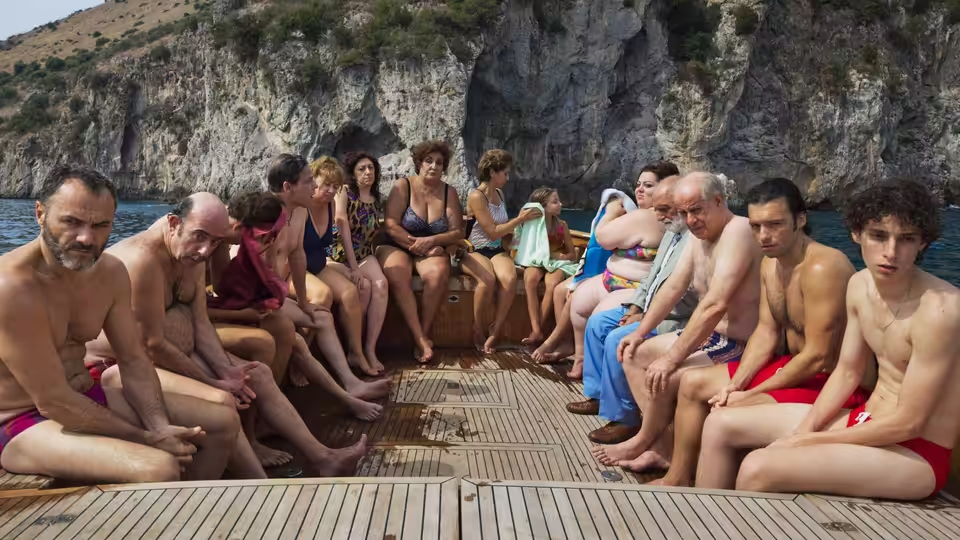
Fabietto Schisa (Filippo Scotti) sits with family on a boat by rocky cliffs
Film review

The Hand of God

2021 · Directed by Paolo Sorrentino · 2h 10m

In a sentenceWe would happily stay for another family lunch, even if growing up has to wait

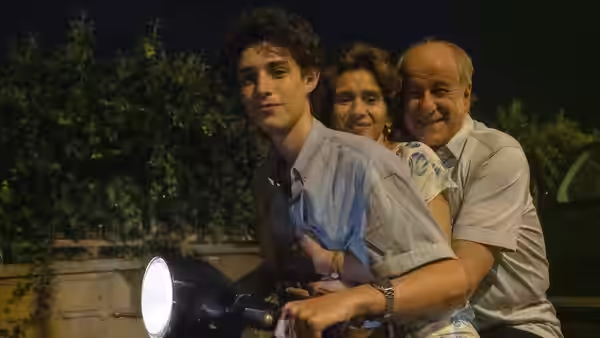
In 1980s Naples, Fabietto Schisa (Filippo Scotti) grows up surrounded by relatives, football and an increasing curiosity about sex. Saverio Schisa (Toni Servillo) and Maria Schisa (Teresa Saponangelo) preside over a family whose affection does not prevent its quarrels. Patrizia (Luisa Ranieri) draws the boy’s attention, while a crowded family lunch brings the relatives’ competing personalities together. Fabietto wants to find his own place among the adults, but their tensions and distractions often leave him watching rather than participating. Between family life and the possibilities of cinema, he begins to look beyond the world he knows.

Plays from YouTube when you press play; nothing loads from them until then.

Fi1m review

Paolo Sorrentino’s coming-of-age drama is warm, funny and worth an evening for its family alone. Its later passages drift, and the women deserve more attention than the boy’s sexual curiosity allows.

Paolo Sorrentino’s The Hand of God is worth seeing for the company it keeps, especially when the family gathers and the boy at its centre has little to say. This partly fictionalised memoir follows Fabietto Schisa through adolescence in 1980s Naples, with football, sexual curiosity and cinema competing for his attention. It is funny and affecting, although its later episodes do not justify all of their time. The family gives the film enough warmth to survive some increasingly aimless passages.

Filippo Scotti gives Fabietto Schisa a watchfulness that suits a boy still working out what the adults around him mean. His relative quiet allows the family to be funny without turning every exchange into a competition between performances. There is a limit to this approach: we sometimes need a stronger sense of what he wants. For much of the film, though, watching him take an interest in other people is absorbing enough.

Toni Servillo and Teresa Saponangelo, as Saverio Schisa and Maria Schisa, supply the comic ease that makes the household convincing. They make affection credible even when the relatives are being difficult. We laughed at the crowded family lunch, then found ourselves reluctant to leave it. The actors’ timing makes the gathering pleasurable; its untidy mixture of warmth and embarrassment makes it familiar.

Daria D’Antonio’s cinematography makes sunlit Naples feel like a place someone would keep returning to in memory. The views have a sensual pleasure of their own, without making the people seem incidental. Carmine Guarino’s production design is effective because the family seems at home in it. The crowded lunch is the useful test: we notice how people occupy the space before we notice the space itself. The 1980s setting never has to become a display of period possessions.

The difficulty is that the women do not always receive such patient attention. Patrizia, played by Luisa Ranieri, is too often presented through the boy’s sexual curiosity, and the film does too little to question that view. Remembering adolescence does not oblige a director to keep seeing everyone as he did then. Teresa Saponangelo’s performance suggests how much richer the film can be when a woman is allowed to be funny, troublesome and ordinary.

Cristiano Travaglioli’s editing is at its most assured in the family passages, where a succession of personalities gives the film momentum. Later, the episodes feel less closely connected, and people who seemed important are left with too little to do. Lele Marchitelli’s music is sympathetic to the film’s tenderness, but cannot supply the continuity that these stretches need. At 130 minutes, there is room to develop these people further, and the decision to let some of them recede feels wasteful.

Coming-of-age films can be too quick to make every encounter a lesson for their young hero. Here, the relatives are often interesting enough to make us forget that someone is meant to be learning from them. That is when Paolo Sorrentino’s affection is most convincing, and when his film least needs to explain itself. Choose it for an evening when a difficult family sounds like good company and a tightly plotted story can wait.

Critical consensus AI synthesised

66
Positive
14
Mixed
6
Negative
4

Most critics respond warmly to The Hand of God, praising Sorrentino’s personal account of growing up and its vivid evocation of Naples. The strongest agreement concerns the crowded family scenes: their comic timing, eccentric characters and affectionate observation give the film much of its life. Filippo Scotti’s performance also draws praise, alongside the sunlit imagery. Admirers find the movement between humour and sorrow affecting, and welcome a degree of restraint in Sorrentino’s filmmaking.

The spread of opinion is wide, however, with reservations clustering around the less focused second half, uneven emotional impact and treatment of women. Some critics see self-indulgence where others find candour. The AV Club admires the family chemistry but objects to the passive central character and sometimes retrograde attitudes. Variety is more sharply dismissive, finding the drama overstated and the characterisation weak, despite recognising raw emotional power in an individual scene.

The Hollywood Reporter
2 September 2021 · festival review · David Rooney
90*

Rooney finds the film a deeply personal and emotionally resonant coming-of-age story. He particularly praises its warm, sharply observed family scenes and Filippo Scotti’s affecting performance.

Read the full review →
Vulture
10 December 2021 · Bilge Ebiri
85*

Ebiri finds the film a captivating, melancholy portrait of how tragedy helps shape Sorrentino into an artist. He praises its unsanitized depiction of family life and its sense of beauty as a force that can help save broken lives.

Read the full review →
IndieWire
2 September 2021 · B+ · David Ehrlich
83

Ehrlich calls the film Sorrentino’s most personal and best, praising how its relative restraint brings the coexistence of joy and tragedy into focus. He notes that the second half leaves important characters dangling, though its final image captures the film’s wistful promise.

Read the full review →
Radio Times
★★★★ · Trevor Johnston
80

The critic presents it as an engaging, unpredictable coming-of-age story. He highlights Fabietto’s exposure to family tensions, sexual temptation and the magic of moviemaking.

Read the full review →
Time Out
2 September 2021 · ★★★★ · Phil de Semlyen
80

The review praises Sorrentino’s film as a hauntingly personal memoir of grief and growing up. It singles out the film’s blend of personal memory and maverick footballers as a Neapolitan gem.

Read the full review →
The i Paper
2 December 2021 · Geoffrey Macnab
78*

Macnab finds the film a moving, lively coming-of-age story that avoids self-indulgence and nostalgia. He praises Sorrentino’s affectionate, vivid portrayal of Naples and its lost world.

Read the full review →

Straight answers AI written, from our review

Is The Hand of God worth watching?
The Hand of God is worth watching for its funny, affectionate family scenes, and we score it 75 out of 100. We recommend it for an evening when engaging company matters more than a tightly plotted story, though the later passages drift and the women deserve fuller attention beyond the boy’s sexual curiosity.
How long is The Hand of God, and what is it rated?
The Hand of God runs 2h 10m. It is a drama film.
Where can I watch The Hand of God in Chile?
The Hand of God is streaming on Netflix in Chile. Availability is checked daily; the links above go straight to each service.
How violent or frightening is The Hand of God, and is it suitable for children?
The Hand of God has a UK 15 certificate and is not suitable for children under 15. Its adolescent story includes sexual curiosity, making it a choice for older teenagers and adults rather than family viewing. The certificate alone does not establish how violent or frightening it is, and we cannot give a more specific warning about those elements.
How does The Hand of God compare to Amarcord?
The Hand of God shares Amarcord’s remembered Italian adolescence, sexual curiosity and family embarrassment, but we find Amarcord’s wandering more rewarding. We recommend The Hand of God particularly for its family gatherings, while Amarcord offers the broader company of a crowded town. Both have limitations in their treatment of women: a boy’s narrow attention in one, tiresome jokes in the other.
What should I watch after The Hand of God?
After The Hand of God, try Amarcord (1973, Fi1m 82): Another Italian adolescence remembered through unruly neighbours, sexual curiosity and family embarrassment. Then Fanny and Alexander (1982, Fi1m 92): For a larger family gathering, with warmth, cruelty and carefully observed domestic rituals; and A Brighter Summer Day (1991, Fi1m 90): A harsher Taiwanese adolescence, with family pressures and youthful longing given patient attention.

Cast

Awards

International Submission to the Academy Awards, 2022

Nominated
International Submission to the Academy Awards

European Film Award for Best Director, 2021

Nominated
European Film Award for Best Director

European Film Award for Best Film, 2021

Nominated
European Film Award for Best Film

European Film Award for Best Screenwriter, 2021

Nominated
European Film Award for Best Screenwriter

If you liked this, try…

  1. Amarcord (1973, Fi1m 82)Another Italian adolescence remembered through unruly neighbours, sexual curiosity and family embarrassment.

  2. The Long Day Closes (1992) · not reviewed yetA remembered British childhood shaped by family, loneliness and trips to the cinema.

  3. Fanny and Alexander (1982, Fi1m 92)For a larger family gathering, with warmth, cruelty and carefully observed domestic rituals.

  4. A Brighter Summer Day (1991, Fi1m 90)A harsher Taiwanese adolescence, with family pressures and youthful longing given patient attention.

  5. 20th Century Women (2016) · not reviewed yetGives the women around a teenage boy fuller lives of their own.