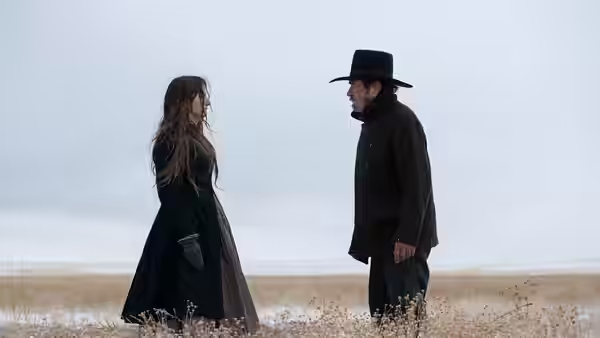
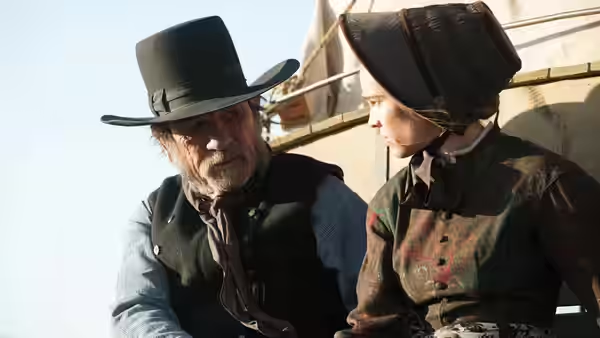
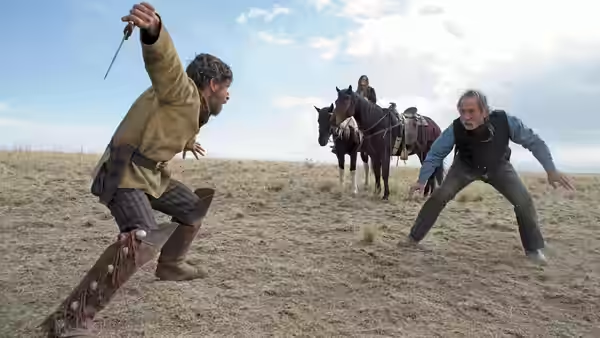
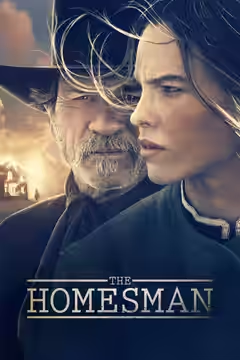
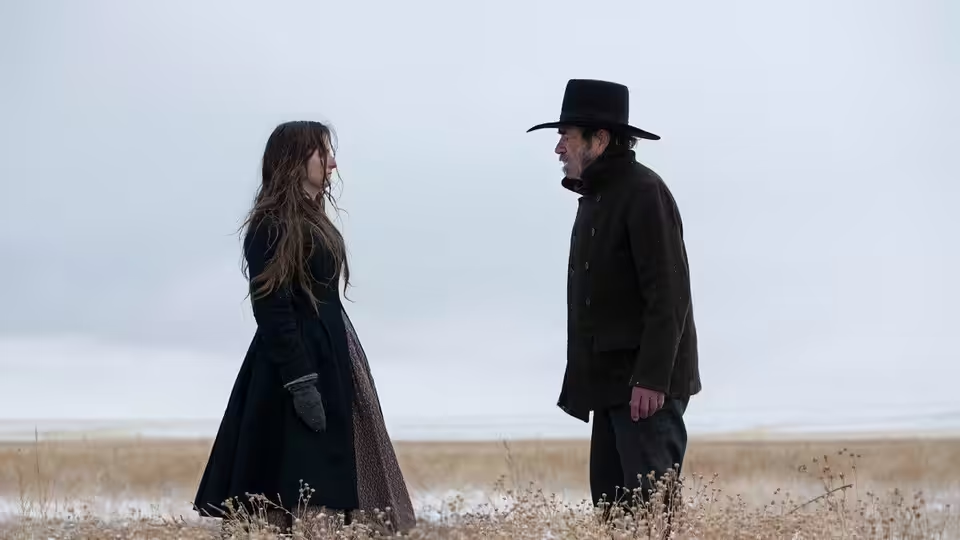
Mary Bee Cuddy (Hilary Swank) faces George Briggs (Tommy Lee Jones) in an open field
Film review

The Homesman

2014 · Directed by Tommy Lee Jones · 2h 02m

In a sentenceHilary Swank looks capable of running the West, if the men would kindly stand aside

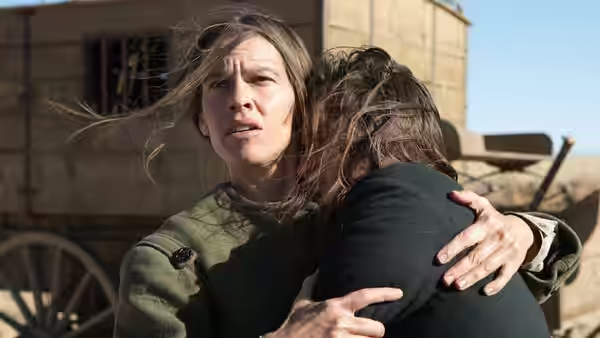
In nineteenth-century Nebraska, Mary Bee Cuddy (Hilary Swank) takes on the task of transporting three women whose mental health has broken down. Her journey brings her together with George Briggs (Tommy Lee Jones). Their charges are Arabella Sours (Grace Gummer), Theoline Belknap (Miranda Otto) and Gro Svendsen (Sonja Richter), each carrying the effects of life on the frontier. The immediate task is to get them safely through an arduous crossing of the prairie. Their need for care complicates the travelling, while Mary Bee Cuddy faces her own loneliness in a place that asks much of women and offers little comfort.

Plays from YouTube when you press play; nothing loads from them until then.

Fi1m review

Hilary Swank makes this uneven Western worth watching, giving frontier loneliness a painful immediacy. Tommy Lee Jones directs with feeling, but pushes the comedy too hard and gives three of his women too little to play.

The Homesman is a worthwhile, uneven Western whose strongest reason for watching is Hilary Swank. Director Tommy Lee Jones wants us to consider what frontier life asks of women, and who is expected to care when they can no longer bear it. That is a good subject for a Western, and he approaches it with seriousness and flashes of rough humour. The trouble comes when the humour grows too broad, or the women become difficult to distinguish from their suffering.

Hilary Swank makes Mary Bee Cuddy’s self-reliance look exhausting. Her firmness leaves room for need, so vulnerability never arrives as a conveniently timed change of character. We found her loneliness painful to watch, because the performance makes the effort of remaining capable so apparent. The film gives her an existence beyond the practical demands of the journey, and she makes us resent the assumption that someone who can cope should be left to get on with it.

Tommy Lee Jones plays George Briggs with enough restraint to keep his more comic passages from taking over entirely. Even so, the early humour is sometimes pushed too hard, as though the film is worried that its bleakness needs compensating for. The screenplay, by Tommy Lee Jones, Kieran Fitzgerald and Wesley Oliver, adapts Glendon Swarthout’s novel and moves between sentiment, cruelty and comedy. The jokes can help us bear the hardship, but several arrive before the preceding distress has had time to register.

The more serious limitation concerns Arabella Sours, Theoline Belknap and Gro Svendsen, played by Grace Gummer, Miranda Otto and Sonja Richter. Their suffering is central to the journey, but their separate personalities receive much less attention. The actresses have too little room to make these women more than people in need of help. We are asked to feel for them before we know much about them. In a film so concerned with women’s experience, that shortage of attention matters.

Rodrigo Prieto’s wide prairie photography gives the journey a discouraging scale. Those expanses make the travellers look exposed, and the beauty of the country offers little reassurance about crossing it. Merideth Boswell’s production design gives the frontier a convincing roughness, supporting the film’s insistence that living here takes labour. The physical setting feels credible even when the writing becomes awkward, although the landscape occasionally draws our attention away from the people whose difficulties should be keeping us occupied.

Roberto Silvi’s editing is less persuasive when it has to bring the film’s different moods together. Individual passages hold us, then a change of tone makes the next one feel as though it belongs to another telling of the story. Marco Beltrami’s music supports the melancholy more comfortably than the humour, and the performances do more to keep the emotion credible. The journey consequently feels uneven in a way that goes beyond the deliberate discomfort of watching people who have been badly treated.

At 122 minutes, this asks for patience, and some of its awkwardness is simply clumsiness. Yet it also gives a familiar genre a difficult subject without pretending the difficulties have been tidied away. If Hilary Swank interests you more than a reassuring tale of frontier courage, give it the evening.

Critical consensus AI synthesised

66
Positive
15
Mixed
9
Negative
4

Most critics lean towards praise for The Homesman, finding a bleak, unconventional western with strong lead performances and an uneven story. Hilary Swank draws the most consistent admiration for combining resolve with vulnerability, while Tommy Lee Jones earns praise for his restrained performance. Rodrigo Prieto’s prairie cinematography is another point of agreement. Supporters value the film’s attention to women’s experience of the frontier and its willingness to move between brutality, black comedy and sorrow.

The wide spread of verdicts reflects disagreement over whether those shifts are expressive or simply awkward. Several reviews find the storytelling muddled and the women being transported underdeveloped, including some that recommend the film. The Evening Standard argues that these women have little voice and become interchangeable figures, undermining its feminist aims. Paste, by contrast, credits the flashbacks with preserving their humanity. The treatment of these characters divides critics more sharply than the acting or photography.

The Guardian
18 May 2014 · festival review · Peter Bradshaw
90*

Bradshaw praises the film as a superbly watchable, confident western, while noting that some performances and emotional flourishes verge on over-ripe. He singles out its rich storytelling and deft shifts between brutal shock, black comedy and sentimentality.

Read the full review →
The Independent
20 November 2014 · Geoffrey Macnab
90*

The critic calls the film distinctive and moving, praising its ambiguity. He singles out Hilary Swank’s performance and the film’s subtle portrayal of women in the Old West.

Read the full review →
Little White Lies
21 November 2014 · 4/4/4 · Glenn Heath Jr
80

The critic finds the film an earnest, unflinching feminist western with interesting, suspenseful tonal shifts. They praise its emotional treatment of gender and longing, along with the strong connection it creates between them.

Read the full review →
Radio Times
★★★★ · Leslie Felperin
80

The review describes the film as a woman-centric, looking-glass Western that reverses familiar genre conventions. It singles out the arduous journey and the story’s shift in terms after a third-act shock.

Read the full review →
Screen Daily
18 May 2014 · festival review · Allan Hunter
80*

Hunter finds the film a beautifully crafted, poignant Western that avoids sentimental convention. He singles out Rodrigo Prieto’s cinematography and the restrained performances of Tommy Lee Jones and Hilary Swank for praise.

Read the full review →
Vulture
15 November 2014 · Bilge Ebiri
75*

Ebiri finds the film’s uncertain, halting approach eventually achieves a hardscrabble nobility. He praises how its uncomfortable tonal shifts give way to an elegiac, evocative ending.

Read the full review →

Straight answers AI written, from our review

Is The Homesman worth watching?
The Homesman is worth watching for Hilary Swank’s painfully convincing performance and its attention to women’s frontier lives; we score it 72 out of 100. We recommend it to patient Western viewers, with reservations about the overplayed comedy, uneven changes of tone and limited characterisation of the three women in Mary Bee Cuddy’s care.
How long is The Homesman, and what is it rated?
The Homesman runs 2h 02m. It is a western and drama film.
Where can I watch The Homesman in Switzerland?
The Homesman is available to rent from Apple TV from CHF 4.50. Availability is checked daily; the links above go straight to each service.
How violent or frightening is The Homesman, and is it suitable for children?
The Homesman carries a UK 15 certificate and is not suitable for children under 15. Its treatment of mental breakdown, cruelty and frontier loneliness makes it an emotionally difficult watch, better suited to older teenagers and adults comfortable with bleak drama. The certificate signals adult material, but we cannot specify the degree of violence or gore from our review.
How does The Homesman compare to Meek's Cutoff?
The Homesman is the more tonally uneven choice beside Meek’s Cutoff, which we recommend more confidently for quietly gripping pioneer hardship. Both concern difficult crossings and women’s practical judgement tested by male certainty, but The Homesman mixes distress with sometimes overplayed comedy. Both need patience; Hilary Swank’s performance is the strongest reason to choose The Homesman.
Is The Homesman based on a true story or a book?
The Homesman is adapted from a novel by Glendon Swarthout, rather than presented here as a true story. Tommy Lee Jones, Kieran Fitzgerald and Wesley Oliver write the screenplay, centred on Mary Bee Cuddy’s task of transporting three women across the prairie. We judge it as a self-contained drama; our review does not assess its fidelity to the book.
What should I watch after The Homesman?
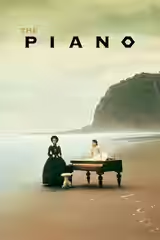
After The Homesman, try Meek's Cutoff (2010, Fi1m 82): Another difficult crossing, with women’s practical judgement tested by male certainty. Then The Piano (1993, Fi1m 88): For another stubborn woman negotiating desire and isolation in an unforgiving landscape.

Cast

If you liked this, try…

  1. Meek's Cutoff (2010, Fi1m 82)Another difficult crossing, with women’s practical judgement tested by male certainty.

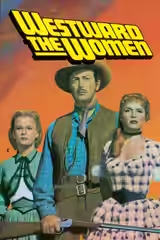
  2. Westward the Women (1951) · not on Fi1m yetA more conventional Western that still makes women’s labour worth watching.

  3. The Piano (1993, Fi1m 88)For another stubborn woman negotiating desire and isolation in an unforgiving landscape.

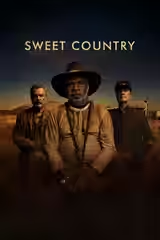
  4. Sweet Country (2017) · not on Fi1m yetFrontier authority comes under harsher scrutiny in a patient, troubling Australian Western.

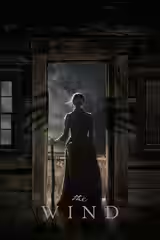
  5. The Wind (2018) · not on Fi1m yetPrairie isolation becomes horror, with a woman’s experience kept at the centre.

The Homesman (2014) review: A moving but often uneven Western (Switzerland) | Fi1m