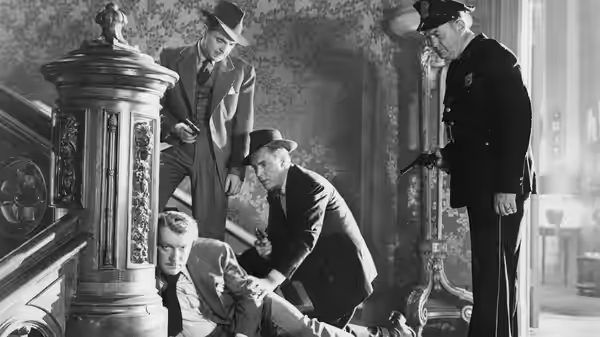
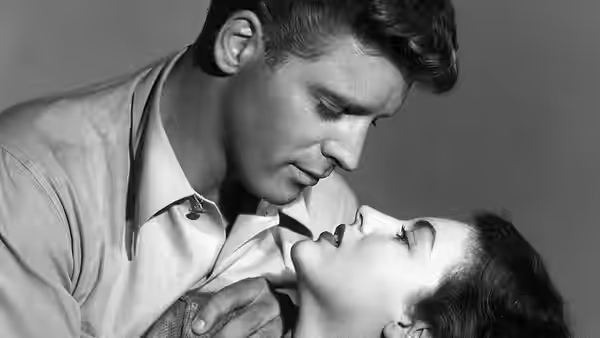
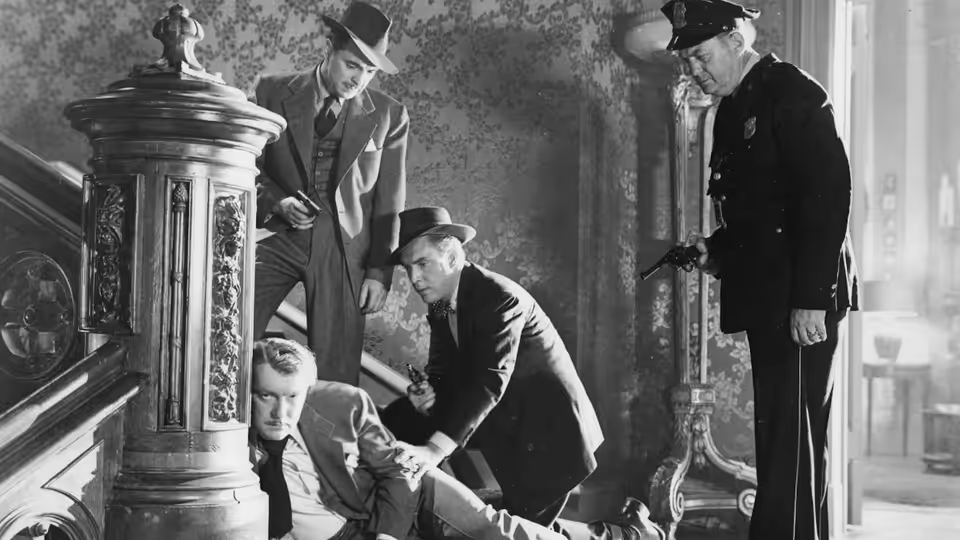
Several men search around an open safe as a uniformed police officer watches
Film review

The Killers

1946 · Directed by Robert Siodmak · 1h 43m

In a sentenceBurt Lancaster can make us nervous without appearing to have the energy for it

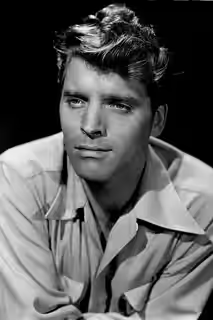
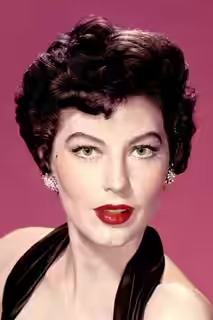
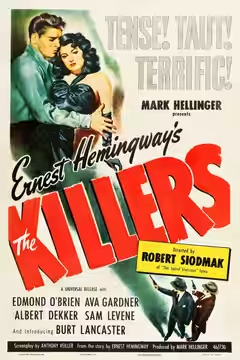
The Killers brings together Jim Reardon (Edmond O’Brien), ‘Swede’ Andersen (Burt Lancaster) and Kitty Collins (Ava Gardner) in a crime mystery told through flashbacks. Big Jim Colfax (Albert Dekker), Lt. Sam Lubinsky (Sam Levene) and Charleston (Vince Barnett) also figure in the story. Virginia Christine plays Lilly Harmon Lubinsky, while Jack Lambert plays ‘Dum-Dum’ Clarke. Robert Siodmak directs this 1946 thriller, which runs for 103 minutes. Anthony Veiller is credited with the screenplay, with Richard Brooks and John Huston also credited as writers.

Plays from YouTube when you press play; nothing loads from them until then.

Fi1m review

Robert Siodmak’s noir thriller is tense, bleak and well worth the evening. Burt Lancaster and Ava Gardner hold our attention even when the flashbacks make the story more laborious than it needs to be.

Robert Siodmak’s The Killers is a gripping noir thriller that occasionally gets bogged down in telling us how everything happened. Its bleakness is persuasive, and the performances give us ample reason to stay with a story that takes the long way round. The reservation matters: the flashbacks can make a tense film feel laborious. Even so, the direction has enough authority to make an evening spent in this company worthwhile.

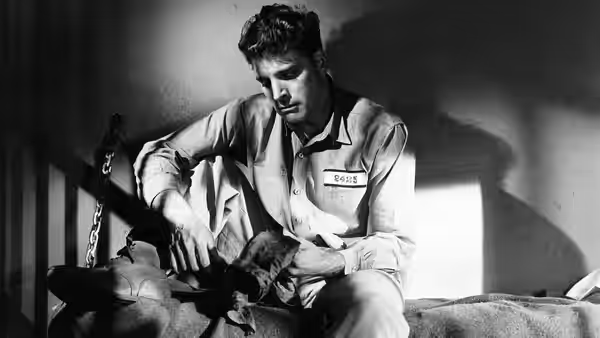
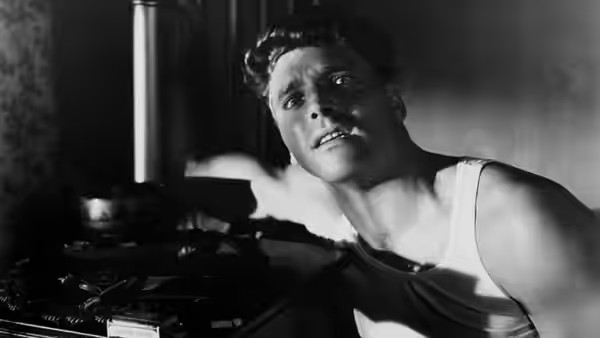
We were unnerved by Burt Lancaster’s first appearance; he seems to have reached a depth of unhappiness from which ordinary reassurance would be useless. As ‘Swede’ Andersen, he gives the film’s fatalism a human weight. He holds our attention so completely that we are prepared to wait for the explanations, though the film occasionally overestimates that patience. His performance remains compelling through the complications, and makes some of them seem unnecessary.

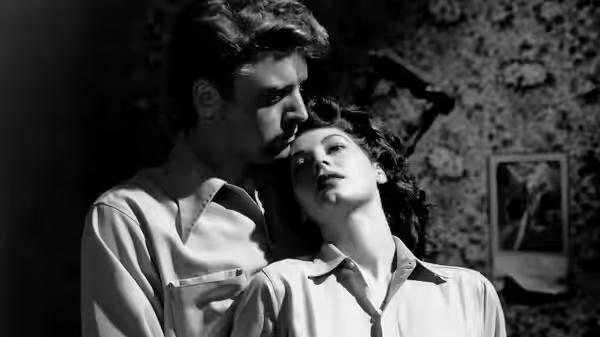
Ava Gardner’s Kitty Collins has a comparable hold on the screen. Her presence makes the film feel more dangerous, which is useful when so much of its storytelling is occupied with explanation. The screenplay does not always give her language as arresting as the performance, and we sometimes find ourselves watching her more closely than we are following the words. She makes those passages worth our attention without disguising their shortcomings.

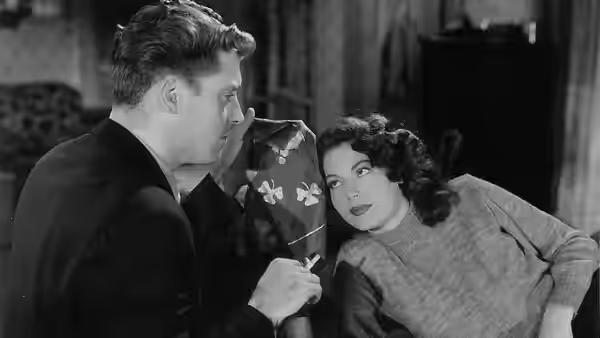
Elwood Bredell’s black-and-white photography sustains much of the tension. The darkness feels oppressive, and the expressive lighting gives the despair a force that the dialogue cannot always supply. Robert Siodmak’s Expressionist direction is certainly conspicuous, but it suits a thriller that wants unease to persist even when nothing much is moving. The images are handsome without making this seem an agreeable place to spend time, and that discomfort is useful.

The heist, staged in one long master shot, demonstrates how confidently the film can handle action. Holding the shot gives the sequence time to develop, and the sustained attention is more exciting than a rush of fragments would have been. Arthur Hilton’s editing has a harder task elsewhere, managing the repeated moves into the past without letting the present lose its urgency. The structure sometimes defeats that effort: the accumulation of explanations slows a film whose individual scenes can be so taut.

Miklós Rózsa’s score helps keep the unease present during those slower passages. It supplies a dramatic pressure that the screenplay, credited to Anthony Veiller, does not consistently achieve through words. The flashbacks are the substantial caveat, rather than evidence that the whole enterprise has gone wrong; there is still plenty here to hold us. We would happily lose some explanation before losing any of the time spent watching either lead.

For a noir thriller, its willingness to linger with despair is a strength, though anyone chiefly seeking brisk investigation may find the pace frustrating. At 103 minutes, the delays register without exhausting our patience. Give it an uninterrupted evening: the faces and the photography deserve better than being glanced at between other things.
Critical consensus AI synthesised

83
Positive
8
Mixed
1
Negative
0

Most critics regard The Killers as a gripping noir thriller, with eight of the nine reviews positive and none wholly negative. Praise centres on Robert Siodmak’s direction and the expressive black-and-white photography, which the reviews credit with sustaining the film’s tense, fatalistic atmosphere. Burt Lancaster’s screen presence draws particular admiration, while Ava Gardner’s performance and Miklós Rózsa’s score also receive praise.

Reservations concern the writing and pace rather than the visual craft, though they produce one marked dissent from an otherwise favourable consensus. Slant Magazine admires the direction, especially a heist staged in one long shot, but finds that the flashbacks clutter Hemingway’s streamlined story. The AV Club is less persuaded, finding the film sluggish despite its expressive photography and preferring the livelier remake. Collider takes the opposite view of the two versions, judging the 1946 film stronger and finding its style deeply satisfying.

Radio Times
★★★★★ · Tony Sloman
100

Sloman calls it a powerful, influential thriller that helped define film noir. He particularly praises Burt Lancaster’s stunning debut and Ava Gardner’s career-defining performance.

Read the full review →
Time Out
12 February 2008 · ★★★★★ · Wally Hammond
100

The critic presents the film as a quintessential noir thriller. The page singles out its taut, tense, terrific qualities.

Read the full review →
Slant Magazine
8 July 2015 · ★★★★½ · Chuck Bowen
90

Bowen finds Siodmak’s film ambitious and vividly directed, but says its flashback-heavy plotting clutters Hemingway’s streamlined story. He particularly praises the breathtaking heist staged in one long master shot.

Read the full review →
The Guardian
17 February 2008 · Philip French
90*

Philip French calls the film a classic and praises Siodmak as a supreme exponent of film noir. He singles out the atmospheric photography and Miklós Rózsa’s score as particular delights.

Read the full review →
Los Angeles Times
20 April 1997 · Kevin Thomas
85*

Thomas says the film has worn very well and remains bleak, terse, and engrossingly fatalistic. He singles out Burt Lancaster, who commands the screen from his first scene.

Read the full review →
Empire
1 February 2008 · David Parkinson
80*

Parkinson gives the film a clearly positive verdict, praising its atmosphere and gripping action. He singles out Robert Siodmak’s Expressionist direction and the foreboding monochrome photography.

Read the full review →

Straight answers AI written, from our review

Is The Killers worth watching?
The Killers is well worth watching for its bleak tension and compelling leads; we score it 84 out of 100. Burt Lancaster and Ava Gardner hold our attention even when the flashbacks become laborious, though we recommend it more readily to noir enthusiasts than to anyone seeking a brisk investigation.
How long is The Killers, and what is it rated?
The Killers runs 1h 43m. It is a crime and mystery film.
Where can I watch The Killers in Vietnam?
The Killers is not on any streaming or rental service in Vietnam at the moment. It is available in 6 other countries; change your country at the top of the page to see where. Availability is checked daily.
How violent or frightening is The Killers, and is it suitable for children?
The Killers is unnerving and bleak, but with no UK or US certificate supplied, we cannot give a firm age recommendation for children. Lancaster’s despair and the oppressive darkness make it uncomfortable viewing; we can speak to that sustained unease, but cannot reliably assess the extent of graphic violence.
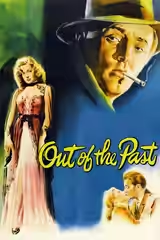
How does The Killers compare to Out of the Past?
The Killers and Out of the Past are similarly rewarding noir thrillers, with compelling performances and plotting that demands patience. We recommend The Killers for Lancaster’s despair and its oppressive lighting, despite laborious flashbacks; Out of the Past is the stronger choice if the appeal is a doomed romance that makes bad judgement painfully understandable.
Is The Killers based on a true story or a book?
The Killers is based on fiction by Ernest Hemingway rather than a true story. We would approach it as a self-contained crime mystery without treating familiarity with Hemingway as preparation: the performances and photography are our reasons to recommend it, rather than any claim about its faithfulness to the source.
What should I watch after The Killers?
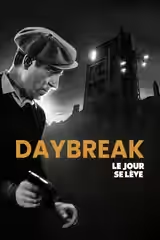
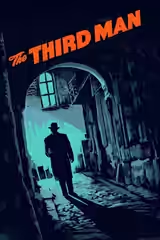
After The Killers, try Out of the Past (1947, Fi1m 89): Another doomed noir romance, with desire making sensible decisions increasingly difficult. Then Le Jour se lève (1939, Fi1m 82): A cornered man and a past reconstructed through steadily deepening despair; and The Third Man (1949, Fi1m 92): For black-and-white menace, compromised loyalties and a mystery worth following into shadows.

Cast

Awards

Academy Awards, 1947

Nominated
Best Director
Nominated
Best Film Editing
Nominated
Best Original Dramatic or Comedy Score
Nominated
Best Writing, Adapted Screenplay

If you liked this, try…

  1. Out of the Past (1947, Fi1m 89)Another doomed noir romance, with desire making sensible decisions increasingly difficult.

  2. Le Jour se lève (1939, Fi1m 82)A cornered man and a past reconstructed through steadily deepening despair.

  3. The Third Man (1949, Fi1m 92)For black-and-white menace, compromised loyalties and a mystery worth following into shadows.

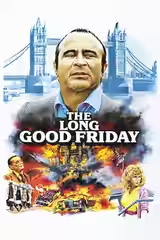
  4. The Long Good Friday (1980, Fi1m 88)A criminal’s confidence crumbles while the city becomes harder for him to read.

  5. Burning (2018, Fi1m 72)A slower mystery that makes watching people an increasingly uncomfortable occupation.