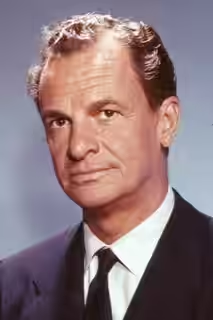
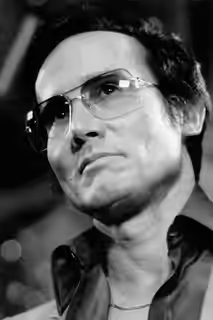
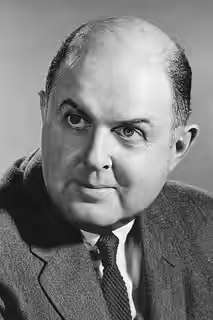
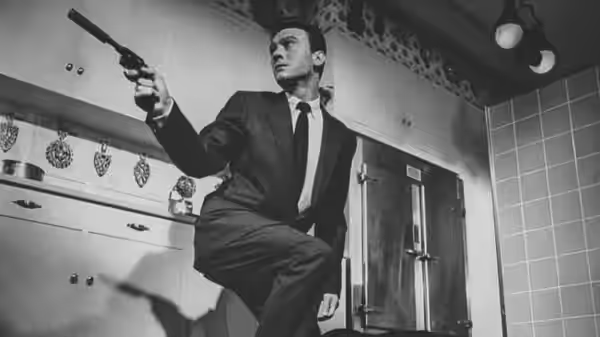
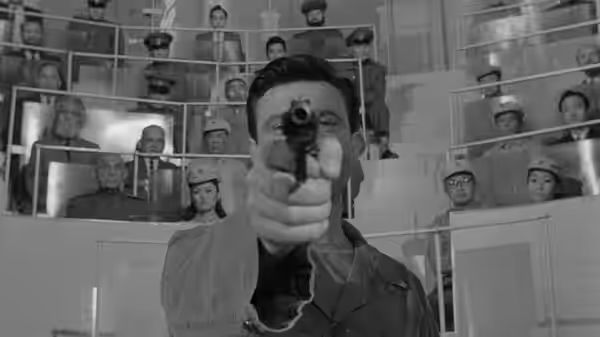
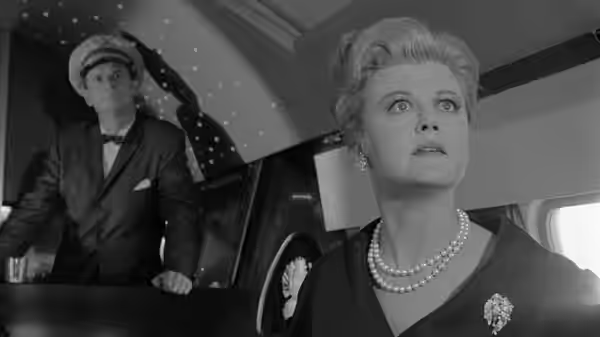
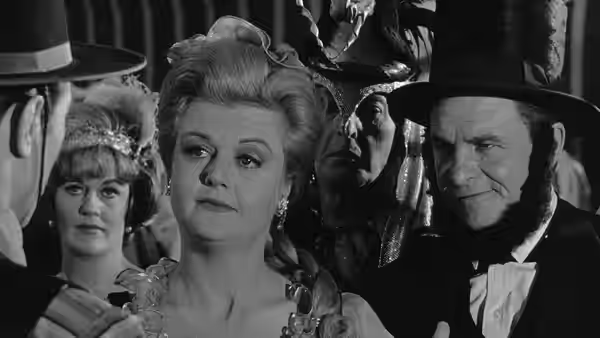
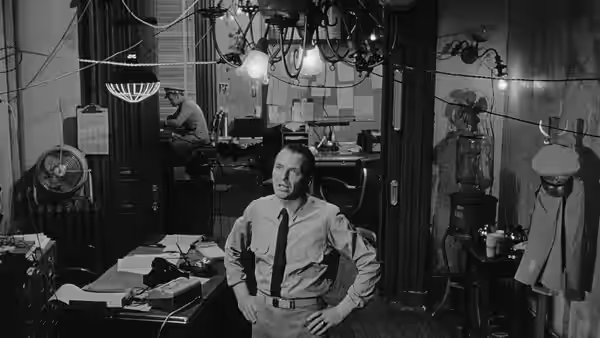
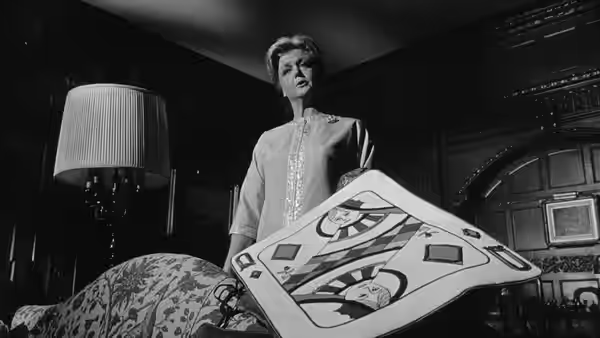
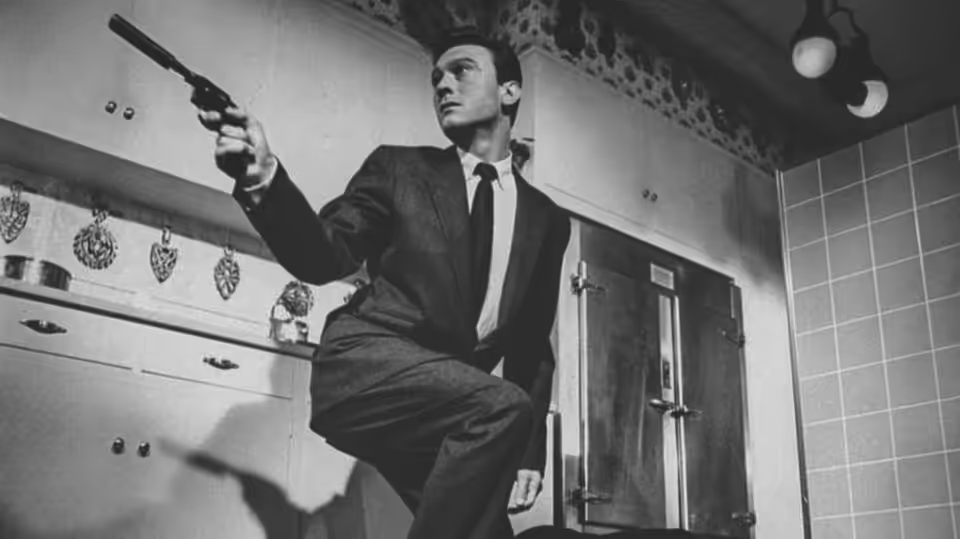
Bennett Marco (Frank Sinatra) raises a pistol inside a decorated room
Film review

The Manchurian Candidate

1962 · Directed by John Frankenheimer · 2h 06m

In a sentenceFifty-seven communists in Washington, one garden club in New Jersey, and a decorated hero who cannot remember either

Korea, 1952. A US Army patrol led by Captain Bennett Marco (Frank Sinatra) is betrayed to the enemy by its Korean interpreter, Chunjin (Henry Silva), and marched north. Raymond Shaw (Laurence Harvey) comes home with the Medal of Honor, and every man in the unit will tell you he is the kindest, bravest, warmest human being they have ever known, in those exact words. Raymond’s mother (Angela Lansbury) and stepfather, the red-baiting Senator John Iselin (James Gregory), meet him at the airport with a photographer. Marco, now a Major, cannot sleep for the same nightmare: a ladies’ garden club in a New Jersey hotel where the speaker is a Chinese doctor, Yen Lo (Khigh Dhiegh), and Raymond does whatever he is told. Corporal Allen Melvin (James Edwards) is having the dream too.

Plays from YouTube when you press play; nothing loads from them until then.

Fi1m review

Frankenheimer’s brainwashing thriller is a spy film, a political satire and a horror story about one family, run together at speed. The middle sags and one subplot goes nowhere, but Angela Lansbury alone is worth the evening, and the dream sequence is worth two.

Korea, 1952, and a patrol is sold to the enemy by its own interpreter. That is where John Frankenheimer’s film of Richard Condon’s novel begins, and within ten minutes it has jumped to a homecoming and a nightmare. George Axelrod’s screenplay is a spy thriller, a satire on the red-baiting politics of the 1950s and a horror film about one family, and it runs all three at once without visible strain. It is one of the best American thrillers of its decade, and we recommend it with one reservation about the middle stretch.

The nightmare is the film’s great sequence. Major Marco (Frank Sinatra) dreams of a ladies’ garden club in a New Jersey hotel, and as Lionel Lindon’s camera pans slowly round, the speaker becomes Dr Yen Lo (Khigh Dhiegh), demonstrating his handiwork to a hall of Soviet and Chinese officers, and the ladies keep smiling. Ferris Webster cuts between the two audiences so that a woman in pearls asks a question and a general answers it, and Raymond Shaw (Laurence Harvey) sits through it as politely as a boy at a recital. Then he is told to kill one of his own men, and does, with no change in his face. We were horrified, and what horrified us was not the killing but the manners: everyone present, victim included, behaves as though nothing rude is happening. Lindon shoots it in deep-focus black and white, and the flat, even light of the ballroom makes it worse.

Angela Lansbury plays Raymond’s mother, credited only as Mrs Iselin. She runs her husband, Senator John Iselin (James Gregory), a booming fool who cannot remember how many communists he has claimed are working in the Defence Department until she settles the number for him off a ketchup bottle. Fifty-seven. Gregory plays Iselin as a man delighted to be told what to think, and Lansbury plays a woman who has never been told anything. She is on screen for perhaps twenty minutes and we could not look anywhere else while she was. Harvey plays a man nobody likes and has the nerve to play him as unlikeable, stiff and cold and faintly disgusted by his own medal. It is the right choice and it costs the film some warmth.

Sinatra gives Marco a sweating, wrecked exhaustion, a man who has read every book trying to fall asleep. His fight with Chunjin (Henry Silva) in a New York flat is short and ugly, and the film’s only conventional action scene. David Amram’s score stays out of the way, a few nervous brass phrases and long silences. Richard Sylbert’s production design puts Abraham Lincoln everywhere in the Iselin house, portraits and busts and a lamp, so that the family’s patriotism is part of the decor. Frankenheimer films Iselin’s press conference off a bank of monitors in the same shot as the man himself, so we watch the lie and its broadcast at once.

Not all of it holds. Janet Leigh’s Eugenie Rose Chaney meets Marco on a train and conducts a conversation about Maryland and railway lines and her address, and the film never explains why she is there or what she wants. It is a loose end, not a mystery. The middle third, in which Raymond takes up with Jocelyn Jordan (Leslie Parrish), daughter of Iselin’s enemy Senator Thomas Jordan (John McGiver), is the slackest stretch, told partly in flashback with a narration the rest of the film does without. And the mechanics of the plot do not survive inspection. The film knows it and keeps moving.

Most critics put it around 90 and we are just behind them. Set against the conspiracy thrillers that came after it in the 1970s, and against the remake of 2004, this one looks stranger, because it does not think the machinery is the frightening part. The frightening part is that the people running it would be welcome at the garden club.

The last act takes a turn we will not describe. Do not read about it first, and do not watch it in pieces; it is 126 minutes built to be sat through. See this before the remake, which explains everything where this one has the sense not to.
Critical consensus AI synthesised

91
Positive
9
Mixed
0
Negative
0

The reviews are unanimous in their approval, and most critics make the same case: that the film’s Cold War paranoia has lost none of its force in the decades since it was made. Praise clusters on two things. Angela Lansbury’s performance as Raymond Shaw’s mother is singled out again and again, described as chilling, commanding and hard-edged. Frankenheimer’s direction draws the rest of the attention, particularly the fragmented press conference, the surreal Manchuria sequence and the distorted compositions that feed the film’s sense of dread. Frank Sinatra’s performance also earns notice from the earliest reviews.

Reservations are scarce and the spread is narrow, from a firm recommendation to a full score. The AV Club is the only voice to suggest a flaw, arguing that the film’s set pieces do not always add up to a satisfying whole. The Guardian frames its praise as a case for the original over the later remake. Nobody dissents from the general verdict.

Radio Times
★★★★★ · Anna Richards
100

Richards calls the film a masterpiece that remains thrilling and provocative. She singles out its chilling Cold War paranoia and assassination plot.

Read the full review →
Time Out
12 April 2010 · ★★★★★ · Tom Huddleston
100

The review presents the film as still politically relevant. It singles out the enduring force of its political intrigue and assassination story.

Read the full review →
RogerEbert.com
90*

The critic regards the film as an outstanding political thriller. Angela Lansbury’s chilling performance is a particular strength.

Read the full review →
Slant Magazine
12 June 2023 · ★★★★½ · Jake Cole
90

Cole praises the disc as a sharpened upgrade to an already excellent presentation of a great conspiracy thriller. He singles out the film’s distorted compositions and unsettling performances for their contribution to its paranoid atmosphere.

Read the full review →
The AV Club
12 March 2016 · A- · Mike D'Angelo
90

The critic calls the film a thrilling, enduring classic, though its parts do not always cohere into a satisfying whole. Frankenheimer’s inventive set pieces, especially the fragmented press conference and surreal Manchuria sequence, earn particular praise.

Read the full review →
Variety
17 October 1962 · Vincent Canby
90*

Canby finds the film nearly completely satisfying, praising its blend of suspense, satire, humor, and shock. He especially singles out Angela Lansbury’s performance as Raymond Shaw’s scheming mother as poignant and hard-edged.

Read the full review →

Straight answers AI written, from our review

Is The Manchurian Candidate worth watching?
The Manchurian Candidate is worth watching for anyone who likes a thriller with a mind of its own, and we scored it 88. Angela Lansbury alone justifies the evening and the garden-club dream sequence justifies two. The middle third slackens and one subplot goes nowhere, so it suits patient viewers rather than anyone wanting a straight spy chase.
How long is The Manchurian Candidate, and what is it rated?
The Manchurian Candidate runs 2h 06m. It is a thriller and drama film.
Where can I watch The Manchurian Candidate in Estonia?
The Manchurian Candidate is not on any streaming or rental service in Estonia at the moment. It is available in 24 other countries; change your country at the top of the page to see where. Availability is checked daily.
How does The Manchurian Candidate compare to Z?
The Manchurian Candidate and Z are both thrillers about a political killing, but Frankenheimer's film is a fiction about brainwashing while Costa-Gavras builds his from a real Greek assassination. Z moves faster and argues harder, though its villains are drawn a shade too broad. Choose Z for pace and outrage; choose this one for satire, strangeness and Lansbury.
Is The Manchurian Candidate based on a true story or a book?
The Manchurian Candidate is based on Richard Condon's novel, adapted for the screen by George Axelrod, and it is not a true story. Its target was real enough, the red-baiting politics of 1950s America, but the brainwashed hero and his family are invention. The film needs no knowledge of the book; it explains what it needs to and has the sense to leave the rest.
What should I watch after The Manchurian Candidate?
After The Manchurian Candidate, try Seconds (1966, Fi1m 84): Frankenheimer again, with a man who buys a new life and cannot return it. Then Z (1969, Fi1m 84): A political killing and its cover-up, cut at a pace Frankenheimer would admire; and The Lives of Others (2006, Fi1m 84): Surveillance from the listener’s side; the paranoia is the same, the state is real.

Cast

Awards

Academy Awards, 1963

Nominated
Best Film Editing
Nominated
Best Supporting Actress

If you liked this, try…

  1. Seconds (1966, Fi1m 84)Frankenheimer again, with a man who buys a new life and cannot return it.

  2. The Parallax View (1974) · not on Fi1m yetThe conspiracy thriller as the 1970s made it: colder, quieter, no garden clubs.

  3. Z (1969, Fi1m 84)A political killing and its cover-up, cut at a pace Frankenheimer would admire.

  4. The Ipcress File (1965) · not on Fi1m yetBritish brainwashing, done on a budget, with Michael Caine in glasses.

  5. The Lives of Others (2006, Fi1m 84)Surveillance from the listener’s side; the paranoia is the same, the state is real.

The Manchurian Candidate (1962) review: the brainwashing thriller stil (Estonia) | Fi1m