Luis Puenzo’s drama about a Buenos Aires teacher who begins to wonder where her adopted daughter came from is patient, plainly told and carried by Norma Aleandro. The men around her are drawn with a heavy hand, but the film still cuts.
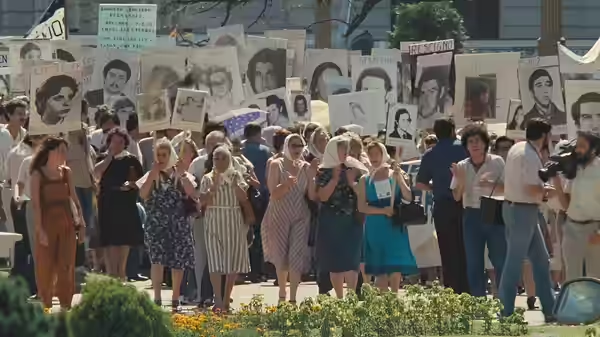
Argentina’s generals ran the country from 1976 to 1983, and the people they took away were not called dead. They were called disappeared. Luis Puenzo’s film, written with Aída Bortnik, is set in Buenos Aires in the regime’s last months, and it is about none of them. It is about a woman who did well out of it without being told, and has arranged her life so as not to find out. It is a good film and in places a fine one, and almost all of what is fine in it is Norma Aleandro.
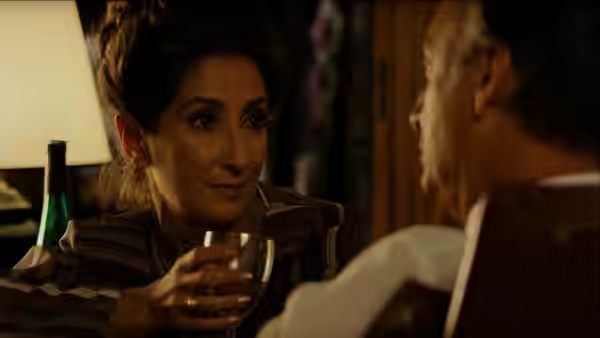
Alicia Marnet teaches history at a secondary school as the textbook has it. A student who says history is written by murderers is sent out of class. At home she has a husband, Roberto (Héctor Alterio), whose business is going well for reasons he keeps to himself, and a daughter, Gaby (Analía Castro), adopted as a baby through channels Alicia never asked about. Then her friend Ana (Chunchuna Villafañe) comes back from abroad. Over a long night of wine Ana tells her, laughing in the wrong places, about the cell she was kept in and the women who gave birth there and never saw their babies again.
Puenzo shoots most of that scene on Aleandro listening, and that is where the film got us. Villafañe’s account is terrible, but it is the other face that hurts: Alicia has plainly thought of Gaby within seconds and spends the rest of the scene refusing to. Aleandro plays the whole film on that gap between what Alicia knows and what she will let herself say, with almost no dialogue. Her eyes move; her hands tidy things. When she finally says it out loud, she sounds surprised at herself.
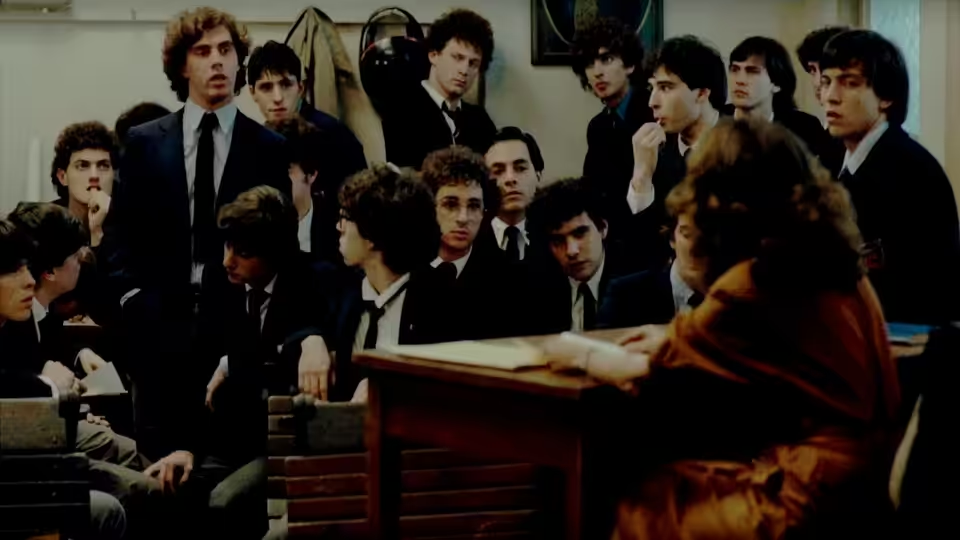
Félix “Chango” Monti lights the Ibáñez flat warmly, all lamps and dark wood, and Abel Facello has filled it with the things a comfortable family owns: good glasses, a piano, a child’s bedroom in white. The school is the opposite, corridors in flat greenish daylight with the anthem coming through the walls. Juan Carlos Macías cuts slowly, letting conversations run to their end, and the film’s 112 minutes feel patient rather than long. Atilio Stampone’s score, piano and strings, leans on us more than it should. The best music in the film is a nursery song Gaby sings about a country where nobody remembers anything.
Chela Ruiz plays Sara, an elderly woman searching for a grandchild born in one of the regime’s prisons, and plays her without any appeal for sympathy. Sara lays photographs on a table and asks Alicia to look. Ruiz plays her as someone presenting evidence, not a mourner, and it is the more frightening for it. Patricio Contreras, as Benítez, a literature teacher who drinks and jokes and has been afraid for longer than Alicia has, is the one voice that says plainly what everyone else steps around.
The film falters with the men in Alicia’s family. Alterio gives Roberto real charm early on, but the script narrows him until he is only what the story requires. A dinner at which his father José (Guillermo Battaglia) accuses him of getting rich off the generals, with his brother Enrique (Hugo Arana) trying to keep the peace, is written as a speech and delivered as one. Puenzo also underlines: the anthem at the start, the lessons on the constitution, the student who says the thing the film believes. It is a film about learning to ask questions that cannot always resist answering them for us.
Most critics have responded to Aleandro and the subject, and so did we. The choice of protagonist is what makes it last. Films about state terror usually follow the victim. This one follows a woman in a nice flat who benefited, and waits for her to notice. The final stretch is quiet, and we will not describe it, except to say that the song comes back and that we watched a five-year-old sing a nursery rhyme with our hands in fists.
Watch it in Spanish with the subtitles on. Most of what Aleandro does happens in her face, and no subtitle will get in the way.