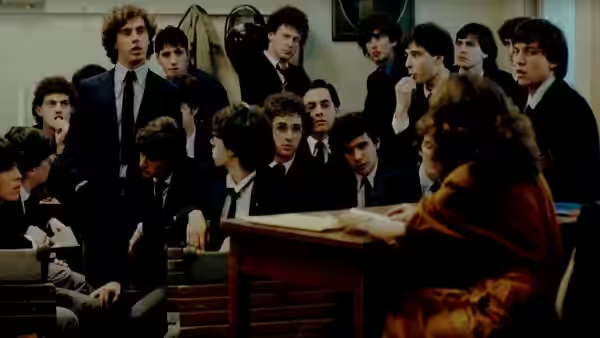
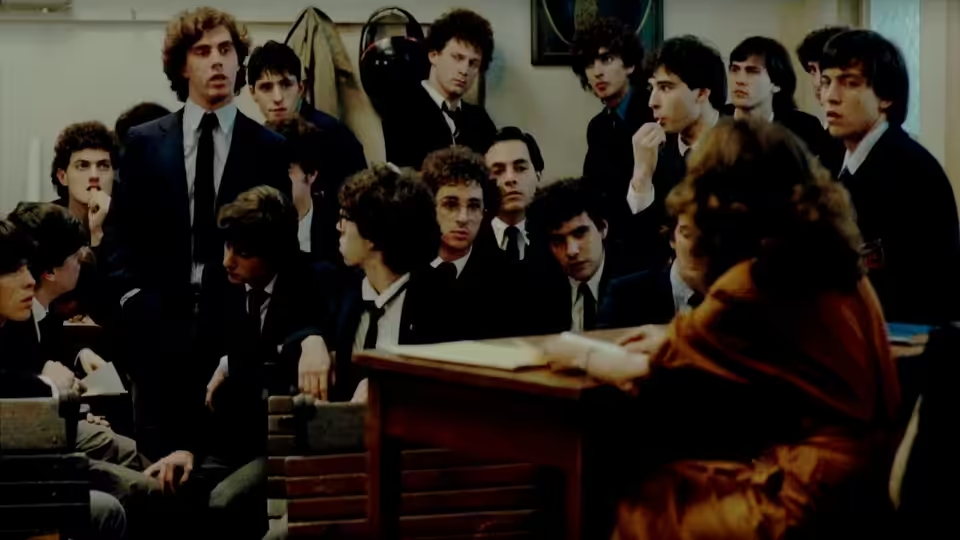
A woman addresses a crowded classroom of male students from behind a lectern
Film review

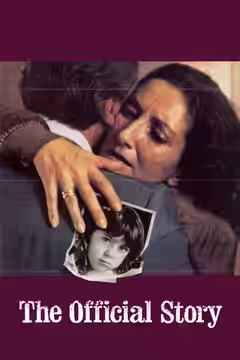
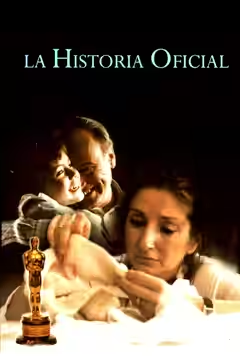
The Official Story

1985 · Directed by Luis Puenzo · 1h 52m · CNC U

In a sentenceA history teacher who trusts the record, and a five-year-old daughter who is not in it

Buenos Aires, 1983. Alicia Marnet (Norma Aleandro) teaches history at a secondary school and believes what is in the textbooks. Her husband Roberto (Héctor Alterio) does well in business and does not say with whom. Their adopted daughter Gaby (Analía Castro) is about to turn five, and Alicia has never asked where she came from. Then her friend Ana (Chunchuna Villafañe) comes back from years abroad and, late one night over a bottle, tells her why she left: a cell, weeks of questioning, and pregnant women whose babies were taken and given to families the regime approved of. Alicia starts to look at her daughter’s papers. At school, a colleague, Benítez (Patricio Contreras), watches her begin to doubt, and at home Roberto would rather she stopped.

Plays from YouTube when you press play; nothing loads from them until then.

Fi1m review

Luis Puenzo’s drama about a Buenos Aires teacher who begins to wonder where her adopted daughter came from is patient, plainly told and carried by Norma Aleandro. The men around her are drawn with a heavy hand, but the film still cuts.

Argentina’s generals ran the country from 1976 to 1983, and the people they took away were not called dead. They were called disappeared. Luis Puenzo’s film, written with Aída Bortnik, is set in Buenos Aires in the regime’s last months, and it is about none of them. It is about a woman who did well out of it without being told, and has arranged her life so as not to find out. It is a good film and in places a fine one, and almost all of what is fine in it is Norma Aleandro.

Alicia Marnet teaches history at a secondary school as the textbook has it. A student who says history is written by murderers is sent out of class. At home she has a husband, Roberto (Héctor Alterio), whose business is going well for reasons he keeps to himself, and a daughter, Gaby (Analía Castro), adopted as a baby through channels Alicia never asked about. Then her friend Ana (Chunchuna Villafañe) comes back from abroad. Over a long night of wine Ana tells her, laughing in the wrong places, about the cell she was kept in and the women who gave birth there and never saw their babies again.

Puenzo shoots most of that scene on Aleandro listening, and that is where the film got us. Villafañe’s account is terrible, but it is the other face that hurts: Alicia has plainly thought of Gaby within seconds and spends the rest of the scene refusing to. Aleandro plays the whole film on that gap between what Alicia knows and what she will let herself say, with almost no dialogue. Her eyes move; her hands tidy things. When she finally says it out loud, she sounds surprised at herself.

Félix “Chango” Monti lights the Ibáñez flat warmly, all lamps and dark wood, and Abel Facello has filled it with the things a comfortable family owns: good glasses, a piano, a child’s bedroom in white. The school is the opposite, corridors in flat greenish daylight with the anthem coming through the walls. Juan Carlos Macías cuts slowly, letting conversations run to their end, and the film’s 112 minutes feel patient rather than long. Atilio Stampone’s score, piano and strings, leans on us more than it should. The best music in the film is a nursery song Gaby sings about a country where nobody remembers anything.

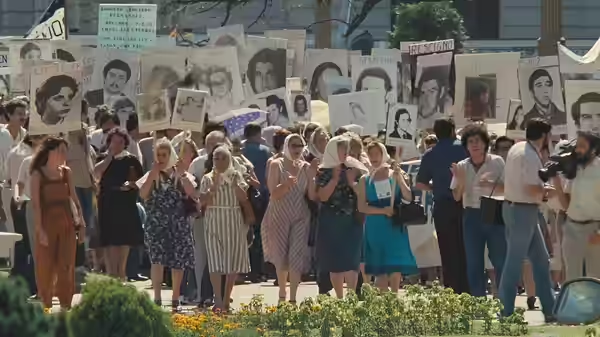
Chela Ruiz plays Sara, an elderly woman searching for a grandchild born in one of the regime’s prisons, and plays her without any appeal for sympathy. Sara lays photographs on a table and asks Alicia to look. Ruiz plays her as someone presenting evidence, not a mourner, and it is the more frightening for it. Patricio Contreras, as Benítez, a literature teacher who drinks and jokes and has been afraid for longer than Alicia has, is the one voice that says plainly what everyone else steps around.

The film falters with the men in Alicia’s family. Alterio gives Roberto real charm early on, but the script narrows him until he is only what the story requires. A dinner at which his father José (Guillermo Battaglia) accuses him of getting rich off the generals, with his brother Enrique (Hugo Arana) trying to keep the peace, is written as a speech and delivered as one. Puenzo also underlines: the anthem at the start, the lessons on the constitution, the student who says the thing the film believes. It is a film about learning to ask questions that cannot always resist answering them for us.

Most critics have responded to Aleandro and the subject, and so did we. The choice of protagonist is what makes it last. Films about state terror usually follow the victim. This one follows a woman in a nice flat who benefited, and waits for her to notice. The final stretch is quiet, and we will not describe it, except to say that the song comes back and that we watched a five-year-old sing a nursery rhyme with our hands in fists.

Watch it in Spanish with the subtitles on. Most of what Aleandro does happens in her face, and no subtitle will get in the way.

Critical consensus AI synthesised

77
Positive
3
Mixed
1
Negative
0
Los Angeles Times
20 December 1985 · SHEILA BENSON
90*

Benson finds the film haunting, persuasive, and richly insightful. She especially praises Norma Aleandro’s deeply affecting performance and the film’s subtle intertwining of personal and political themes.

Read the full review →
Variety
31 December 1984 · Variety Staff
80*

Variety praises the film as a thoughtful, resolute examination of Argentina’s dirty war. It singles out the lead performances for bringing warmth and pathos to its political subject.

Read the full review →
The New York Times
8 November 1985 · Janet Maslin
64*

The blocked page does not reveal the critic’s verdict. It also does not provide enough text to identify what the critic praised or criticized.

Read the full review →
Eye for Film
19 April 2005 · Gary Duncan
75*

Duncan finds the story heartbreaking and praises Norma Aleandro’s restrained portrayal of Alicia. He singles out the emotion conveyed through her silence and expressive eyes.

Read the full review →

Straight answers AI written, from our review

Is The Official Story worth watching?
The Official Story is worth watching for anyone with patience for a slow, plainly told drama about Argentina's disappeared, and we scored it 81. Norma Aleandro carries it almost entirely in her face, as a comfortable Buenos Aires teacher who begins to wonder where her adopted daughter came from. The men around her are written with a heavy hand, and the score leans too hard, but the film still cuts.
How long is The Official Story, and what is it rated?
The Official Story runs 1h 52m and is rated U by the CNC in France. It is a drama and history film.
Where can I watch The Official Story in France?
The Official Story is not on any streaming or rental service in France at the moment. It is available in 1 other country; change your country at the top of the page to see where. Availability is checked daily.
How does The Official Story compare to Missing?
The Official Story and Missing both look at state terror in Latin America through someone who has kept out of it, but they come at it from opposite sides. Costa-Gavras follows an American father searching for his son, angry and boiling under Jack Lemmon's politeness; Puenzo follows a woman who quietly benefited from the regime and waits for her to notice. Missing is the more forceful, The Official Story the more patient and, we think, the finer of the two.
What should I watch after The Official Story?
After The Official Story, try Missing (1982, Fi1m 80): An American father learns what a coup does to people; Lemmon has never been quieter. Then The Lives of Others (2006, Fi1m 84): East Berlin, a Stasi man listening; another film about complicity in a comfortable flat; and Z (1969, Fi1m 84): Costa-Gavras on a state cover-up, fast and angry where Puenzo is slow and sad.

Cast

Awards

Academy Awards, 1986

Nominated
Best Writing, Original Screenplay
Won
Best International Feature Film

International Submission to the Academy Awards, 1986

Nominated
International Submission to the Academy Awards

lists of Argentine films, 1985

Nominated
lists of Argentine films

People's Choice Awards, 1985

Nominated
People's Choice Awards

If you liked this, try…

  1. Missing (1982, Fi1m 80)An American father learns what a coup does to people; Lemmon has never been quieter.

  2. Cautiva (2003) · not on Fi1m yetThe same wound from the child’s side: a Buenos Aires teenager told who her parents were.

  3. The Lives of Others (2006, Fi1m 84)East Berlin, a Stasi man listening; another film about complicity in a comfortable flat.

  4. Z (1969, Fi1m 84)Costa-Gavras on a state cover-up, fast and angry where Puenzo is slow and sad.

  5. Argentina, 1985 (2022) · not on Fi1m yetWhat happened next: the prosecutors who put the generals in the dock.