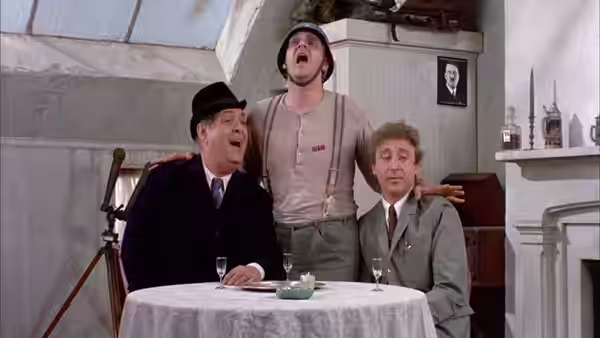
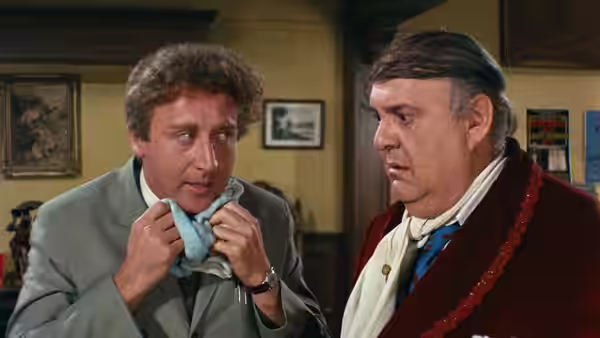
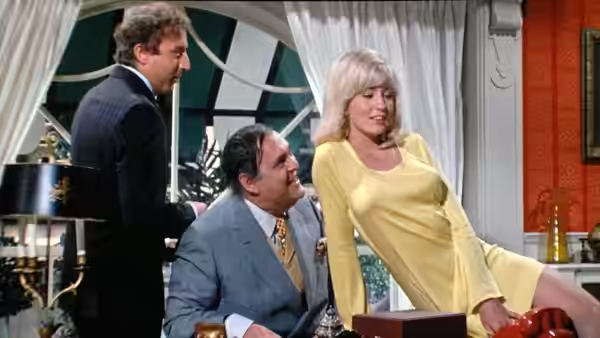
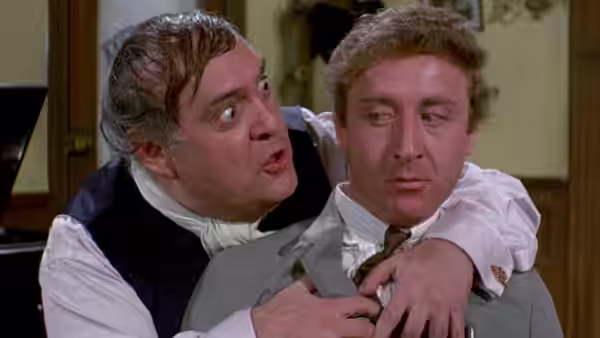
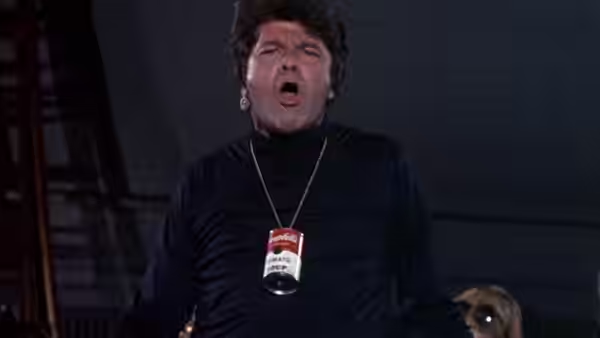
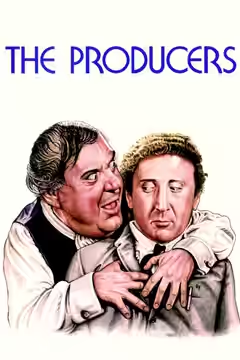
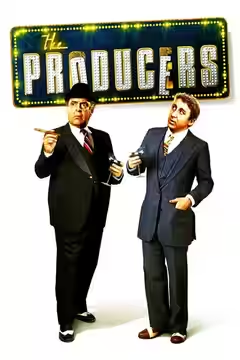
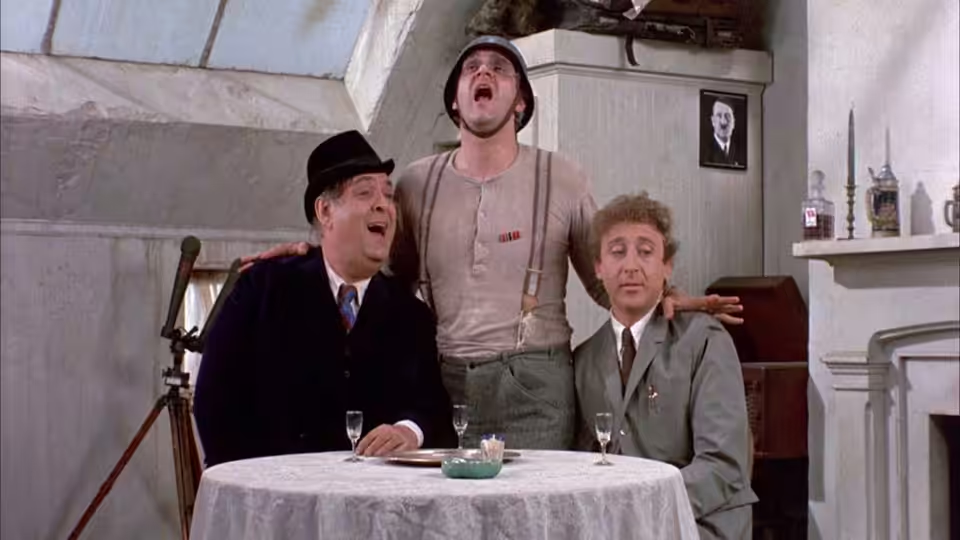
Max Bialystock sits at a table as a man sings behind him and another watches
Film review

The Producers

1968 · Directed by Mel Brooks · 1h 29m

In a sentenceGene Wilder looks as though sharing a film with Zero Mostel ought to qualify for danger money

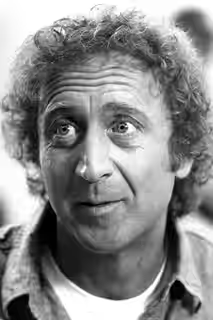
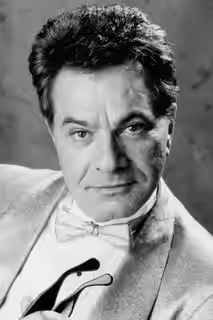
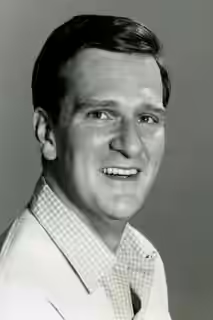
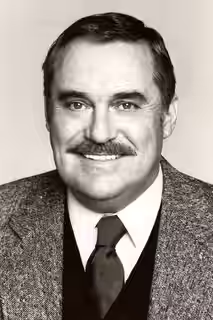
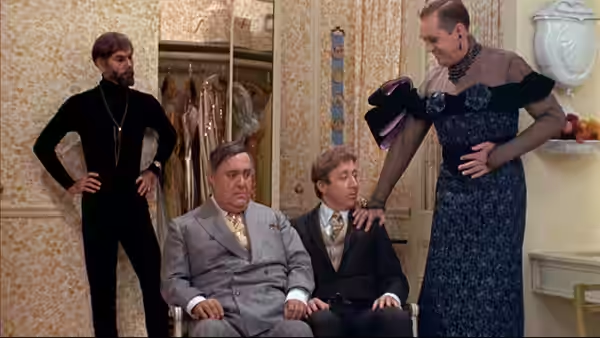
Max Bialystock (Zero Mostel) and Leo Bloom (Gene Wilder) are the central pair in Mel Brooks’s comedy. The surrounding characters include Franz Liebkind (Kenneth Mars), Roger De Bris (Christopher Hewett), Carmen Ghia (Andreas Voutsinas) and Ulla (Lee Meredith). Dick Shawn plays Lorenzo St. DuBois (L.S.D.), while Renée Taylor appears as Eva Braun and Estelle Winwood as “Hold Me Touch Me”. Michael Davis plays Production Tenor, John Zoller plays Drama Critic and Madlyn Cates plays Concierge. Mel Brooks writes and directs this 89-minute film.

Plays from YouTube when you press play; nothing loads from them until then.

Fi1m review

Zero Mostel and Gene Wilder make Mel Brooks’s satire worth the occasional heavy-handed stretch. The musical excess is a pleasure, but the friction between the leads earns our warm recommendation.

We recommend The Producers for Zero Mostel and Gene Wilder, whose pairing makes its rough edges easy to forgive. Mel Brooks’s comedy is broad, noisy and occasionally ungainly, but its satire has enough bite to keep the slapstick from feeling merely busy. The unevenness matters most whenever the film draws attention away from those two performers. At 89 minutes, it also has the good sense not to demand an entire evening in return for its laughs.

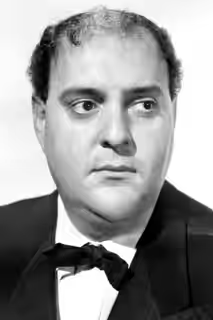
As Max Bialystock, Zero Mostel plays with an expansiveness that could be exhausting on its own; Gene Wilder gives Leo Bloom a nervous precision that makes the excess funnier. We laughed hardest at the mismatch between them, with one performance seeming to crowd the other out of the picture. Their exchanges have a welcome unpredictability even when the comedy itself is broad. Both actors understand that the other needs space to land a laugh, and neither seems anxious to appear reasonable.

Mel Brooks’s writing is funniest when it lets those performances pull a scene in different directions. The jokes need enough structure to remain intelligible, but not so much that the actors feel confined to taking turns. That balance generally holds, though a few routines continue beyond the point at which we have enjoyed them most. The extra insistence is a small price for a comedy prepared to be so unguarded about wanting a laugh, but a little less of it would have helped.

Joseph F. Coffey’s cinematography is sensible about where the interest lies: the performances remain easy to read. The images rarely demand admiration on their own, which is no great loss in a comedy so dependent on the friction between its actors. Charles Rosen’s production design provides a workable setting for that broadness, though the extravagant musical number gives the eye most to enjoy. There, the sheer scale of the silliness earns the attention that might otherwise belong to the leads.

John Morris’s music is willing to be as emphatic as the rest of the film, and that suits the musical comedy. A more discreet approach would hardly help material that takes such pleasure in being excessive. Ralph Rosenblum’s editing is most persuasive when it allows the contrast between the leads to establish the pace. Our reservation about extended jokes belongs here too, but the film would lose something important if every performance were trimmed to the quickest possible delivery.

Slapstick can become mechanical when every performer seems to be waiting for the same laugh. The pleasure here comes from watching two actors accommodate completely different ways of being ridiculous, without smoothing away their differences. The satire gives their exertions a useful sharpness, although not every prolonged gag deserves to be defended as provocation. Mel Brooks occasionally asks enthusiasm to carry a joke further than it can travel. Choose it for a shared evening, provided nobody is hoping for restraint.
Critical consensus AI synthesised

80
Positive
4
Mixed
0
Negative
0
Empire
1 January 2000 · Andrew Collins
85*

The critic regards the film as Brooks’s finest work and a classic, praising its depth and inventive satire. They single out the performances of Zero Mostel and Gene Wilder, along with the Busby Berkeley-style musical number.

Read the full review →
Variety
31 December 1967 · Variety Staff
75*

The review finds that Mel Brooks turns a funny premise into an entertaining slapstick film. It especially praises the scenes featuring Zero Mostel and Gene Wilder together.

Read the full review →
RogerEbert.com
74*

The page could not be accessed, so the critic’s verdict and specific praise or complaint cannot be confirmed. The URL identifies a Great Movies review of the 1968 film.

Read the full review →
Eye for Film
12 October 2004 · Amber Wilkinson
90*

Wilkinson praises the film as funny, richly satirical and still effective today. She singles out the inspired pairing of Zero Mostel and Gene Wilder, along with the sharp contrast their performances create.

Read the full review →

Straight answers AI written, from our review

Is The Producers worth watching?
The Producers is worth watching for Zero Mostel and Gene Wilder’s gloriously mismatched performances, and we score it 82/100. We recommend it for a shared evening of broad, noisy comedy and extravagant musical silliness, provided a few overextended routines and Mel Brooks’s occasional heavy-handedness do not put you off.
How long is The Producers, and what is it rated?
The Producers runs 1h 29m. It is a comedy film.
Where can I watch The Producers in Denmark?
The Producers is not on any streaming or rental service in Denmark at the moment. It is available in 13 other countries; change your country at the top of the page to see where. Availability is checked daily.
How does The Producers compare to To Be or Not to Be?
The Producers is the broader, noisier choice beside To Be or Not to Be, whose anti-Nazi comedy is sharper and more unnerving. We favour the Lubitsch film for satire, despite its slow early stretches; choose Brooks’s film for the friction between Mostel and Wilder, whose contrasting performances make its occasional heavy-handedness easier to forgive.
What should I watch after The Producers?
After The Producers, try To Be or Not to Be (1942, Fi1m 87): Another theatrical comedy whose performers discover that vanity can have dangerous uses. Then The Ladykillers (1955, Fi1m 86): Criminal confidence meets domestic inconvenience, with a similarly welcome shortage of dignity; and Tampopo (1985, Fi1m 84): For the same willingness to interrupt comedy with something extravagantly silly.

Cast

Awards

Academy Awards, 1969

Nominated
Best Supporting Actor
Won
Best Writing, Original Screenplay

Writers Guild of America Award for Best Original Screenplay, 1969

Won
Writers Guild of America Award for Best Original Screenplay

If you liked this, try…

  1. To Be or Not to Be (1942, Fi1m 87)Another theatrical comedy whose performers discover that vanity can have dangerous uses.

  2. The Ladykillers (1955, Fi1m 86)Criminal confidence meets domestic inconvenience, with a similarly welcome shortage of dignity.

  3. Tampopo (1985, Fi1m 84)For the same willingness to interrupt comedy with something extravagantly silly.

  4. Bowfinger (1999) · not on Fi1m yetAnother showbusiness scheme sustained by desperate optimism and performers who understand humiliation.

  5. The Death of Stalin (2017, Fi1m 83)For sharper political cruelty and an ensemble skilled at making panic funny.