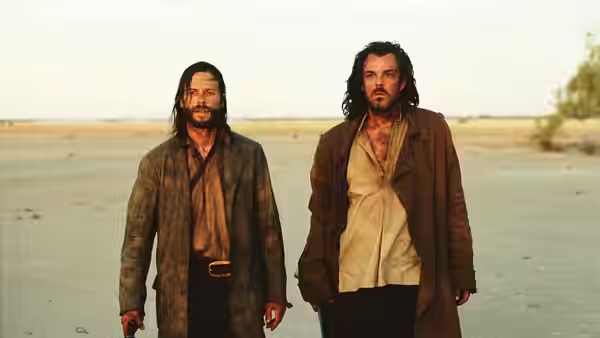
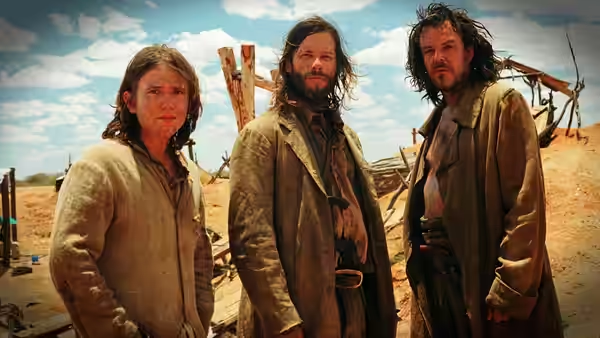
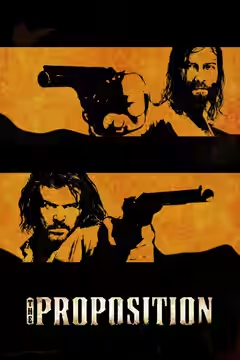
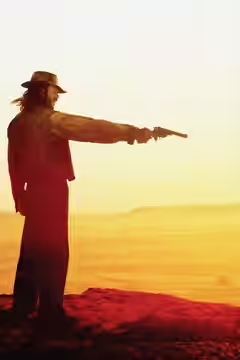
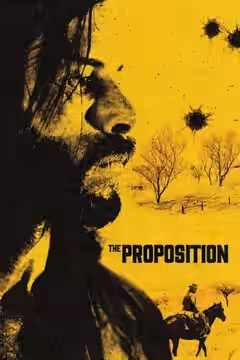
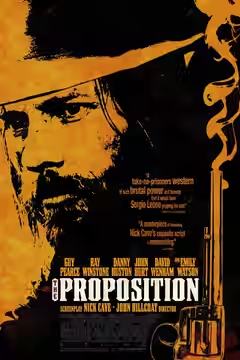
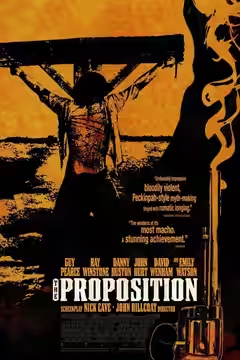
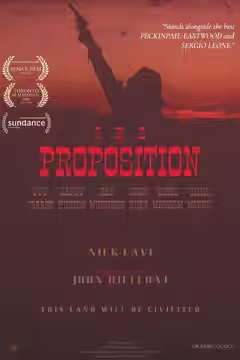
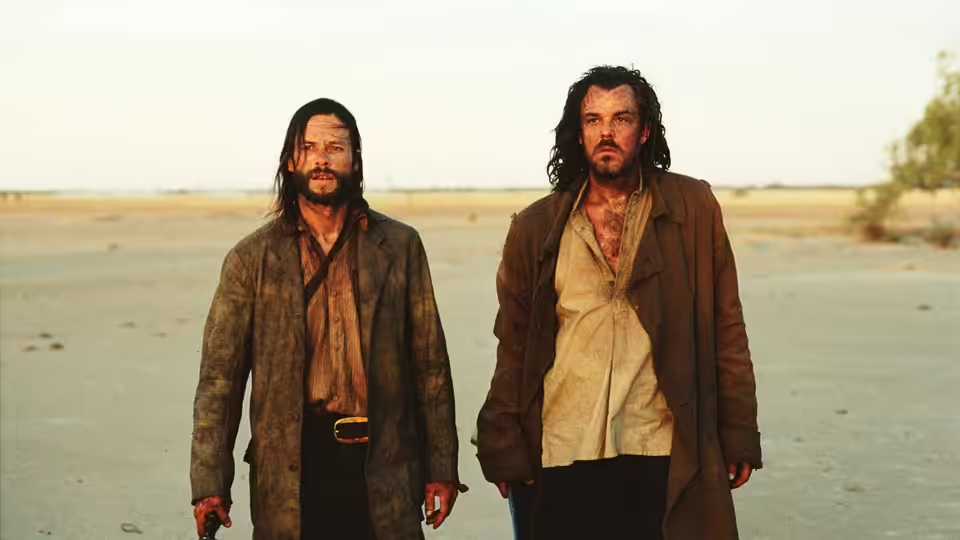
Arthur Burns and Charlie Burns stand together on a barren stretch of open country
Film review

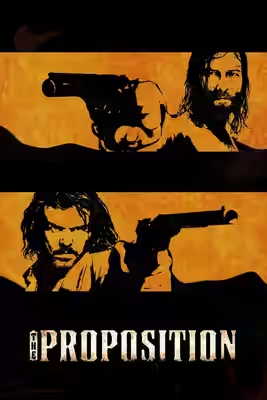
The Proposition

2005 · Directed by John Hillcoat · 1h 44m

In a sentenceThe outback as Nick Cave sees it: flies, scripture, and nobody clean enough to be the hero

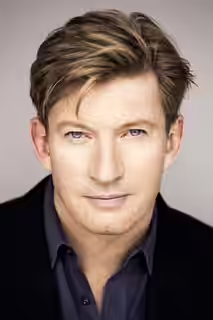
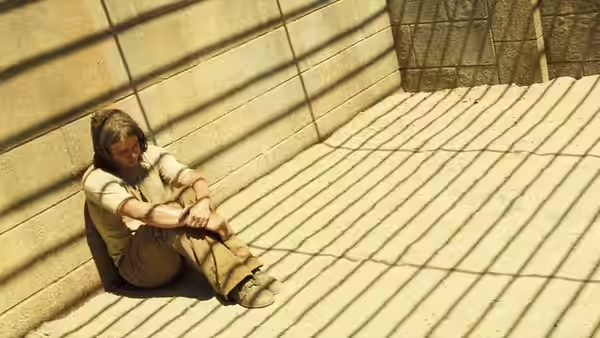
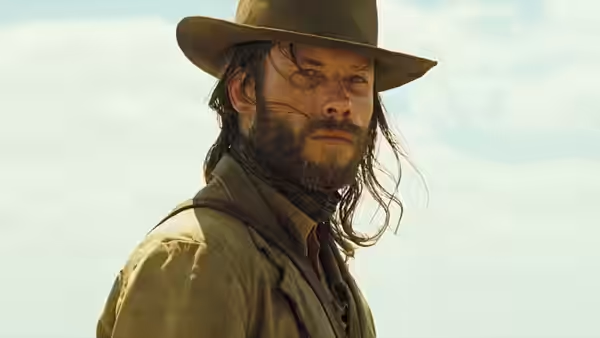
Australia, the 1880s. Captain Morris Stanley (Ray Winstone), an English policeman in a dusty outback town, has taken two of the Burns brothers alive after a gunfight in a tin shack. Charlie Burns (Guy Pearce) is the middle brother; Mike (Richard Wilson) is the youngest and not quite all there. Stanley makes Charlie an offer: ride into the hills, find the eldest, Arthur (Danny Huston), whose gang butchered the Hopkins family, and kill him before Christmas Day, and Mike will be spared the rope. Charlie rides out. Back in town Stanley’s wife Martha (Emily Watson) keeps an English garden alive in the heat, and Eden Fletcher (David Wenham), who outranks Stanley, wants a hanging whatever was promised. In the desert Charlie meets Jellon Lamb (John Hurt), a drunk bounty hunter after the same man.

Fi1m review

John Hillcoat’s Australian Western, written by Nick Cave, is brutal, slow and often beautiful. Guy Pearce rides into the hills to kill his brother while Ray Winstone and Emily Watson keep Christmas in the heat. It sags in the middle, and it stays with you.

The bargain is set out in the first ten minutes. Captain Stanley (Ray Winstone) has caught two Burns brothers and wants the third, Arthur (Danny Huston), who leads the gang and did the worst of the killing. He tells Charlie (Guy Pearce) to go and shoot Arthur before Christmas or watch his younger brother Mike (Richard Wilson) hang. Then he lets Charlie go. The rest of The Proposition is Charlie riding into the hills, Stanley waiting in a town that despises him, and 104 minutes of heat. It is a good film, ugly on purpose and in no hurry, and if you can stomach it, it is worth your evening.

Nick Cave wrote it and, with Warren Ellis, scored it, and the two jobs have the same temperature. The script gives nearly everyone a speech about God, blood or the land; the music is a single violin sawing at one note while a voice mutters under it. John Hillcoat directs as though the sun were a character, and Benoît Delhomme shoots to match. Daylight here is white, not golden; faces are shadowed under hat brims and the horizon is a smear. At dusk the light turns orange and purple and the film stops to look at it, usually with Arthur looking too.

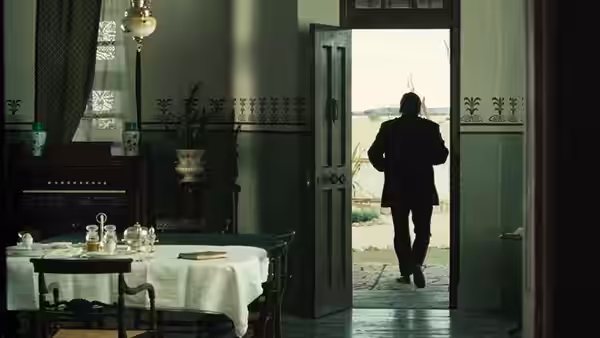
Chris Kennedy’s production design does the clearest thinking in the film. Stanley’s house has a white picket fence, roses, a tablecloth and a Christmas tree, and it sits in red dust a few hundred yards from the lock-up where men are chained. Margot Wilson dresses Martha Stanley (Emily Watson) in clean English cotton and everyone else in cloth that looks as if it has been buried. That is the argument of the film, and the design makes it without a line of dialogue. Jon Gregory cuts slowly, holding on the flies on a man’s face longer than is comfortable, and once or twice longer than is useful.

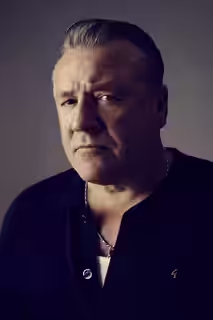
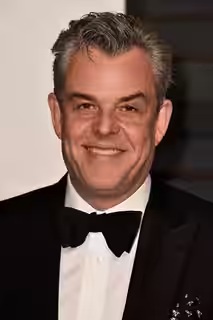
Winstone is the reason to see it. Stanley is a brute with a conscience, a man who flogs and hangs for a living and wants, more than anything, to get his wife back to England with her illusions intact. Winstone plays him tired, sweating and gentle at home, and the scenes where he lies to Martha about his day are the best-written in the picture. Watson matches him; Martha is not a fool, and her slow realisation of what the town does is the quietest thing in a loud film. Pearce says almost nothing and lets his face do it. Huston, as Arthur, talks about sunsets and recites poetry and is the more frightening for it. John Hurt turns up for two scenes as the bounty hunter Lamb and makes a meal of both.

We were horrified early, and not by the shooting. The film opens on a gunfight seen through holes in corrugated iron, and then on photographs of the murdered family laid out on a table, and it is the photographs that did it: still, formal, a child among them, with Stanley’s voice going on about civilisation over the top. Later there is a public punishment in the town we will not describe, and what disturbed us was not the blood but the townspeople who had come to watch it and then found they could not. Hillcoat holds on their faces. He is right to.

The flaws are real. The middle stretch, with Charlie in the hills, loses momentum; there is a lot of riding, a lot of looking at rocks, and a subplot with a spear that stops the film rather than turns it. Cave’s dialogue reaches for the biblical so often that when a character speaks plainly it comes as a relief. And Arthur’s gang is a gallery of grimaces rather than people; only Huston is given anything to play.

Set against the Westerns it borrows from, the ones where the land is hostile and the law is only a slightly cleaner kind of violence, it holds its own. It has none of their swagger and no interest in a hero. Watch it on a cold night with the curtains shut; the heat comes through anyway, and so does the smell.

Critical consensus AI synthesised

74
Positive
8
Mixed
3
Negative
1

Most critics come away impressed by The Proposition. The reviews return again and again to the outback itself: the heat, the dust and the sense of a landscape that offers no comfort to anyone in it. John Hillcoat’s precise, unflinching handling of the violence earns consistent praise, as does Nick Cave’s work on both the script and the score, which several critics credit with the film’s off-kilter feel. The performances are widely admired, with Guy Pearce, Ray Winstone, Danny Huston and John Hurt each singled out by different writers.

The reservations cluster on pace and writing. Several critics find the middle sags, and a few think the dialogue strains for portent. The spread is wide: eight positive reviews sit alongside one outright dismissal. The AV Club finds it bluntly ugly and weighed down by its own seriousness, while Eye for Film argues the moral premise and the characters are never properly developed. Even the sceptics grant the photography and the score.

Empire
24 February 2006 · Adam Smith
90*

The critic calls it a brutal, impressive film and one of the finest of the year. They praise Hillcoat’s precise handling of violence and the outback’s oppressive atmosphere.

Read the full review →
Slant Magazine
18 January 2006 · ★★★½/4 · Nick Schager
88

Schager sees the film as a bleak, caustic meditation on civilization’s struggle against human savagery. He praises the measured imagery, Nick Cave’s writing and score, and Ray Winstone’s performance as Stanley.

Read the full review →
The Guardian
21 July 2006 · Rob Mackie
85*

Mackie praises the film as a poetic, strange and brutal western that earns a place among the genre’s classics. He singles out the convincing atmosphere and especially strong performances, including Danny Huston’s.

Read the full review →
Radio Times
★★★★ · Adam Smith
80

Adam Smith praises the film as a gritty, grim and blood-soaked western. He singles out its bleak, violent portrayal of the Australian outback.

Read the full review →
Total Film
10 March 2006 · ★★★★ · Total Film
80

The review calls it a bold, brilliant and haunting Western that revives a moribund genre, despite some slow pacing and a forced accent. It praises the distinctive collaboration between John Hillcoat and Nick Cave for giving the film its off-kilter feel.

Read the full review →
Variety
16 September 2005 · Richard Kuipers
75*

Kuipers finds the film a muscular, allegory-rich Western whose bleakness and violence may limit its commercial appeal. He praises the exemplary performances, particularly Guy Pearce’s nuanced portrayal of Charlie Burns.

Read the full review →

Straight answers AI written, from our review

Is The Proposition worth watching?
The Proposition is worth watching for anyone who can take a slow, brutal Western with no hero in it, and we scored it 79. Ray Winstone and Emily Watson are the reason to see it, and the design makes its argument about English manners in red dust without a line of dialogue. The middle stretch sags, and Nick Cave's dialogue reaches for scripture more often than it needs to.
How long is The Proposition, and what is it rated?
The Proposition runs 1h 44m. It is a western and drama film.
Where can I watch The Proposition in Poland?
The Proposition is not on any streaming or rental service in Poland at the moment. It is available in 5 other countries; change your country at the top of the page to see where. Availability is checked daily.
How violent or frightening is The Proposition, and is it suitable for children?
The Proposition is an 18 certificate in the UK and not suitable for children or younger teenagers. It opens on a gunfight and photographs of a murdered family, a child among them, and later holds on a public punishment that the townspeople themselves cannot watch. The violence is slow and deliberate rather than constant, which makes it harder to sit through, not easier.
What should I watch after The Proposition?
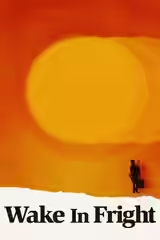
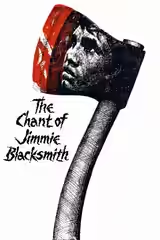
After The Proposition, try Wake in Fright (1971, Fi1m 86): The outback as a trap, with beer and kangaroos instead of rifles. Then The Chant of Jimmie Blacksmith (1978, Fi1m 80): Fred Schepisi’s colonial Australia, angrier and more direct about who paid for it; and Dead Man (1995, Fi1m 84): Jim Jarmusch’s slow black-and-white Western, poetry and corpses in roughly equal measure.

Cast

Awards

AACTA Award for Best Actor in a Leading Role, 2005

Nominated
AACTA Award for Best Actor in a Leading Role

AACTA Award for Best Cinematography, 2005

Won
AACTA Award for Best Cinematography

AACTA Award for Best Costume Design, 2005

Won
AACTA Award for Best Costume Design

AACTA Award for Best Direction, 2005

Nominated
AACTA Award for Best Direction

AACTA Award for Best Editing, 2005

Nominated
AACTA Award for Best Editing

AACTA Award for Best Film, 2005

Nominated
AACTA Award for Best Film

AACTA Award for Best Original Music Score, 2005

Won
AACTA Award for Best Original Music Score

AACTA Award for Best Original Screenplay, 2005

Nominated
AACTA Award for Best Original Screenplay

AACTA Award for Best Production Design, 2005

Won
AACTA Award for Best Production Design

AACTA Award for Best Sound, 2005

Nominated
AACTA Award for Best Sound

If you liked this, try…

  1. Wake in Fright (1971, Fi1m 86)The outback as a trap, with beer and kangaroos instead of rifles.

  2. The Chant of Jimmie Blacksmith (1978, Fi1m 80)Fred Schepisi’s colonial Australia, angrier and more direct about who paid for it.

  3. Dead Man (1995, Fi1m 84)Jim Jarmusch’s slow black-and-white Western, poetry and corpses in roughly equal measure.

  4. Unforgiven (1992, Fi1m 92)Clint Eastwood takes the glamour out of killing and leaves the ache.

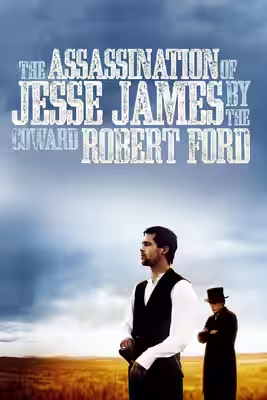
  5. The Assassination of Jesse James by the Coward Robert Ford (2007, Fi1m 84)Another slow, beautiful Western where the outlaw is the most dangerous when he is calm.

Free account

Know what to watch tonight

Two lists that know where things are streaming, collections you can share, your own score beside ours, and Discover that remembers what you have seen.

  • Want to see, sorted by what is streaming now
  • Seen, with your score out of ten
  • No adverts, ever