Almodóvar’s first film in English puts Tilda Swinton and Julianne Moore in a mid-century house in upstate New York to talk about dying, and the house is the best thing in it. Swinton is plain and level and gets to us; the dialogue never stops sounding written.
Ingrid (Julianne Moore) is a novelist who has just published a book about her fear of death, and she is signing copies of it when a friend tells her that Martha (Tilda Swinton) is in hospital. They were close once, years ago, and then drifted, in the way people do. Ingrid visits. Martha, a war correspondent with a cancer that is not responding to treatment, is glad to see her and does not pretend otherwise. Pedro Almodóvar, adapting Sigrid Nunez’s novel for his first feature in English, sets all this up quickly and cleanly. Then Martha makes her request.
She has bought a pill. She intends to take it at a rented house in the country, on a date of her choosing, and she wants Ingrid in the house when she does: not to help, just to be in the room next door. Each morning Ingrid will check Martha’s door. Open, and they have another day; closed, and it is done. It is a strong premise for a chamber piece, and for about half of its 106 minutes the film is one.
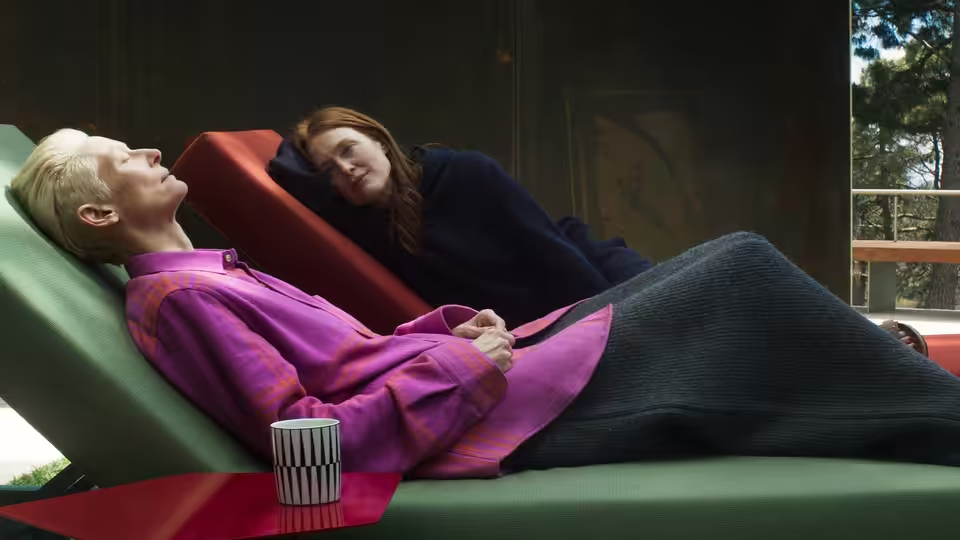
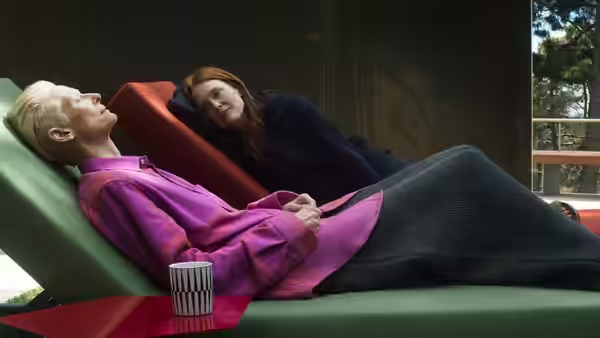
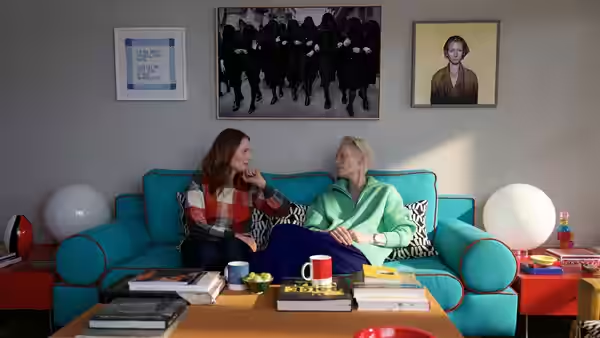
The house is the best thing in it. Inbal Weinberg’s production design gives the two women a mid-century house in upstate New York, and Almodóvar frames it with the symmetry he has always liked. Eduard Grau keeps the colours strong and the contrast high, so the rooms look like Almodóvar rooms even with English being spoken in them. Bina Daigeler’s costumes are cut from the same palette. It looks at all times like an Almodóvar film, which is not a small thing to manage in another language.
Swinton is the reason to watch. She plays Martha without any of the tremble a dying-woman part usually comes with; the voice stays level, the eyes stay dry, and she describes what the illness is doing to her memory as though filing a report from somewhere else. The scene in which she lays out the plan moved us more than we expected, and it did so because she asks for what she wants as a favour between adults. We had braced for a speech. There is not one.
The trouble is what comes out of everyone else’s mouth, and quite often out of Swinton’s too. Almodóvar’s people speak in complete paragraphs. They announce their feelings, quote from books, recall the past in tidy order and never interrupt each other. Moore has the harder job, which is to listen and be frightened, and she does it with her hands and her breathing, but the script keeps handing her lines that tell us what her face has already told us. John Turturro arrives as Damian, a former lover of both women, and is given a long speech about the state of the world. He delivers it well and it belongs in another film.
The flashbacks do not help. Esther-Rose McGregor plays the younger Martha and Alex Høgh Andersen plays Fred, and the stretch of the past they occupy plays like a short film someone has slipped into the middle of this one. Teresa Font cuts back to the present each time, and those cuts were the moments we were most glad of. Alberto Iglesias’s score, mostly strings, does what it can to supply warmth. We believed the two women had known each other; we did not believe they had missed each other.
Almodóvar has made films about women, illness and the body before, and in Spanish they had a heat this one keeps at arm’s length. Nothing here is overwrought, which is a sentence we did not expect to write about him, and we are not sure it is praise. The melodrama has been tidied away with the clutter, and what remains is handsome, thoughtful and a little cold. Most critics have liked it more than we did. The handful who found it stagy heard what we heard.
It is a 12A and almost entirely conversation, so nobody need be afraid of it. Watch it for Swinton and for the house, and be patient in the middle stretch, where the men turn up with their opinions. There is a turn in the last half hour we will not describe, except to say it is the one scene in which somebody is caught off guard, and the film is better for it.