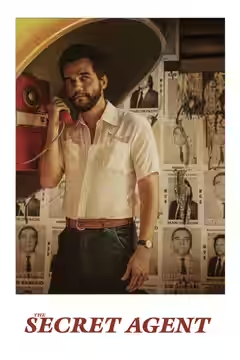
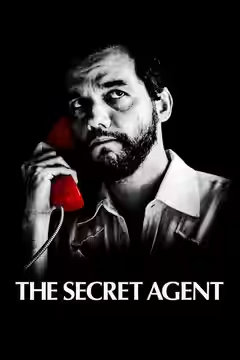
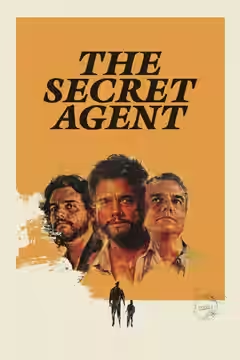
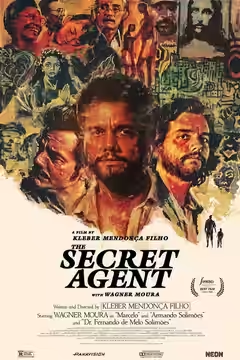
The Secret Agent poster

The Secret Agent

2025 · Directed by Kleber Mendonça Filho
2h 41mThrillerDramaCrime15
84
Fi1m score
87
Critics · 19
Audience · not yet

Where to watch in the UK

Checked 10 September at 22:28. Prices and availability change; the service’s page is the last word.

Plays from YouTube when you press play; nothing loads from them until then.

Synopsis

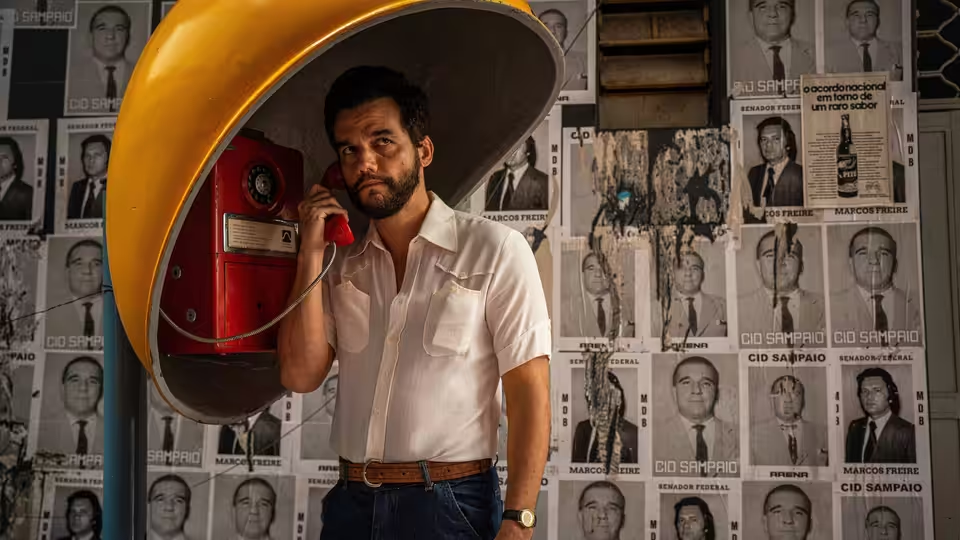
Recife, 1977, the week of Carnival. Brazil is under military rule and a man calling himself Marcelo (Wagner Moura) arrives in the city with a suitcase and a name that may not be his. He takes a room in a house where nobody asks why anybody is there, and sets about two things: seeing his young son, and getting the papers that will let him leave the country. Someone with influence has other plans and has sent men, among them Bobbi (Gabriel Leone), to find him. Elza (Maria Fernanda Cândido) keeps him hidden; Hans (Udo Kier) is an old German who has been in town long enough to know how it works. Meanwhile the newspapers are full of a human leg found inside a shark.

Fi1m review

In a sentenceA man with three names hides in the sweatiest city in Brazil while the newspapers fret about a leg found in a shark

Kleber Mendonça Filho’s thriller about a hunted man in Recife in 1977 is funny, frightening and made with great care, and Wagner Moura holds it together by hardly moving. It is also long, and the present-day scenes are where you feel it.

Kleber Mendonça Filho has made a film about a woman who will not leave her flat (Aquarius) and one about a village that will not be wiped off the map (Bacurau). The Secret Agent is about a man who cannot stay anywhere. Wagner Moura plays him, and the credits give him three names, which tells you something. He arrives in Recife in the Carnival week of 1977, in the middle of the military dictatorship, takes a room in a house full of people who would rather not say why they are there, and tries to see his young son and get the papers that will let him leave the country. Someone with money would prefer he did neither. It is one of the better thrillers we have seen in some time, funny and frightening by turns, and it takes 161 minutes over a story that might have been told in 140.

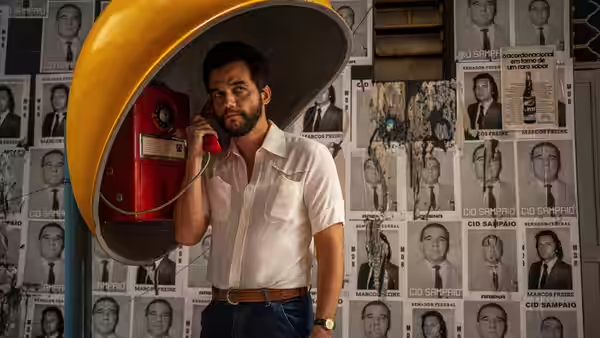
Moura’s job is to look ordinary, and he does it by doing almost nothing. Marcelo keeps his shoulders down and his voice level, and the film’s best scenes are the ones where he sits across a desk from someone who is deciding whether he lives, and we watch him work out how much to smile. He is a man used to being clever who has learned that cleverness is now dangerous. When he is allowed to relax, with his boy or in the dark of a cinema, the change in his face is small, and it is the whole point.

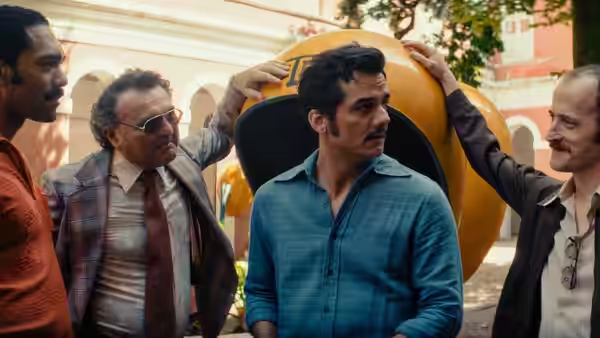
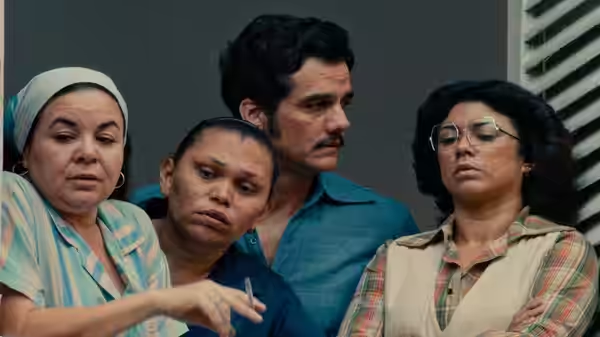
Evgenia Alexandrova shoots Recife as a city where nobody is ever dry. Shirts stick to backs, the light is yellow by mid-morning, and she likes a long lens across a crowded street so that the man we are following is one figure among hundreds who could be anyone. Thales Junqueira’s production design puts 1977 in every corner: the boarding house of mismatched chairs and a shared telephone, the police offices with their desk fans and typewriters, a cinema with a painted front the size of a house, and cars in colours nobody has ordered since. None of it is shown off.

The film runs a newspaper story about a human leg found inside a shark through its first hour, and the whole city treats it as light entertainment. We laughed. Then Mendonça Filho shows us, plainly and in daylight, how ordinary the people doing the dictatorship’s dirty work are, as bored as plumbers, and we stopped laughing and felt slightly foolish for having started. The absurd and the murderous sit at the same table here, and nobody at the table thinks that is odd.

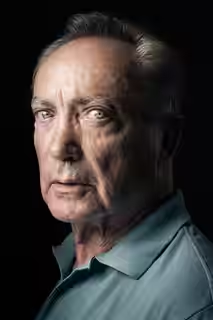
The supporting cast is full of people you want to follow home. Udo Kier’s Hans is an old German who has been in Brazil long enough to have his own way of not answering questions, and Kier gives him a courtesy that is more unsettling than rudeness would be. Gabriel Leone plays Bobbi, one of the men sent after Marcelo, as handsome, tired and not much interested in why. Maria Fernanda Cândido’s Elza keeps the network of hiding places running with the manner of a woman organising a church fete. Alice Carvalho, as Fátima, shares the house and gets one of the film’s few scenes of plain kindness.

Matheus Farias and Eduardo Serrano cut between 1977 and a present-day thread in which people go through archives and listen to old recordings. The cuts are clean and the idea is sound: this is a country going back through its own paperwork. But every return to the present stops the Recife story dead, and it was in those rooms, not in the heat, that we felt the running time. The score by Mateus Alves and Tomaz Alves de Souza mostly keeps its head down and lets the radio and the street carry the noise, which is the right decision.

Most critics have reached for Hitchcock, and there is something in it: an ordinary man, a false name, people who know more about him than he does. But Hitchcock would have cut half of this and been ashamed of the shark. Set against Mendonça Filho’s own work, it is warmer than Bacurau and less angry than Aquarius, and it shares with Pictures of Ghosts a fondness for old cinemas and the paper trails people leave behind.

See it in a cinema if you can, where the heat comes off the screen and into your seat. Take water, and do not plan anything afterwards.

Critical consensus AI synthesised

87
Positive
19
Mixed
0
Negative
0

The reviews for The Secret Agent are almost uniformly warm, and the spread is narrow: nothing lands below a solid pass and several critics reach for the top of the scale. Praise clusters in two places. The first is Wagner Moura, whom most critics single out for a restrained, vulnerable lead performance as a man trying to slip out of the reach of the dictatorship. The second is the recreation of Recife in 1977, which critics describe as sweaty, garish and precise, with the period detail carrying much of the film’s feeling. Many also admire how Mendonça Filho mixes a thriller with absurdist comedy, surreal detours and his own love of cinemas and archives, and most find that the mixture holds. The reservations are few and mild. Deadline calls it overlong and prone to rambling, and The Wrap finds it messy, though it treats the mess as part of the point. Nobody argues it is dull.

Little White Lies
16 February 2026 · 5/5/5 · Rafa Sales Ross
100

Mendonça Filho’s most refined, outright-auteurist work yet, an intimate epic that always delivers the unexpected with head-spinning craft. Moura anchors this tale of history as an afterlife with a terrific encapsulation of hopelessness that masks itself as resilience.

Read the full review →
Empire
16 February 2026 · Siddhant Adlakha
90*

The critic calls it an astonishing cinematic experience that lures the past into the present, praising the rich period details, vivid supporting characters, surreal detours, and how it roots its story of authoritarianism in deeply human dilemmas and resilience.

Read the full review →
The AV Club
12 September 2025 · A- · Natalia Keogan
90

The review highlights the film's interweaving of politics, espionage, and cinema love, praising its detailed recreation of 1970s Recife and emotional depth through personal and historical lenses.

Read the full review →
The New Yorker
26 November 2025 · Richard Brody
90*

The critic lauds the film as a political thriller teeming with life, overflowing with sharply drawn characters and offering a bracingly immediate portrayal of history under dictatorship, with inventive cinematic form.

Read the full review →
The Times
19 February 2026 · Kevin Maher
90*

It’s a kaleidoscopic riot that quickly becomes a gear-shifting masterpiece. Wagner Moura plays the central character with vulnerability that makes you yearn for him to best Timothée Chalamet.

Read the full review →
Evening Standard
17 February 2026 · Nick Howells
85*

The critic hails it as a hypnotic thriller and piece of cinematic gold, praising Wagner Moura's shimmering lead performance, the scorched equatorial atmosphere, intoxicating music, surreal symbolism, and the deep-fried Brazilian rhythm of its story set during the military dictatorship.

Read the full review →

Cast

Wagner Moura
Marcelo Alves / Armando Solimões / Fernando Solimões
Isabél Zuaa
Tereza Victória
Rubens Santos
Natalício

Stills

Awards

Academy Awards, 2026

Nominated
Best International Feature Film
Nominated
Best Picture

Golden Globes, 2026

Won
Best Non-English Language Film

APRECI Award for Best International Premiere, 2025

Won
APRECI Award for Best International Premiere

FIPRESCI Grand Prix, 2025

Nominated
FIPRESCI Grand Prix

If you liked this, try…

Aquarius poster

Aquarius

2016 · Mendonça Filho’s earlier Recife film, with Sônia Braga refusing to be moved.

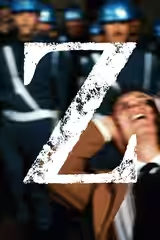
Z poster

Z

1969 · Costa-Gavras on a state murder and its cover-up, cut like a chase.

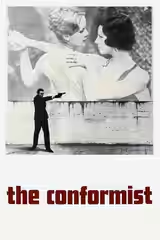
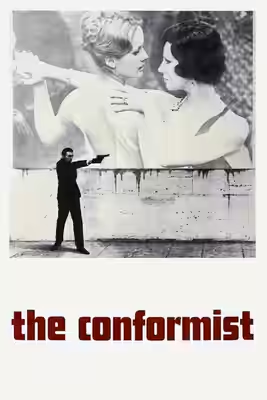
The Conformist poster

The Conformist

1970 · Bertolucci’s study of a man who goes along with fascism, shot in shadow.

Night Moves poster

Night Moves

1975 · Gene Hackman as a detective who understands nothing; the seventies at their most tired.

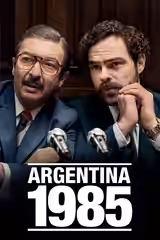
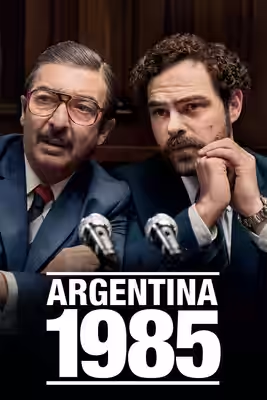
Argentina, 1985 poster

Argentina, 1985

2022 · A dictatorship put on trial, told with a lightness that sneaks up on you.