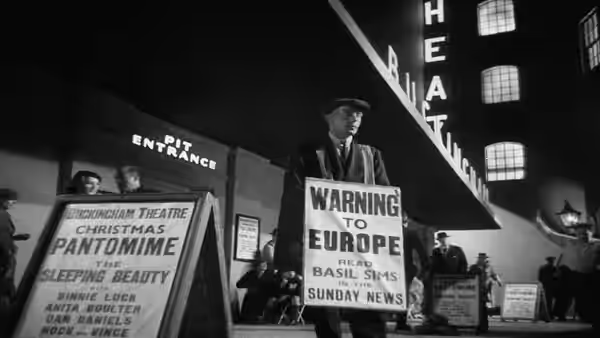
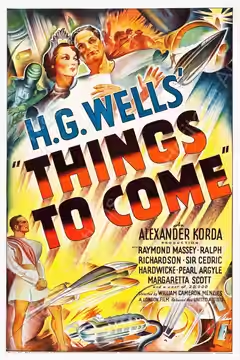
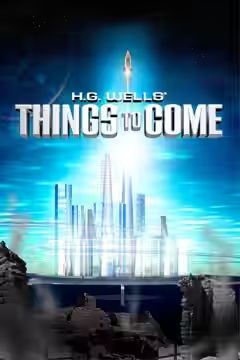
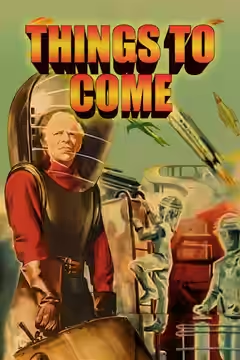
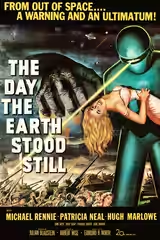
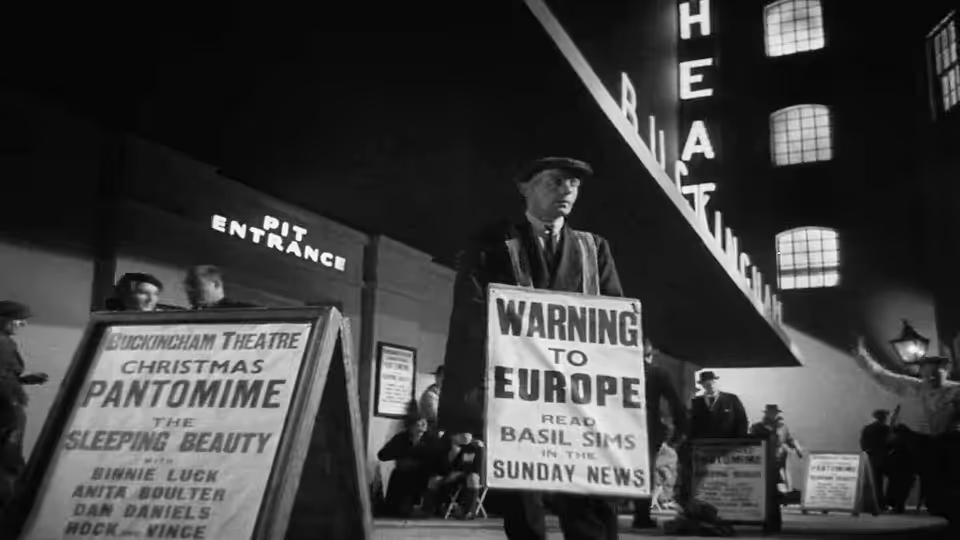
A man stands among street-side news placards and theatre advertisements
Film review

Things to Come

1936 · Directed by William Cameron Menzies · 1h 40m

In a sentenceThe future has impressive architecture and no shortage of people willing to explain it

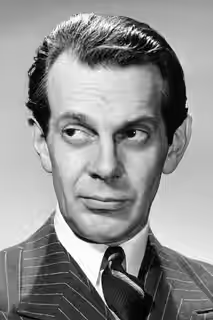
Things to Come is a science-fiction drama featuring John Cabal (Raymond Massey), Pippa Passworthy (Edward Chapman) and Dr. Harding (Maurice Braddell). Raymond Massey also plays Oswald Cabal, while Edward Chapman also plays Raymond Passworthy. Ralph Richardson appears as The Boss, alongside Margaretta Scott as Roxana and Rowena and Cedric Hardwicke as Theotocopulos. William Cameron Menzies directs from a screenplay by H. G. Wells, who also receives the novel credit. The film dates from 1936 and runs 100 minutes, with music by Arthur Bliss.

Fi1m review

William Cameron Menzies’s science-fiction drama is worth seeing for its design, though H. G. Wells’s long explanations make it heavy going. Those interested in imagined futures will have the most patience for it.

William Cameron Menzies makes an imagined future feel substantial in Things to Come. H. G. Wells’s screenplay then spends too long explaining it. This is an imaginative, awkward science-fiction film, worth the evening for those interested in how the future has been pictured. Its ambitions deserve respect, but they do not excuse dialogue that repeatedly slows our progress through a world we would rather be allowed to examine.

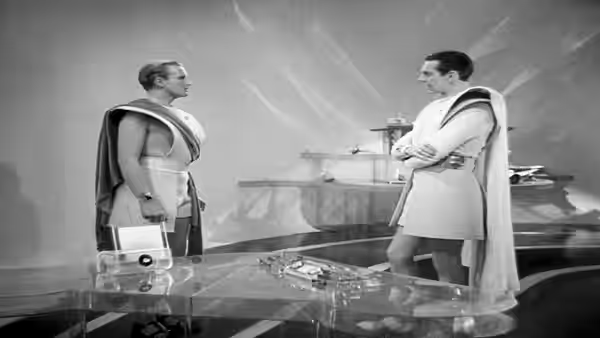
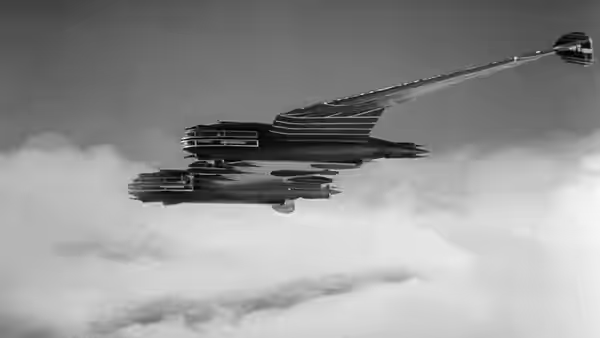
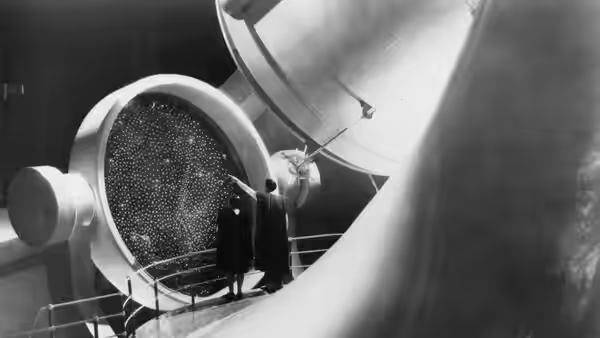
The art deco and modernist design gives the film much of its conviction. These are spaces conceived with a seriousness that makes their appearance interesting beyond the usual pleasure of unfamiliar surroundings. We were stirred by their imposing scale. William Cameron Menzies understands how architecture can hold our attention, and the film remains worth looking at even when the conversations have begun to exhaust their welcome.

Georges Périnal’s cinematography gives that design weight and clarity, without making its grandeur feel entirely comfortable. The severity of the images suits a film so determined to be taken seriously. There is a drawback: such imposing surroundings can make the people seem secondary before the screenplay has given them much chance to establish themselves. Still, the photography sustains curiosity through passages where the dialogue does little to help.

Raymond Massey, playing John Cabal and Oswald Cabal, brings the seriousness this material demands. His gravity also exposes its difficulty: solemn delivery becomes tiring when the words already sound prepared for a public address. Ralph Richardson’s The Boss offers welcome roughness, giving the film some of the human untidiness it needs. The performances are most engaging when a personality comes through strongly enough to distract us from the business of explaining an idea.

H. G. Wells has plenty of ideas, and their number is part of the attraction. The trouble is that hearing them stated does not always help us understand how they fit together. The screenplay can be intellectually muddled while sounding firmly convinced, which makes its longer explanations particularly wearing. We became impatient with those stretches because the images had already prompted questions that another speech did little to settle.

Editors Francis D. Lyon and Charles Crichton cannot entirely overcome that dependence on exposition. The film feels heavy whenever a conversation has to carry too much information, and a quicker cut would hardly solve the underlying problem. Arthur Bliss’s music supplies a welcome force, helping the scale of the images register without requiring another explanation. Its contribution matters to the pleasure of watching, especially when the dialogue has made the film feel more dutiful than curious.

Against the familiar demands of science fiction, Things to Come succeeds at making an imagined world worth contemplating and struggles to make its people equally absorbing. It takes the possibilities of the genre seriously enough to risk being ponderous, and sometimes becomes precisely that. We would not recommend it simply as an evening’s easy entertainment. Choose it when the prospect of examining a future city sounds more appealing than keeping brisk company.
Critical consensus AI synthesised

67
Positive
3
Mixed
3
Negative
0

The reviews lean towards qualified admiration for Things to Come, with praise clustering around its visual ambition and abundance of ideas. The Guardian singles out the art deco and modernist design, finding poetic power despite intellectual confusion. Slant Magazine praises Menzies’s imposing visual style and finds the film’s ambiguities fascinating. Across the available verdicts, its imagined future gives critics more to admire than its storytelling does.

The reservations concern dated elements, clumsy exposition and whether the ideas sustain interest. Empire finds the film fascinating and prescient, but also clumsy and dated. Variety offers the coolest assessment, admiring Menzies’s direction and Georges Perinal’s photography while finding the exposition prolonged and the result dull. The spread therefore runs from enthusiasm with caveats to mixed appreciation, though the limited accessible text from two of the six reviews makes their precise positions harder to establish.

Slant Magazine
18 June 2013 · ★★★★ · Budd Wilkins
80

Wilkins praises the film as a visually dazzling work with fascinating ambiguities, and finds its Criterion Blu-ray presentation and supplements excellent. He singles out Menzies’s imposing visual style and the transfer’s vibrant clarity, while noting that the film’s monaural sound is limited.

Read the full review →
The Guardian
6 May 2007 · Philip French
80*

French regards the film as a unique, visionary work of poetic power despite its intellectual confusion and dated elements. He especially praises its art deco and modernist design.

Read the full review →
Empire
10 May 2007 · William Thomas
70*

The review finds the film fascinating but clumsy and dated. It praises the prescience and sheer volume of its ideas.

Read the full review →
The New York Times
30 June 2013
64*

The headline frames the film as a trip back to a retro-future. The article text was inaccessible, so its verdict and specific praise cannot be verified.

Read the full review →
Time Out
· CW
64*

The page is identified as a review of William Cameron Menzies’s 1936 film, but the critic’s verdict cannot be determined from the available text. The visible description discusses H.G. Wells’s creative freedom, without revealing a specific element praised or criticized.

Read the full review →
Variety
31 December 1935 · Variety Staff
45*

The review finds the film impressive but dull overall. It praises William Cameron Menzies’ direction and Georges Perinal’s photography, while faulting the exposition for running on and on.

Read the full review →

Straight answers AI written, from our review

Is Things to Come worth watching?
Things to Come is worth watching for its imposing future-city design, provided we approach it with patience for lengthy explanations; we scored it 65 out of 100. We recommend it to viewers interested in imagined futures, though Wells’s speech-heavy screenplay makes it a poor choice for an evening’s easy entertainment.
How long is Things to Come, and what is it rated?
Things to Come runs 1h 40m. It is a drama and science fiction film.
Where can I watch Things to Come in South Africa?
Things to Come is streaming on Amazon Prime Video in South Africa. Availability is checked daily; the links above go straight to each service.
How does Things to Come compare to Metropolis?
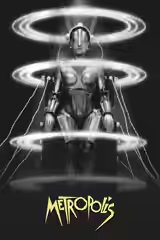
Things to Come is the more ponderous companion to Metropolis, which we recommend more strongly for its thrilling scale and visual precision. Both make future-city architecture central to their appeal, but Wells’s lengthy explanations weigh down Things to Come, while our reservation about Metropolis concerns its much-too-easy proposed cure for class conflict.
Is Things to Come based on a true story or a book?
Things to Come is based on a novel by H. G. Wells, who also writes the screenplay, rather than on a true story. We find its imagined future worth examining on screen without prior reading, though the film’s long explanations can be tiring; Wells’s involvement alone does not establish how faithfully it follows the book.
What should I watch after Things to Come?
After Things to Come, try Metropolis (1927, Fi1m 87): Another imagined city whose architecture makes its politics impossible to overlook. Then The Day the Earth Stood Still (1951, Fi1m 82): A more concise warning about humanity’s habits, delivered by an unwelcome visitor; and Gattaca (1997, Fi1m 80): Scientific order looks seductive until someone has to live outside its rules.

Cast

If you liked this, try…

  1. Metropolis (1927, Fi1m 87)Another imagined city whose architecture makes its politics impossible to overlook.

  2. Aelita (1924) · not on Fi1m yetAn earlier future with angular sets and an unruly political imagination.

  3. The Day the Earth Stood Still (1951, Fi1m 82)A more concise warning about humanity’s habits, delivered by an unwelcome visitor.

  4. Alphaville (1965) · not on Fi1m yetAn authoritarian future assembled from ordinary streets, offices and a forbidding voice.

  5. Gattaca (1997, Fi1m 80)Scientific order looks seductive until someone has to live outside its rules.