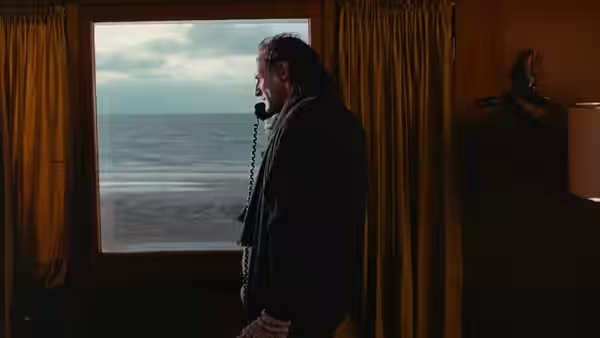
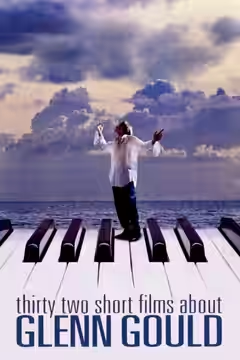
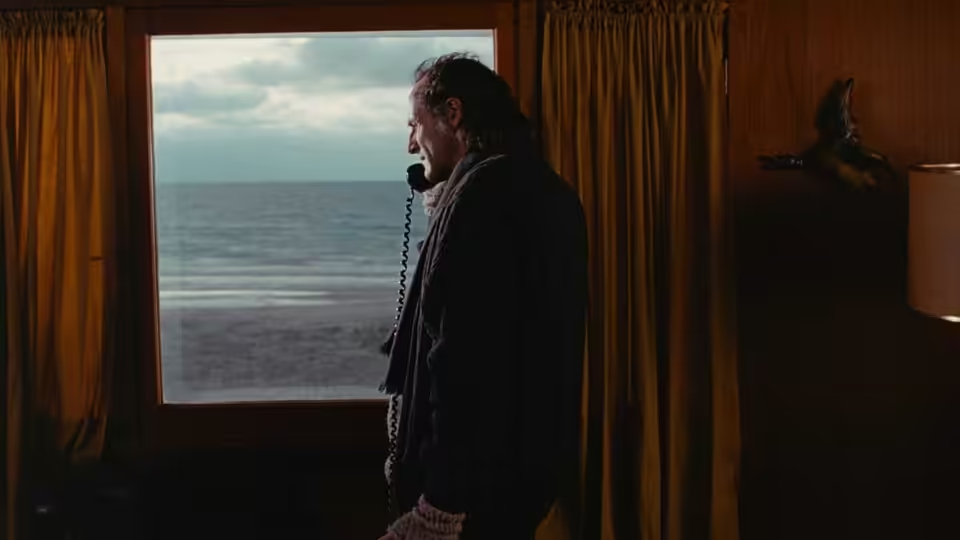
Glenn Gould (Colm Feore) stands by a window, speaking on the telephone as the sea stretches beyond
Film review

Thirty Two Short Films About Glenn Gould

1993 · Directed by François Girard · 1h 33m

In a sentenceThirty-two short films, and mercifully no single explanation for the man making the music

Glenn Gould (Colm Feore) is a musician whose life is approached through thirty-two separate pieces. His father (Derek Keurvorst) and mother (Katya Ladan) are among the people in a portrait that also presents Gould at three, eight and twelve. Dramatised encounters sit beside archive material and interviews, with musical performances running through the film. A chambermaid (Kate Hennig), a concert promoter (Don McKellar) and a C.B.S. producer (Carlo Rota) figure among those around him. The film moves between these people, the work and accounts of Gould, without following a single continuous plot.

Fi1m review

François Girard’s fragmented portrait of Glenn Gould is absorbing, playful and unusually attentive to music. Colm Feore holds it together, though the reverence sometimes keeps the man at a polite distance.

Thirty Two Short Films About Glenn Gould is an absorbing musical biography with a modest but persistent drawback: we sometimes feel that its subject is being protected from us. François Girard builds his portrait from dramatised episodes, archive material and interviews, allowing each part to offer a different impression. The music receives sustained attention of its own. We recommend it for that attention, and for the wit of a film willing to change its approach before we have settled into it.

The screenplay, by François Girard and Don McKellar, avoids turning every detail of Gould’s life into a clue. There are thirty-two pieces, so a fragment can suggest something without having to prove it or prepare the next dramatic crisis. That freedom suits a subject whose relationship with music cannot be tidied into a speech. It also gives the film a playful curiosity that is welcome in a genre prone to treating achievement as a medical condition.

Colm Feore gives the dramatised passages the consistency this arrangement needs. He has to remain credible beside documentary material, and we accept him readily when the film returns to drama. His Gould holds our attention without demanding that every appearance add another piece of biographical information. Having an actor at the centre also matters: after a change of form, there is someone to return to, rather than another explanation of what made Gould unusual.

Alain Dostie’s cinematography gives the musical passages visual interest without making us wish the music would stop so that the story could get going again. Gaëtan Huot’s editing keeps the changes between dramatic reconstruction and documentary material from becoming a series of awkward restarts. We remain aware of the separate pieces, and that seems right for a portrait which is asking us to reconsider its subject repeatedly.

We were moved by the musical performances. The director lets us listen long enough to become interested in what is being played, without hurrying us towards another incident in Gould’s life. The layered sound also rewards attention; it gives our ears work to do while the film keeps changing its methods. There is pleasure in following the music even when the film has no new biographical information to give us.

The reservation is the film’s respectfulness. The writers are so reluctant to explain Gould that some fragments leave us looking at an admired figure when we would like a little more contact with a person. Colm Feore cannot entirely overcome that distance, however persuasive he is from moment to moment. We occasionally want a scene to continue beyond the particular quality it has introduced, giving us time to question our first impression of him.

At 93 minutes, it asks for considerably less time than its title seems to promise. There is no need to treat the separate pieces as a test, or to insist that each delivers an equally large revelation. Anyone wanting a continuous account of Gould’s life may find the arrangement fussy. Give it an evening when listening feels like something worth doing for its own sake.
Critical consensus AI synthesised

86
Positive
7
Mixed
1
Negative
0

Most critics warmly endorse Thirty Two Short Films About Glenn Gould, with praise clustering around its departure from conventional biography. The 32-vignette structure is widely seen as a way to explore Gould without pretending to explain him completely. The reviews value the combination of dramatic reconstruction, archival material and interviews, while several single out the sound and musical sequences for conveying his intense relationship with music. Colm Feore’s performance also draws particular praise.

There is little substantive disagreement in the available commentary: critics differ chiefly in which aspect of the filmmaking they emphasise. Some favour the playful episodic structure; others concentrate on the musical performances or visual invention. The recorded scores include one more moderate assessment from The New York Times, but its review text is inaccessible, so no specific reservation can reliably be attributed to it.

Radio Times
★★★★★ · David Parkinson
100

Parkinson calls it an exceptional biopic, praising its refusal to explain Gould and its portrait built from 32 vignettes. He also singles out Colm Feore’s remarkable performance and Girard’s masterful use of sound.

Read the full review →
Los Angeles Times
14 April 1994 · Kenneth Turan
95*

Turan finds the film an audacious, confident portrait that captures Gould’s singular spirit. He especially praises how it conveys Gould’s passionate relationship with music through inventive visual sequences.

Read the full review →
Slant Magazine
26 June 2025 · ★★★★½ · Derek Smith
90

Smith praises Girard’s film as a formally inventive, unified alternative to conventional biopics. He singles out its layered sound and musical presentation, further enhanced by the Criterion release’s detailed 4K image and strong extras.

Read the full review →
Time Out
· TCh
90*

The critic considers the film an exceptional work that reinvents cinema’s customary form. They praise its capacity to reveal new possibilities for the medium.

Read the full review →
The New Yorker
13 June 2012 · Richard Brody
85*

Brody is strongly appreciative of Girard’s film, finding its approach to Gould’s life and work compelling. He singles out the film’s varied musical performances as a vivid expression of Gould’s creative genius.

Read the full review →
Variety
17 September 1993 · festival review · Leonard Klady
85*

Klady finds the film a uniquely entertaining and reverential portrait of Glenn Gould. He praises its seamless blend of dramatic reconstruction, archival material and interviews.

Read the full review →

Straight answers AI written, from our review

Is Thirty Two Short Films About Glenn Gould worth watching?
Thirty Two Short Films About Glenn Gould is worth watching for its absorbing, playful approach to musical biography, and we score it 85 out of 100. We recommend it especially to anyone happy to spend time listening, though its fragmented structure will frustrate those wanting a continuous life story, and its reverence sometimes keeps Gould at a distance.
How long is Thirty Two Short Films About Glenn Gould, and what is it rated?
Thirty Two Short Films About Glenn Gould runs 1h 33m. It is a drama and music film.
Where can I watch Thirty Two Short Films About Glenn Gould in the Philippines?
Thirty Two Short Films About Glenn Gould is not on any streaming or rental service in the Philippines at the moment. Availability is checked daily.
How does Thirty Two Short Films About Glenn Gould compare to The Music Room?
Thirty Two Short Films About Glenn Gould is the more playful musical portrait, while The Music Room offers a sterner study of pride and loss. We favour Gould’s fragmented biography for attentive listening and shifts between drama and documentary; Ray’s film is the better choice for a moving character study, though the drama between its musical performances sometimes feels too fixed in place.
What should I watch after Thirty Two Short Films About Glenn Gould?
After Thirty Two Short Films About Glenn Gould, try The Music Room (1958, Fi1m 88): A landowner’s devotion to music makes for a sterner study of pride and loss. Then Topsy-Turvy (1999, Fi1m 88): Artistic work gets its due, including the awkward business of doing it together.

Cast

Awards

Academy of Canadian Cinema and Television Award for Best Motion Picture, 1993

Won
Academy of Canadian Cinema and Television Award for Best Motion Picture

If you liked this, try…

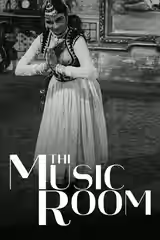
  1. The Music Room (1958, Fi1m 88)A landowner’s devotion to music makes for a sterner study of pride and loss.

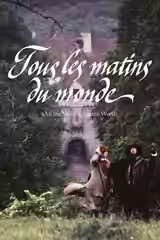
  2. Tous les matins du monde (1991) · not on Fi1m yetAnother musical life approached patiently, with room for difficult people and sustained listening.

  3. Topsy-Turvy (1999, Fi1m 88)Artistic work gets its due, including the awkward business of doing it together.

  4. Pina (2011) · not on Fi1m yetDance supplies the pleasure here, through another portrait assembled from performances and personal accounts.

  5. F for Fake (1973) · not on Fi1m yetA playful mixture of documentary and performance for anyone who enjoyed the shifting form.

Thirty Two Short Films About Glenn Gould (1993) review: An absorbing p (the Philippines) | Fi1m