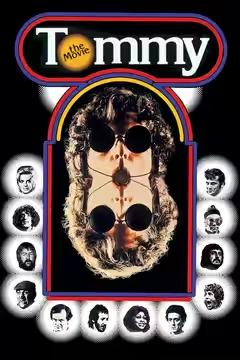
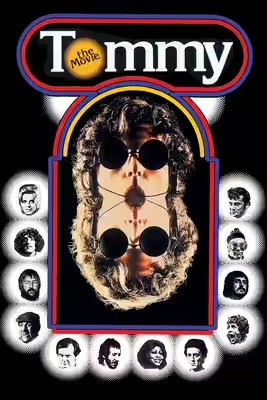
Ken Russell’s Tommy is a forceful, uneven rock musical whose performances justify much of the noise. We recommend it to anyone with a taste for theatrical excess and a reasonable tolerance for overstatement.
Ken Russell’s Tommy is a good rock musical whose excesses become tiring. We recommend it chiefly to those who enjoy theatrical extravagance and are prepared to accept some uneven storytelling. Ken Russell, who also writes the screenplay, treats Pete Townshend’s music as permission to make each number as emphatic as possible. There is pleasure in that freedom, but too many passages keep demanding our attention after we have already got the point.
Dick Bush, Robin Lehman and Ronnie Taylor share the cinematography credit, and the images have an extravagance to match the music. That suits the performances when the singer can command our attention without help, giving each number plenty of room to be theatrical. Elsewhere, the pictures seem unwilling to leave a performance alone, and the effort becomes distracting. We need some variation in the amount of visual activity, if only to appreciate how much work has gone into it.
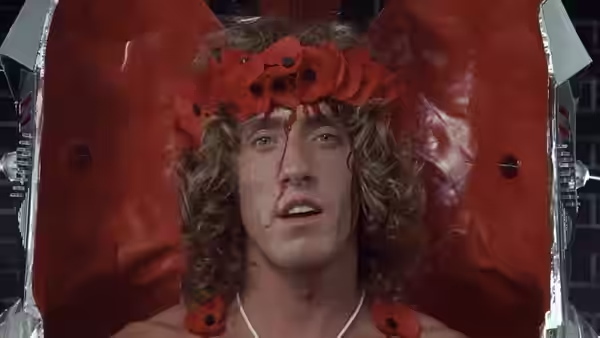
Ann-Margret, as Nora, does the most useful work of the principal cast. Her expressiveness lets us find a human response in scenes that might otherwise be remembered only for their display. Roger Daltrey’s Tommy gives the film its centre, but Nora is often the person we find ourselves watching. It helps to have a performance that can be as expansive as the film without making every emotion feel like another special attraction.
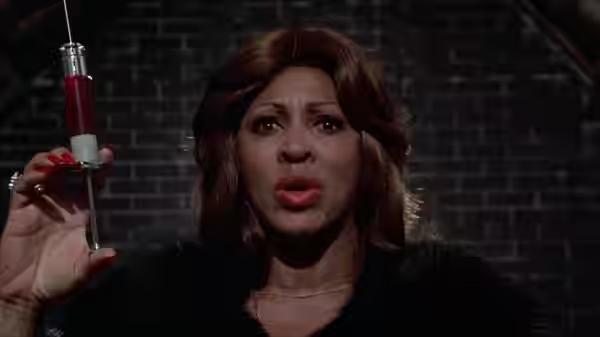
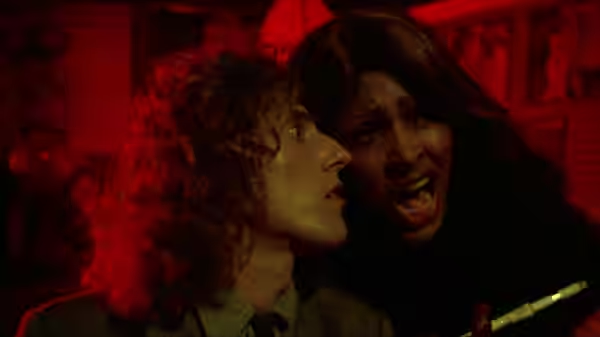
We were exhilarated by Tina Turner’s performance as The Acid Queen. The force of her singing makes the surrounding extravagance feel necessary, because the pictures have a performer strong enough to compete with them. Elton John, as The Pinball Wizard, brings another welcome burst of pleasure: his number has a liveliness that the film cannot sustain throughout. These performances make a persuasive case for a musical’s freedom to interrupt its story, provided the interruption is worth having.
Pete Townshend’s music gives the film a firmer identity than Ken Russell’s screenplay gives its dramatic connections. The songs can carry the extravagance, although the insistent sound eventually left us tired. Stuart Baird’s editing helps the individual numbers register, but the joins between them do not always persuade us that the whole film needs this much emphasis. There is too little time between high points for either the music or the drama to settle. At 111 minutes, Tommy feels longer than its running time whenever the excitement becomes routine.
At home, the temptation may be to turn it down until it becomes a more manageable entertainment. We suspect that would remove some of the pleasure without solving the problem, since the visual insistence would remain. This is a film for an evening when everyone has agreed to something loud. Do not choose it as a compromise.