A person covered in baked beans presses both hands over their face
Film review

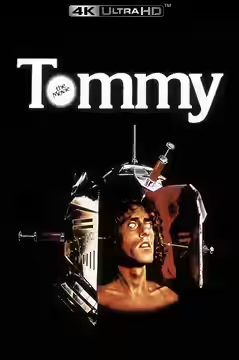
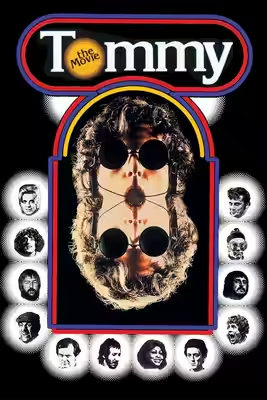
Tommy

1975 · Directed by Ken Russell · 1h 51m

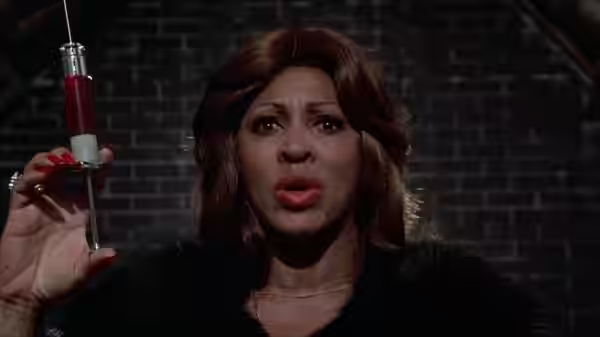
In a sentenceTina Turner sings as though somebody has suggested turning the volume down

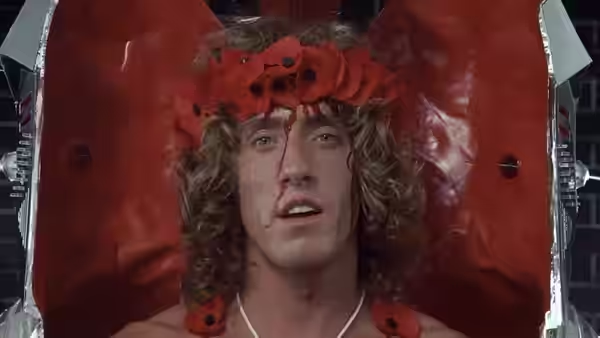
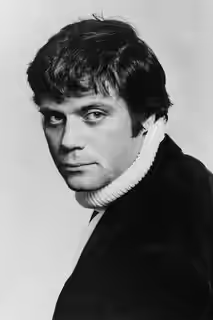
Tommy (Roger Daltrey), Nora (Ann-Margret) and Frank (Oliver Reed) are the principal characters in Ken Russell’s musical drama. Its cast extends to The Preacher (Eric Clapton), The Priest (Arthur Brown) and The Specialist (Jack Nicholson), alongside Cousin Kevin (Paul Nicholas) and Uncle Ernie (Keith Moon). Tina Turner plays The Acid Queen, while Elton John appears as The Pinball Wizard. Ken Russell also writes the screenplay, with Pete Townshend providing the music for a story told through rock performance.

Plays from YouTube when you press play; nothing loads from them until then.

Fi1m review

Ken Russell’s Tommy is a forceful, uneven rock musical whose performances justify much of the noise. We recommend it to anyone with a taste for theatrical excess and a reasonable tolerance for overstatement.

Ken Russell’s Tommy is a good rock musical whose excesses become tiring. We recommend it chiefly to those who enjoy theatrical extravagance and are prepared to accept some uneven storytelling. Ken Russell, who also writes the screenplay, treats Pete Townshend’s music as permission to make each number as emphatic as possible. There is pleasure in that freedom, but too many passages keep demanding our attention after we have already got the point.

Dick Bush, Robin Lehman and Ronnie Taylor share the cinematography credit, and the images have an extravagance to match the music. That suits the performances when the singer can command our attention without help, giving each number plenty of room to be theatrical. Elsewhere, the pictures seem unwilling to leave a performance alone, and the effort becomes distracting. We need some variation in the amount of visual activity, if only to appreciate how much work has gone into it.

Ann-Margret, as Nora, does the most useful work of the principal cast. Her expressiveness lets us find a human response in scenes that might otherwise be remembered only for their display. Roger Daltrey’s Tommy gives the film its centre, but Nora is often the person we find ourselves watching. It helps to have a performance that can be as expansive as the film without making every emotion feel like another special attraction.

We were exhilarated by Tina Turner’s performance as The Acid Queen. The force of her singing makes the surrounding extravagance feel necessary, because the pictures have a performer strong enough to compete with them. Elton John, as The Pinball Wizard, brings another welcome burst of pleasure: his number has a liveliness that the film cannot sustain throughout. These performances make a persuasive case for a musical’s freedom to interrupt its story, provided the interruption is worth having.

Pete Townshend’s music gives the film a firmer identity than Ken Russell’s screenplay gives its dramatic connections. The songs can carry the extravagance, although the insistent sound eventually left us tired. Stuart Baird’s editing helps the individual numbers register, but the joins between them do not always persuade us that the whole film needs this much emphasis. There is too little time between high points for either the music or the drama to settle. At 111 minutes, Tommy feels longer than its running time whenever the excitement becomes routine.

At home, the temptation may be to turn it down until it becomes a more manageable entertainment. We suspect that would remove some of the pleasure without solving the problem, since the visual insistence would remain. This is a film for an evening when everyone has agreed to something loud. Do not choose it as a compromise.

Critical consensus AI synthesised

67
Positive
6
Mixed
1
Negative
1

Most critics respond positively to Tommy, praising the energy of Ken Russell’s adaptation and the extravagant imagery he brings to The Who’s music. Praise clusters around the musical performances: Tina Turner’s Acid Queen and Elton John’s Pinball Wizard receive particular attention, while Ann-Margret gives the surreal proceedings an expressive human centre. The favourable reviews tend to accept the film’s excesses as part of its appeal, finding force and entertainment even where its construction is uneven.

The reservations concern overstuffing, inconsistency and a visual style that can overwhelm; The AV Club also finds the music dated-sounding. The spread is wide, though most reviews lean towards admiration rather than rejection. Penelope Gilliatt in The New Yorker supplies the sharpest dissent, arguing that the bombastic sound and imagery defeat the satire and leave a self-important commercial in its place.

Variety
31 December 1974 · Variety Staff
90*

The review finds Ken Russell’s film spectacular in nearly every way. It praises the visual dimension added to The Who’s album and singles out Tina Turner’s performance as especially forceful.

Read the full review →
The AV Club
1 September 2010 · B+ · Noel Murray
83

Murray finds the film powerful despite its excesses and dated-sounding music. He praises its ferocious musical performances and Russell’s visually extravagant set pieces.

Read the full review →
Little White Lies
20 November 2019 · 3/4/4 · BP Flanagan
80

The critic finds the film wildly entertaining but overstuffed and inconsistent, calling it a glorious monument to a bygone era. Ann-Margaret’s expressive performance is singled out for grounding its surreal, image-heavy proceedings.

Read the full review →
Sight and Sound
27 November 2019 · Jonathan Rosenbaum
70*

Rosenbaum finds the adaptation uneven but energetic, a fitting meeting of Russell’s theatrical sensibility and Townshend’s rock opera. He particularly praises Tina Turner’s Acid Queen sequence and Elton John’s lively Pinball Wizard number.

Read the full review →
The Guardian
27 March 1975 · Derek Malcolm
70*

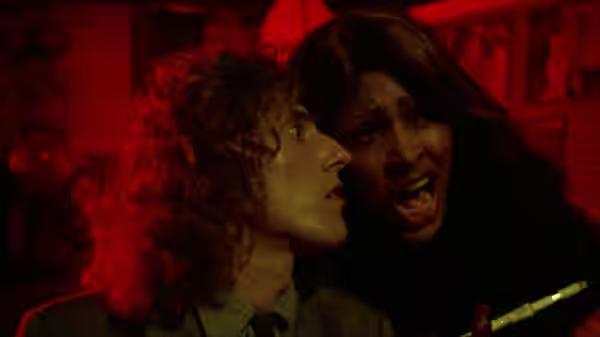
Malcolm finds the film an extraordinary, audacious blend of rock music and Russell’s visual style, though its excess may overwhelm some viewers. He especially praises the Pinball Wizard sequence and the energetic performances, singling out Ann-Margret’s baked-bean breakdown as unforgettable.

Read the full review →
Time Out
· GA
70*

The available description presents Russell's film as formally undisciplined but significant. It praises his early break from realism's strictures.

Read the full review →

Straight answers AI written, from our review

Is Tommy worth watching?
Tommy is worth watching for its forceful performances and theatrical extravagance, and we score it 74 out of 100. Tina Turner and Elton John provide particular pleasure, but the uneven storytelling and relentless visual and musical emphasis make it tiring; we recommend it chiefly to those who enjoy a loud, excessive rock musical.
How long is Tommy, and what is it rated?
Tommy runs 1h 51m. It is a drama and music film.
Where can I watch Tommy in Croatia?
Tommy is not on any streaming or rental service in Croatia at the moment. It is available in 3 other countries; change your country at the top of the page to see where. Availability is checked daily.
How violent or frightening is Tommy, and is it suitable for children?
Tommy carries a UK 15 certificate, so it is not suitable for children under 15 despite its US PG rating. The certificate indicates material requiring caution for younger viewers, but we cannot specify levels of violence or fright from our review; we do flag relentless sound and visual activity that can become tiring.
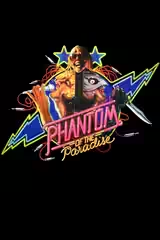
How does Tommy compare to Phantom of the Paradise?
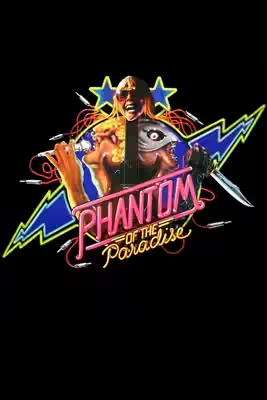
Tommy offers forceful singing and theatrical excess, while Phantom of the Paradise is the stronger choice for sharp satire about who profits from the music. We recommend Tommy for its standout performances, especially Tina Turner’s; we favour Phantom of the Paradise for humour and songs, though its visual bustle also leaves some performers fighting for space.
What should I watch after Tommy?
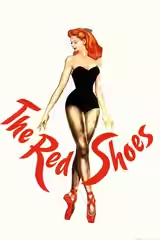
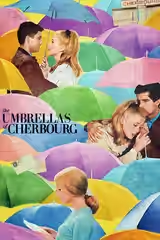
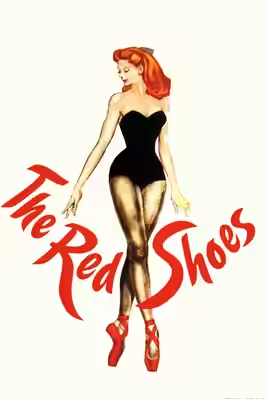
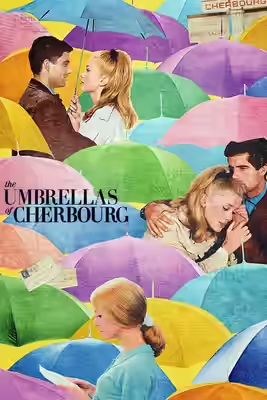
After Tommy, try Phantom of the Paradise (1974, Fi1m 82): Another unruly rock musical, with sharper satire about who profits from the singing. Then The Red Shoes (1948, Fi1m 92): For theatrical spectacle that gives its performers’ suffering more room to register; and The Umbrellas of Cherbourg (1964, Fi1m 88): Sung drama with disciplined colour and considerably more patience for ordinary human disappointment.

Cast

Awards

Academy Awards, 1976

Nominated
Best Actress
Nominated
Best Original Song Score

If you liked this, try…

  1. The Devils (1971) · not reviewed yetKen Russell pursues religious spectacle with still more anger and less musical relief.

  2. Phantom of the Paradise (1974, Fi1m 82)Another unruly rock musical, with sharper satire about who profits from the singing.

  3. The Red Shoes (1948, Fi1m 92)For theatrical spectacle that gives its performers’ suffering more room to register.

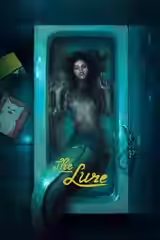
  4. The Lure (2015) · not reviewed yetA Polish musical whose strange appetites make its songs feel dangerous.

  5. The Umbrellas of Cherbourg (1964, Fi1m 88)Sung drama with disciplined colour and considerably more patience for ordinary human disappointment.

Free account

Know what to watch tonight

Two lists that know where things are streaming, collections you can share, your own score beside ours, and Discover that remembers what you have seen.

  • Want to see, sorted by what is streaming now
  • Seen, with your score out of ten
  • No adverts, ever