Jason Reitman’s comedy about a man who fires people for a living is smooth, funny and well cast, and its best scenes belong to the sacked. The romance is slighter, and the last half hour reaches for a lesson it has not earned.
Ryan Bingham fires people. Companies that cannot face doing it themselves hire his firm, and he flies in, sits across a table from a stranger, explains that their position is no longer available and hands over a folder. He does this most days, and Jason Reitman’s film, written with Sheldon Turner from Walter Kirn’s novel, is about how much he enjoys it. It is a smooth, funny, well-cast 110 minutes with one great subject and one merely pleasant one, and it gives most of its time to the pleasant one.
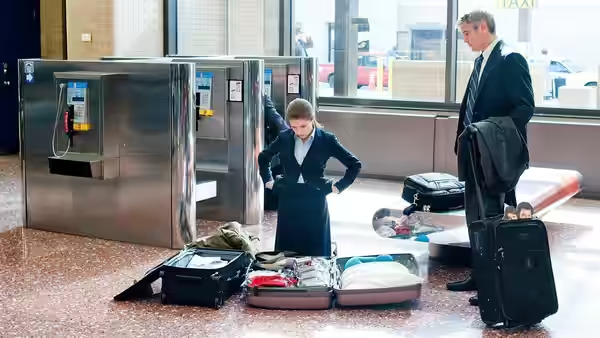
Clooney is exactly right for it. He plays Ryan as a man who has turned having no home into a set of skills, and the early stretch is a demonstration. Dana E. Glauberman cuts his packing and his walk through airport security to a brisk beat, shoes off, laptop out, belt coiled, and it plays like a routine he has rehearsed ten thousand times. Eric Steelberg lights the lounges and hotel corridors in a clean, cool, even light, so that everywhere Ryan goes looks like everywhere else, which is what he likes about it. Steve Saklad gives him rooms that could be in any city and one flat in Omaha with almost nothing in it. Danny Glicker puts him in grey suits that never crease.
The best scenes are the firings. Reitman has put people who had recently lost their real jobs alongside the actors, and they talk to camera about what the work meant to them, and you can hear the difference. J.K. Simmons has one scene as Bob, a man who opens a folder of his children’s photographs, and Clooney’s answer to him is the only moment the film lets Ryan be good at his job for someone else’s sake. We found these scenes far harder to watch than the light tone around them had led us to expect. Nobody shouts. People ask what they are supposed to do on Monday morning. The camera stays on their faces and the film, for once, does not cut away.
Vera Farmiga’s Alex meets Ryan in a hotel bar and they flirt by comparing loyalty cards, which is funnier and warmer than it has any right to be. Farmiga plays her as his match in every particular, a woman who travels as much as he does and asks for as little, and their scenes have the easy pace of two people who expect nothing. Anna Kendrick’s Natalie is the film’s engine. She arrives with a plan to do the firing by video link and ground the whole staff, and Kendrick gives her a rigid, over-prepared brightness that cracks a little further each time the road takes something off her. Jason Bateman, as the boss who sends the pair out together, does his dry executive turn and does it well.
The trouble is the last half hour. Ryan is called home to Wisconsin for the wedding of his sister Julie (Melanie Lynskey) to Jim (Danny McBride), and a film that has been so exact about airports goes vague about families. Amy Morton, as his sister Kara, has the one scene there that lands, a long look at a brother who has missed everything. Then the script decides Ryan must learn something, and arranges events so that he does. We will not say what happens. We will say that a film which had been content to watch a man and let us judge him starts, in its final stretch, to judge him for us, and the soundtrack helps it along. Rolfe Kent’s score is light and unobtrusive; the songs laid over the travel montages are used often enough that by the fourth we were counting.
Reitman’s Thank You for Smoking (2005) took a man with an indefensible job and never once asked him to apologise, and it was sharper for it. Juno (2007) was warm and knew it. Up in the Air wants both and settles the question by being kind to Ryan at the end, which is the least interesting thing it could do with him. The opening, fields and cities seen from a great height while Sharon Jones sings ‘This Land Is Your Land’, promises a film about the country. What follows is a film about one man, and the country stays outside the window.
See it for the firings, for Kendrick, and for Clooney and Farmiga in a hotel bar. It plays well at home, where something this smooth goes down easily and its lesson, when it comes, is easier to forgive. It runs 110 minutes and carries a 15.