Film review

Vice

2018 · Directed by Adam McKay · 2h 12m · MPA R

In a sentenceTwo hours of Christian Bale not raising his voice while the editing does it for him

DramaComedyHistory

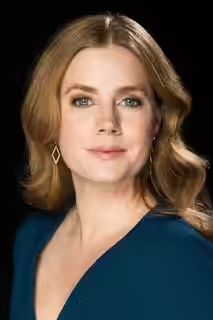
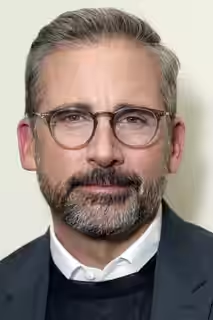
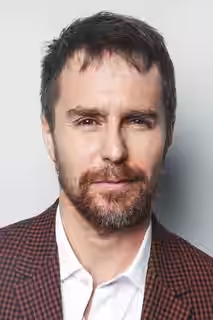
Wyoming, 1963. Dick Cheney (Christian Bale) is a Yale drop-out stringing power lines and drinking, until his wife Lynne (Amy Adams) tells him to make something of himself or lose her. By the end of the decade he is an intern in Washington, attaching himself to Donald Rumsfeld (Steve Carell), a foul-mouthed congressman on a fast rise through the Nixon administration. Cheney learns to say little, stand near power and wait until it notices him. A narrator called Kurt (Jesse Plemons), whose connection to Cheney the film withholds, leads us from the young lineman to the heavy, quiet man in the White House bunker on 11 September 2001, who will serve George W. Bush (Sam Rockwell) as vice president.

Plays from YouTube when you press play; nothing loads from them until then.

Fi1m review

Christian Bale’s Dick Cheney is a remarkable piece of impersonation, heavy, quiet and watchful, and Adam McKay builds around it a film so busy telling us what to think that it never finds out what the man thought. Funny in bursts, wearying by the end.

Adam McKay’s film about Dick Cheney opens with a caption admitting that its subject is one of the most secretive men in American history and that the film has done its best. That best runs 132 minutes, carries a 15 certificate, and uses every device McKay tried in The Big Short (2015) and a few he did not: a narrator, freeze frames, cutaways to fishing lures and a beating heart, captions that argue with the pictures. At the centre of it, saying almost nothing, is Christian Bale, and he is the reason to see it.

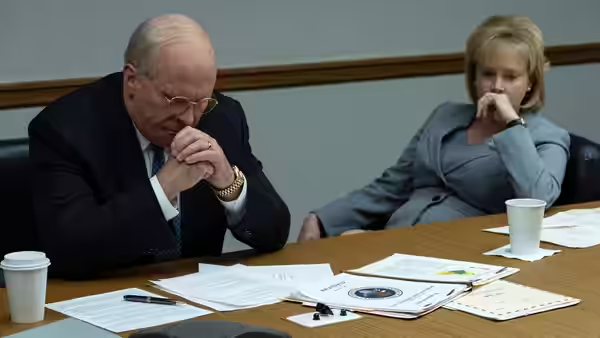
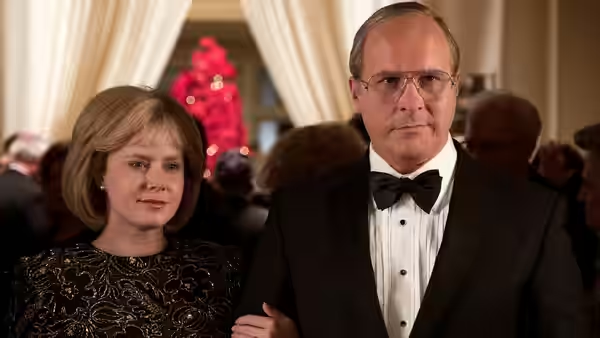
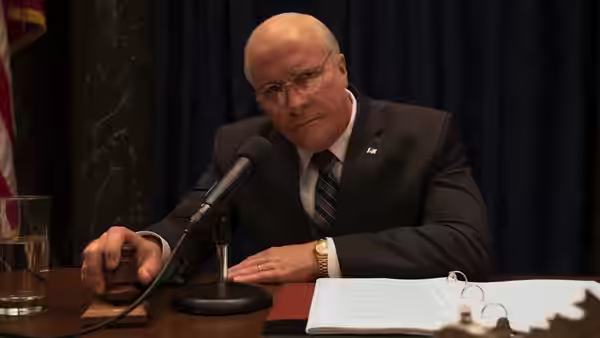
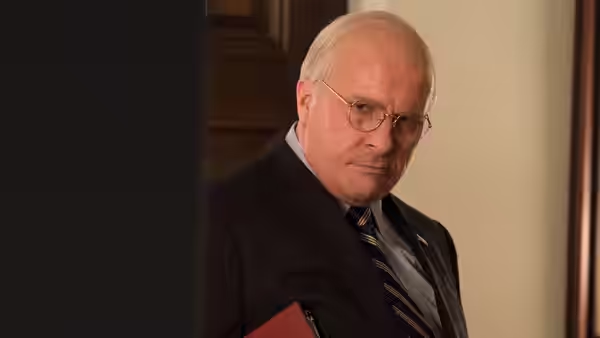
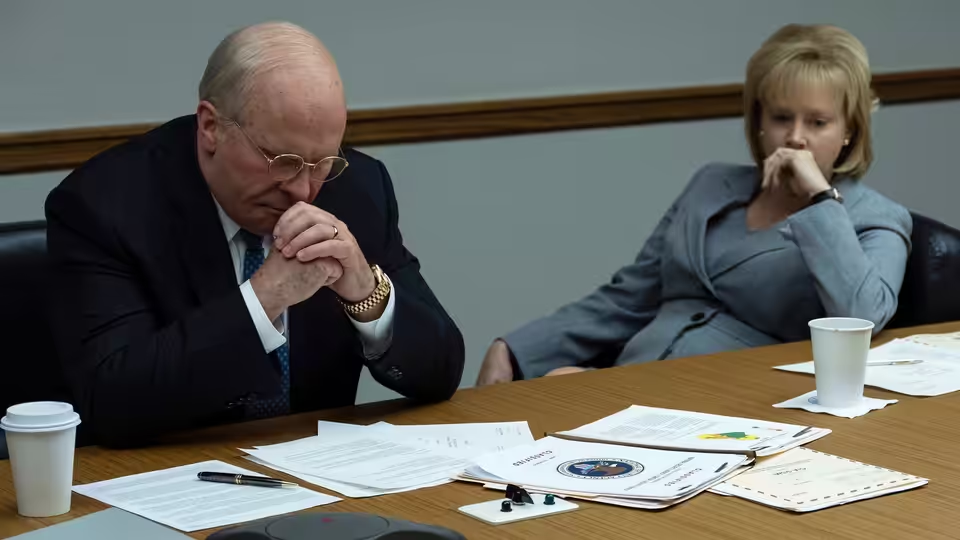
Bale plays Cheney heavy, bald and slow, talking out of one side of his mouth in a voice that never rises. He does not do a turn. He plays a man who has noticed that nobody watches the quiet one, and uses it. His best moments are the ones in which nothing happens: Cheney at the back of a room, Cheney listening to a phone, Cheney deciding in silence to want something. Amy Adams gives Lynne the ambition her husband has to be lent, and their early scenes in Wyoming, with the future laid out across a kitchen table, are the film’s most honest drama.

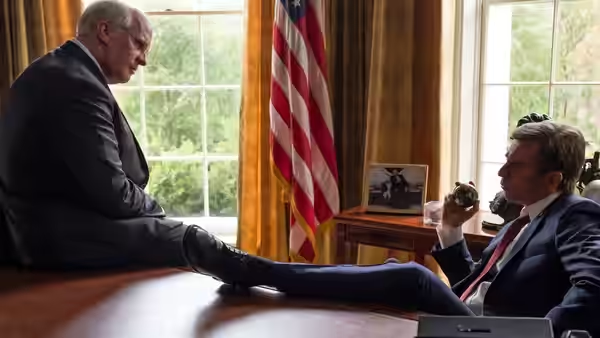
Steve Carell’s Rumsfeld is a grinning bully who laughs out loud when the young Cheney asks him what they believe in. Bill Camp is a decent, harassed Gerald Ford. Sam Rockwell plays George W. Bush as an amiable man eating fried chicken while giving away the store, and we laughed, then felt slightly ashamed of ourselves, because the joke depends on our already having decided he was a fool, and the film never checks whether we have. Alison Pill and Lily Rabe, as the daughters Mary and Liz, are the one place the script finds something the public record does not already say, and it saves them for last and handles them with a quiet the rest of the film does not have.

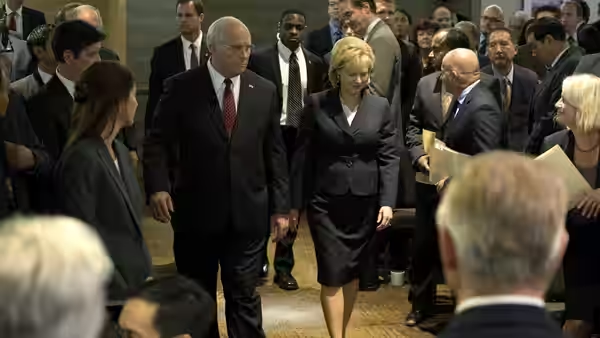
The craft is real. Greig Fraser shoots the Nixon and Ford years in dun browns and fluorescent office light, so that power looks like a corridor with a carpet. Patrice Vermette dresses the White House as a run of small, over-furnished rooms. Susan Matheson keeps Cheney in the same boxy suit across four decades and lets his body change inside it. Nicholas Britell’s score is the film’s wittiest element, martial brass played a little too grandly for whatever is on screen, and it does more satire on its own than any of the captions.

Hank Corwin’s editing is where the argument happens, and where the trouble is. Corwin cuts a Cheney handshake to a fish taking a hook, a legal memo to a heart pumping, a cabinet meeting to a river in Wyoming, and for half an hour this is exciting. Then it does not stop. Every time Bale has built a silence, the film cuts away to explain what the silence meant. By the second hour we were watching a lecture with a very good actor in the corner of the frame, and we were angry, partly at Cheney, as intended, and partly at a film that would not trust us to get there on our own.

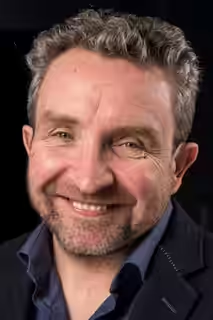
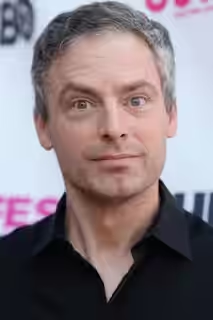
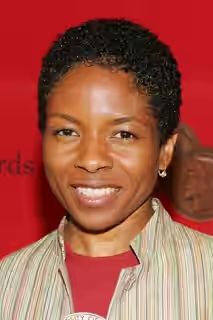
The unitary executive theory, the idea that a president may do anything he decides is within his office, is explained twice, once as a comic sketch and once in text on screen. The Iraq invasion, the camps and the torture memos arrive as a montage of headlines. Eddie Marsan, Justin Kirk and LisaGay Hamilton, as Wolfowitz, Libby and Rice, each get a scene in which to look shifty or worried. None of this is untrue; almost none of it is dramatised.

The Big Short worked because its subject was a system and the sketches were the only way in. Cheney is a man, and the film could have gone and looked at him. McKay is so sure of what he would find that he never does, and Bale, who plainly did the looking, spends the film answering questions his director keeps interrupting. It is worth an evening for him and for Adams. Watch it at home, where you can pause on the captions and let the performance breathe, which the cut never does.
Critical consensus AI synthesised

66
Positive
15
Mixed
5
Negative
5

Most critics come down in favour, and on one point they are nearly unanimous: Christian Bale’s performance as Dick Cheney. Reviews describe it as transformative, uncannily convincing and the film’s dramatic centre; even the hostile notices concede it. Amy Adams draws steady praise in support, and those who enjoy the film enjoy Adam McKay’s formal games too: the freeze frames, the cutaways, the fourth-wall breaks, the narrator trick. To its admirers it is angry, funny and timely.

The reservations cluster on McKay himself. A sizeable minority find the gimmicks glib and the satire smug, preaching to people who already agree and offering anger where insight is wanted. The AV Club calls Bale the film’s sole virtue. Little White Lies thinks it turns Cheney into a Bond villain and flattens complicated politics into conspiracy. The Wrap argues the comic approach is the wrong one for so grim a subject. The spread is wide, running from raves to flat dismissals.

Los Angeles Times
21 December 2018 · Kenneth Turan
90*

Brainy, audacious, and fun, the savage satire is a tonic for troubled times that delights in throwing everything on screen and playing games with structure while delivering a dark warning about ignoring facts. It succeeds through committed acting, especially Bale’s transformative portrayal of Cheney and Adams as his driving force.

Read the full review →
The Hollywood Reporter
17 December 2018 · Todd McCarthy
90*

McKay delivers a scorchingly audacious dark tragicomedy about Cheney's rise that illuminates history with buoyant humor and depth. Bale's transformative performance as the shape-shifting Cheney is singled out for particular praise.

Read the full review →
Empire
20 January 2019 · Andrew Lowry
80*

It is smart filmmaking from a director who improves with every film and features a near career-best from Bale. The film mixes formal games and strong performances to deliver an angry lesson in American civics.

Read the full review →
Radio Times
22 January 2019 · ★★★★ · Terry Staunton
80

McKay's savage satire chronicles Cheney's career as a sinister true-life drama of Shakespearean proportions, with standout performances especially Bale's uncannily convincing portrayal. The gimmicks and showboating make it divisive, but the calibre of the acting is inarguable.

Read the full review →
The Guardian
17 December 2018 · Peter Bradshaw
80*

The critic finds the film entertaining and nihilistic, with a standout central performance from Christian Bale as the blandly magnificent Dick Cheney. McKay's meta gags and structural tricks are effective, making it stronger than his previous effort The Big Short.

Read the full review →
Time Out
18 December 2018 · ★★★★ · Joshua Rothkopf
80

McKay delivers a daringly impressionistic biopic anchored by Bale's astounding, vicious performance as Cheney, with radical editing and audiovisual flair that feels timely. Some metaphors and bookends strain, but the jazzy momentum and pop-cultural details carry it.

Read the full review →

Cast

Awards

Academy Awards, 2019

Nominated
Best Picture

If you liked this, try…

The Big Short poster80

The Big Short

2015 · McKay’s same tricks on a subject that actually needed them; funnier and clearer

Nixon poster

Nixon

1995 · Oliver Stone gives a hated president three hours and, crucially, the benefit of curiosity

Il Divo poster

Il Divo

2008 · Sorrentino’s Andreotti: another quiet, unreadable man, shot like a horror film

In the Loop poster86

In the Loop

2009 · The run-up to a war as a farce of memos, meetings and men out of their depth

The Death of Stalin poster83

The Death of Stalin

2017 · Power struggle as slapstick, with the bodies kept firmly in frame