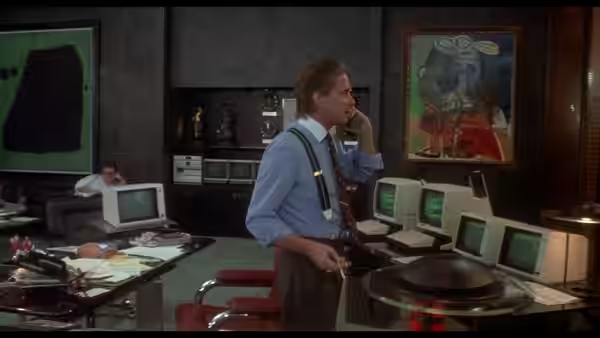
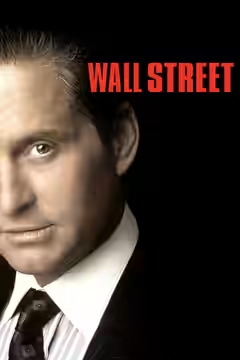
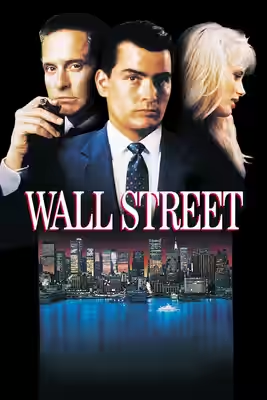
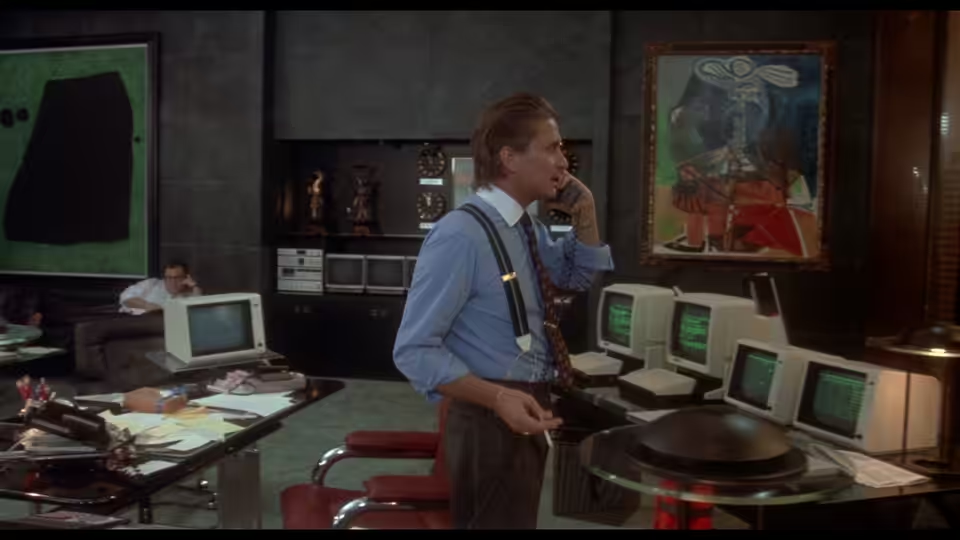
Bud Fox (Charlie Sheen) talks on the phone in a cluttered trading office
Film review

Wall Street

1987 · Directed by Oliver Stone · 2h 06m

In a sentenceMichael Douglas could make a lecture on greed sound like a job offer

Bud Fox (Charlie Sheen) is a young broker trying to make his way in the investment business. Gordon Gekko (Michael Douglas) is a corporate raider who treats the pursuit of profit as a guiding principle. As Bud pursues money and advancement, the business of trading draws him towards choices that test his values. Oliver Stone directs this crime drama about ambition, corporate raiding and the appeal of material wealth. The cast also includes Martin Sheen as Carl Fox, Daryl Hannah as Darien Taylor and Hal Holbrook as Lou Mannheim.

Plays from YouTube when you press play; nothing loads from them until then.

Fi1m review

Michael Douglas makes Gordon Gekko persuasive enough to trouble us, and Oliver Stone keeps the financial dealings brisk. We recommend Wall Street for that performance, though the script explains its morals long after we have understood them.

Oliver Stone’s Wall Street is a good crime drama, worth seeing for Michael Douglas even when the writing grows blunt. It wants to show how a young broker can learn to treat making money as permission to do almost anything. Stone makes that temptation persuasive, then keeps interrupting to explain why we should resist it. The pace helps, and Douglas is such an enjoyable presence that the lectures remain a tolerable fault.

As Gordon Gekko, Douglas gives ruthlessness the ease of a man who no longer expects to be challenged. His charm matters as much as his aggression: we can understand why somebody might mistake his confidence for wisdom. We were more persuaded than we wanted to be when Gekko speaks in defence of greed. Douglas makes his certainty enjoyable to listen to, which leaves us with the uncomfortable job of checking what we have just accepted. His performance gives us enough to recognise the danger without further explanation.

Charlie Sheen has a harder task as Bud Fox, the young broker whose ambition supplies the story. He makes the wanting legible, but Stone and co-writer Stanley Weiser give him too little to think about beyond the moral choice in front of him. Beside Gekko, he can seem like somebody waiting for his next instruction from the screenplay. Martin Sheen’s Carl Fox brings a welcome steadiness to a film that is otherwise keen to keep pushing.

Robert Richardson’s moving camera suits people who seem unable to stop measuring their progress. Its restlessness gives the financial talk physical urgency, and helps make trading feel like dramatic action rather than a subject requiring a diagram. Claire Simpson’s editing sustains that pace, keeping the verbal exchanges from becoming exhausting. We need not understand every term to follow the competition, because the desire to get ahead is always comprehensible.

Stephen Hendrickson’s production design makes the expensive surroundings tempting enough to explain some of Bud’s hunger. We need to believe that this comfort is desirable, and the film allows us to look before asking us to disapprove. Stewart Copeland’s score adds to the impatience, helping the financial business hold our attention. The combined effect is persuasive: the pursuit of wealth looks exciting, and the people doing the pursuing have plenty of encouragement to keep going.

The weakness is Stone and Weiser’s lack of confidence in what the audience can infer. Their longer statements about money leave less space for the characters to surprise us, and the broader dramatic writing can make a difficult decision seem prearranged. The objections to Gekko deserve to be as interesting as Gekko himself. Instead, we too often hear the film setting out the correct position, after Douglas has made the wrong one sound far more inviting.

Crime dramas need to make wrongdoing attractive if they want us to understand why anybody bothers with it. On that measure, Wall Street works: Douglas makes the invitation credible, and Stone gives the business enough energy to sustain our attention. The lack of subtlety is a real limitation, but it does not cancel out the pleasure of watching an actor control a film so completely. Choose it for Douglas; patience with the lectures is the price.

Critical consensus AI synthesised

67
Positive
6
Mixed
1
Negative
2

Most critics find Wall Street an absorbing, if unsubtle, morality tale, with praise concentrated on Michael Douglas’s Gordon Gekko. His charm, ruthlessness and persuasive delivery make the corporate raider compelling even in reviews that dislike the film around him. The energetic camerawork and immersion in financial language also earn approval, helping Oliver Stone capture the appeal of the wealth and excess he sets out to condemn.

The reviews divide over how effectively that condemnation works, with a wide spread between enthusiasm and outright dissatisfaction. RogerEbert.com sees a radical critique of a value system built around the deal; Time Out finds muddled moralising and a film seduced by the luxury it attacks. Reservations elsewhere cluster around blunt lessons, simplistic character development and melodrama. Even several favourable reviews suggest that Gekko makes greed more attractive than the case against it, leaving Douglas’s performance as the clearest point of agreement.

RogerEbert.com
11 December 1987 · ★★★½/4 · Roger Ebert
88

The film offers a radical critique of the capitalist trading mentality and the value system that places the deal above all else. Michael Douglas delivers a chilling, convincing performance as the ruthless corporate raider Gordon Gekko.

Read the full review →
Radio Times
★★★★ · John Marriott
80

Stylish morality tale with strong performances, especially Michael Douglas as Gekko; neurotic camera movements fit the theme.

Read the full review →
Slant Magazine
15 September 2007 · ★★★/4 · Fernando F. Croce
75

The review acknowledges ambivalence in Stone's attack on 1980s excess, noting Gekko emerges as a complex, charismatic villain whose appeal undercuts the moralizing. It singles out the dynamic camerawork and supporting performances for praise while criticizing the blunt, melodramatic narrative and lack of complexity in the protagonist.

Read the full review →
The AV Club
10 October 2007 · B- · Scott Tobias
70

The review calls Wall Street one of Stone's more tolerable efforts for capturing the period's material excesses, though it faults the heavy-handed morality tale and simplistic character arcs. It singles out the intoxicating fiscal-speak and Douglas's compelling 'greed is good' speech as making sin more attractive than the sermon against it.

Read the full review →
The New York Times
11 December 1987 · Vincent Canby
70*

Stone's Wall Street is an upscale morality tale about ambition and greed that entertains achievers while touching on moral centers. The standout is Michael Douglas's witty, charming portrayal of the ruthless corporate raider Gordon Gekko.

Read the full review →
Los Angeles Times
11 December 1987 · Sheila Benson
40*

The film is a slick, fast-paced entertainment with razzle-dazzle but becomes preachy and thin, bottoming out as simplistic moralizing. Michael Douglas's ferocious performance as Gekko is a highlight amid the moral bankruptcy.

Read the full review →

Straight answers AI written, from our review

Is Wall Street worth watching?
Wall Street is worth watching for Michael Douglas, whose Gordon Gekko makes greed sound like sensible advice, and we scored it 74. Oliver Stone keeps the trading brisk enough that nobody needs a diagram to follow it. The script explains its morals long after we have understood them, so some patience with the lectures is required.
How long is Wall Street, and what is it rated?
Wall Street runs 2h 06m. It is a crime and drama film.
Where can I watch Wall Street in Israel?
Wall Street is available to rent from Apple TV from ₪16.90. Availability is checked daily; the links above go straight to each service.
How violent or frightening is Wall Street, and is it suitable for children?
Wall Street carries a UK 15 certificate, and its adult content is a matter of language, dishonesty and the pursuit of money rather than violence or fear. It is a crime drama about corporate raiding, and nothing in it is designed to frighten. Younger children would find it dull rather than disturbing; teenagers who can follow a boardroom argument will be fine.
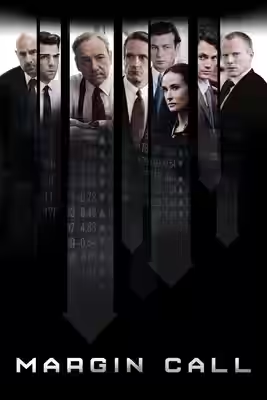
How does Wall Street compare to Margin Call?
Wall Street is the more entertaining film of the two, because Michael Douglas gives it a villain worth listening to; Margin Call is the more disciplined. J.C. Chandor treats a financial crash as one night of office work and declines to say who is to blame, where Oliver Stone keeps stopping to tell us. Choose Stone's film for the performance and Chandor's for the tension.
What should I watch after Wall Street?
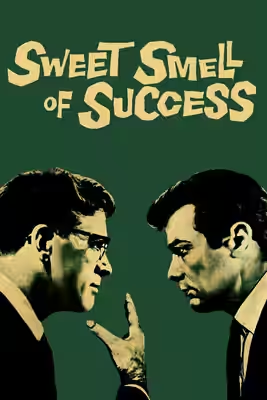
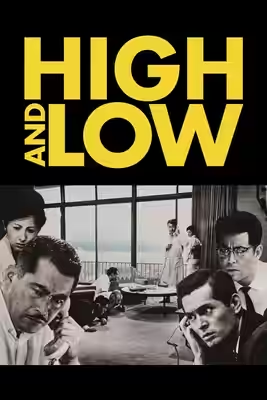
After Wall Street, try Margin Call (2011, Fi1m 82): Financial panic treated as office work, with the moral excuses left audible. Then Sweet Smell of Success (1957, Fi1m 88): Another ambitious young man discovers what a powerful patron expects in return; and High and Low (1963, Fi1m 90): A businessman’s wealth becomes a practical moral problem rather than an achievement.

Cast

Awards

Academy Awards, 1988

Won
Best Actor

Golden Raspberry Award for Worst Supporting Actress, 1988

Won
Golden Raspberry Award for Worst Supporting Actress

If you liked this, try…

  1. Margin Call (2011, Fi1m 82)Financial panic treated as office work, with the moral excuses left audible.

  2. Sweet Smell of Success (1957, Fi1m 88)Another ambitious young man discovers what a powerful patron expects in return.

  3. High and Low (1963, Fi1m 90)A businessman’s wealth becomes a practical moral problem rather than an achievement.

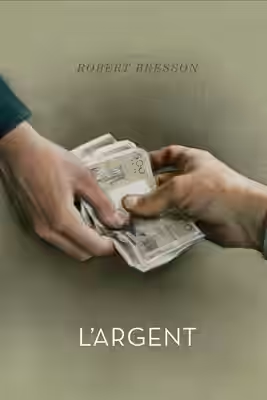
  4. L'Argent (1983, Fi1m 88)Money passes between strangers, and the damage keeps spreading beyond the transaction.

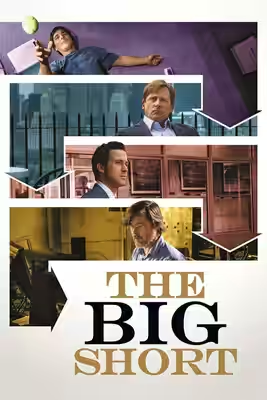
  5. The Big Short (2015, Fi1m 80)Financial jargon becomes black comedy, with sharper attention to who pays afterwards.

Free account

Know what to watch tonight

Two lists that know where things are streaming, collections you can share, your own score beside ours, and Discover that remembers what you have seen.

  • Want to see, sorted by what is streaming now
  • Seen, with your score out of ten
  • No adverts, ever