Nancy Meyers gets some good laughs from a premise that deserved tougher handling. Mel Gibson supplies the charm, but the film gives its newly attentive man rather too much credit for listening.
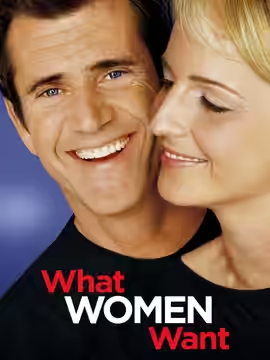
The joke in What Women Want is simple enough: a man who can hear women’s thoughts must finally pay attention to them. Nancy Meyers makes a fitfully funny romantic comedy that is too willing to forgive its leading man. We can enjoy Mel Gibson’s comic energy without accepting every excuse made for Nick Marshall, and the film gives us ample time to notice the difference. It runs 127 minutes.
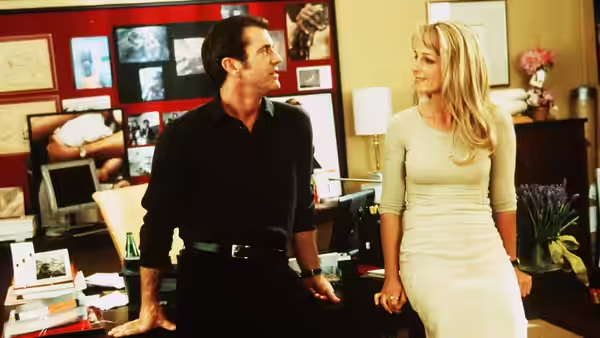
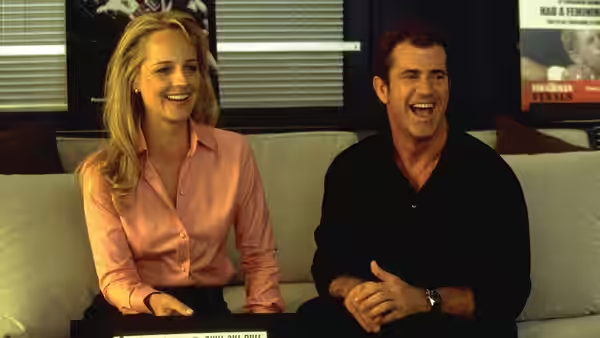
Mel Gibson gives the premise its necessary comic momentum, letting Nick Marshall look foolish without making him cease to be pleased with himself. We laughed at the way his confidence falters under the intrusion of women’s thoughts. His reactions do more for the joke than the mere fact that we can hear those thoughts, and Nancy Meyers knows to let him carry it. The trouble is that being amusing so often seems to count as sufficient evidence that he deserves our affection.
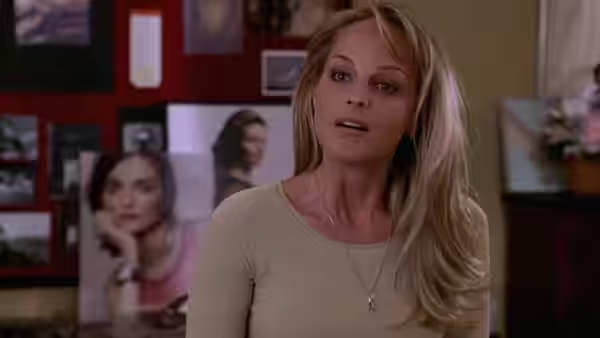
Helen Hunt gives Darcy McGuire a welcome firmness, making her seem capable of having a life when Nick Marshall is not there. That should be a modest achievement; here it matters. Marisa Tomei brings Lola enough personality to make us want the film to give her more room. Both performances make us notice how often the women have to establish their importance through their effect on the man, even when the premise apparently promises to let them speak for themselves.
Dean Cundey’s cinematography keeps the performers easy to read, which matters when the joke depends on a reaction to something nobody else can hear. Jon Hutman’s production design adds an air of comfort that suits the romance, though we wanted less reassurance around a man who needs challenging. The film is pleasant to look at without giving the eye much independent work. Its polish helps the actors, but does little to sharpen the comedy.
Alan Silvestri’s music is most useful when it supports the comedy’s lightness, less so when it presses us towards affection the writing has not quite earned. Editors Thomas J. Nordberg and Stephen A. Rotter keep individual exchanges moving, but the film as a whole feels slow to finish making its point. Its changes of mood need more preparation, and several comic ideas outstay their usefulness. The effort to make the romance matter becomes conspicuous when we are being encouraged to feel something the performances could have conveyed without assistance.
Romantic comedy is entitled to an improbable premise; the problem is what happens after we accept it. Here, listening is treated as such an achievement that the film has trouble asking much more of Nick Marshall. The screenplay by Cathy Yuspa and Josh Goldsmith finds comic possibilities in his predicament, then settles too readily for the charm of the man enjoying them. We wanted the women to surprise him more often, and to be less conveniently understood once their thoughts became audible.
There is enough warmth here for an undemanding evening, particularly if watching performers handle a daft situation matters more than a persuasive change of heart. We would have preferred less indulgence and a shorter running time, though the comedy is seldom hostile to its characters. Choose it for the performances, with limited expectations of what it has to say about women.