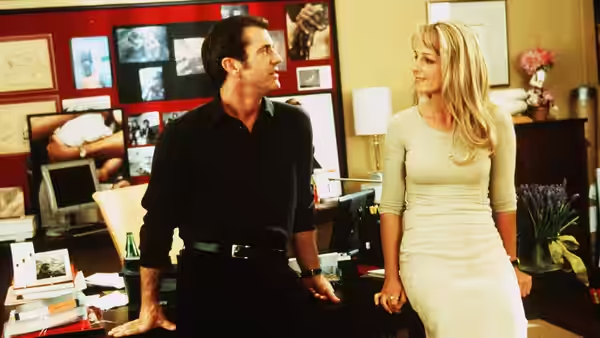
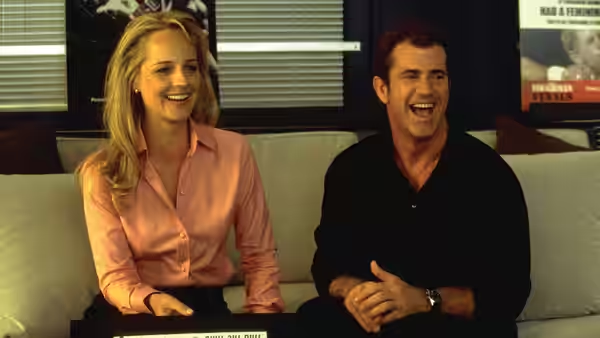
Nick Marshall (Mel Gibson) practices yoga beside a woman in a studio
Film review

What Women Want

2000 · Directed by Nancy Meyers · 2h 07m · Kijkwijzer 12

In a sentenceA man discovers women have thoughts, and somehow he remains the main attraction

Nick Marshall (Mel Gibson) can hear everything women are thinking, including the thoughts they keep to themselves. Darcy McGuire (Helen Hunt) and Lola (Marisa Tomei) can speak to him without knowing how much they are saying. Nick has access to the difference between what women say aloud and what they think, with none of the usual privacy on their side. He must work out how to use this information and how to answer words that nobody has actually spoken to him. Listening is no longer something he can choose to avoid.

Plays from YouTube when you press play; nothing loads from them until then.

Fi1m review

Nancy Meyers gets some good laughs from a premise that deserved tougher handling. Mel Gibson supplies the charm, but the film gives its newly attentive man rather too much credit for listening.

The joke in What Women Want is simple enough: a man who can hear women’s thoughts must finally pay attention to them. Nancy Meyers makes a fitfully funny romantic comedy that is too willing to forgive its leading man. We can enjoy Mel Gibson’s comic energy without accepting every excuse made for Nick Marshall, and the film gives us ample time to notice the difference. It runs 127 minutes.

Mel Gibson gives the premise its necessary comic momentum, letting Nick Marshall look foolish without making him cease to be pleased with himself. We laughed at the way his confidence falters under the intrusion of women’s thoughts. His reactions do more for the joke than the mere fact that we can hear those thoughts, and Nancy Meyers knows to let him carry it. The trouble is that being amusing so often seems to count as sufficient evidence that he deserves our affection.

Helen Hunt gives Darcy McGuire a welcome firmness, making her seem capable of having a life when Nick Marshall is not there. That should be a modest achievement; here it matters. Marisa Tomei brings Lola enough personality to make us want the film to give her more room. Both performances make us notice how often the women have to establish their importance through their effect on the man, even when the premise apparently promises to let them speak for themselves.

Dean Cundey’s cinematography keeps the performers easy to read, which matters when the joke depends on a reaction to something nobody else can hear. Jon Hutman’s production design adds an air of comfort that suits the romance, though we wanted less reassurance around a man who needs challenging. The film is pleasant to look at without giving the eye much independent work. Its polish helps the actors, but does little to sharpen the comedy.

Alan Silvestri’s music is most useful when it supports the comedy’s lightness, less so when it presses us towards affection the writing has not quite earned. Editors Thomas J. Nordberg and Stephen A. Rotter keep individual exchanges moving, but the film as a whole feels slow to finish making its point. Its changes of mood need more preparation, and several comic ideas outstay their usefulness. The effort to make the romance matter becomes conspicuous when we are being encouraged to feel something the performances could have conveyed without assistance.

Romantic comedy is entitled to an improbable premise; the problem is what happens after we accept it. Here, listening is treated as such an achievement that the film has trouble asking much more of Nick Marshall. The screenplay by Cathy Yuspa and Josh Goldsmith finds comic possibilities in his predicament, then settles too readily for the charm of the man enjoying them. We wanted the women to surprise him more often, and to be less conveniently understood once their thoughts became audible.

There is enough warmth here for an undemanding evening, particularly if watching performers handle a daft situation matters more than a persuasive change of heart. We would have preferred less indulgence and a shorter running time, though the comedy is seldom hostile to its characters. Choose it for the performances, with limited expectations of what it has to say about women.


Critical consensus AI synthesised

57
Positive
2
Mixed
5
Negative
2

The critical response is mixed, with praise clustering around the performances rather than the film’s ideas about men and women. Several critics find Mel Gibson’s comic charm a substantial asset, keeping the romantic comedy entertaining even when the writing falters. Ashley Johnson and Hunt also receive praise. The warmer reviews enjoy the film’s lightness and energy; Radio Times goes further, finding wit and invention in the writing and sharpness in the direction despite the daft premise.

Reservations centre on shallow themes, awkward plotting and comedy that does not consistently land. The spread is wide: some critics find agreeable entertainment, while others object to the central character or the gender conventions. The Guardian offers the strongest rejection, treating the resemblance to Doris Day and Rock Hudson comedies as complacent imitation. Three listed reviews have no recoverable verdict, which limits how fully the reasons behind the numerical consensus can be described.

Radio Times
★★★★ · Dave Aldridge
80

The review calls the romantic comedy inventive, witty and sharply directed. It praises the writing and direction, while noting the premise is daft.

Read the full review →
Screen Daily
18 December 2000 · Mike Goodridge
64*

The review’s verdict is not visible in the accessible text. The paywall also obscures what the critic singled out for praise or complaint.

Read the full review →
The New York Times
15 December 2000
64*

The article is identified as a review of the film, but its verdict is unavailable. The page provided no review text from which to identify what the critic praised or criticized.

Read the full review →
Time Out
· SS
64*

The page identifies this as a review, but the review text is unavailable, so its verdict cannot be established. The available description foregrounds the electrocution-triggered mind-reading premise, with no praise or criticism recoverable.

Read the full review →
Total Film
2 February 2001 · ★★★ · Total Film
60

The review finds the film likeable and entertaining, but ultimately adequate rather than inspired. It praises Mel Gibson’s charisma and Ashley Johnson’s performance, while faulting the shallow themes and clumsy plot turns.

Read the full review →
Variety
11 December 2000 · Todd McCarthy
50*

McCarthy finds the film energetic and appealing, but says its comedy often misfires and its ending putters to an indifferent stop. He praises Mel Gibson’s buoyant comic performance for lifting the people around him.

Read the full review →

Straight answers AI written, from our review

Is What Women Want worth watching?
What Women Want is worth considering for an undemanding romantic comedy evening, and we score it 64 out of 100. We enjoy Gibson’s comic reactions and the warmth Hunt and Tomei bring, but 127 minutes stretches the premise, and the film gives its leading man too much credit simply for listening.
How long is What Women Want, and what is it rated?
What Women Want runs 2h 07m and is rated 12 by the Kijkwijzer in the Netherlands. It is a comedy and romance film.
Where can I watch What Women Want in the Netherlands?
What Women Want is not on any streaming or rental service in the Netherlands at the moment. It is available in 19 other countries; change your country at the top of the page to see where. Availability is checked daily.
How violent or frightening is What Women Want, and is it suitable for children?
What Women Want has a UK 12 certificate, so it is not a choice for younger children. The certificate indicates material that calls for caution below that age; it does not, by itself, establish how violent or frightening the film is, or identify the content parents may wish to check.
How does What Women Want compare to The Shop Around the Corner?
What Women Want offers a broad mind-reading comedy, but we recommend The Shop Around the Corner more confidently for its treatment of the people behind the romantic misunderstandings. The former suits an evening built around Gibson’s comic charm; the latter makes mistaken assumptions funny without making its characters disposable, and finds sadness beneath its lightness.
What should I watch after What Women Want?
After What Women Want, try The Shop Around the Corner (1940, Fi1m 88): A romantic comedy that makes mistaken assumptions funny without making people disposable. Then The Apartment (1960, Fi1m 91): Office politics and romantic longing, with considerably less patience for male entitlement; and The Lunchbox (2013, Fi1m 75): An Indian romance where indirect communication gradually gives two people room to speak.

Cast

If you liked this, try…

  1. The Shop Around the Corner (1940, Fi1m 88)A romantic comedy that makes mistaken assumptions funny without making people disposable.

  2. The Apartment (1960, Fi1m 91)Office politics and romantic longing, with considerably less patience for male entitlement.

  3. The Valet (2006) · not reviewed yetA French romantic farce that keeps vanity and social embarrassment briskly employed.

  4. Enough Said (2013) · not reviewed yetAdult attraction complicated by knowing more about someone than they intended.

  5. The Lunchbox (2013, Fi1m 75)An Indian romance where indirect communication gradually gives two people room to speak.

Free account

Know what to watch tonight

Two lists that know where things are streaming, collections you can share, your own score beside ours, and Discover that remembers what you have seen.

  • Want to see, sorted by what is streaming now
  • Seen, with your score out of ten
  • No adverts, ever