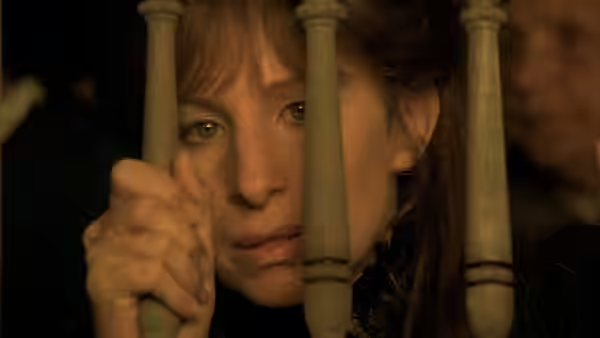
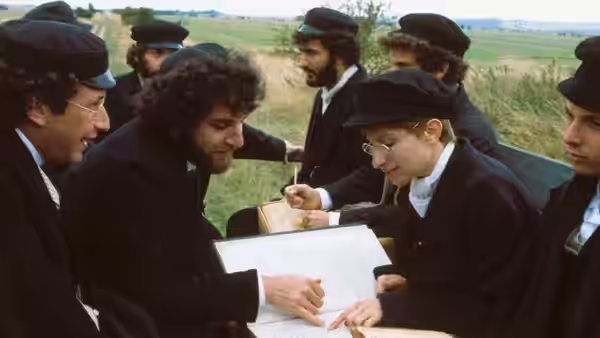
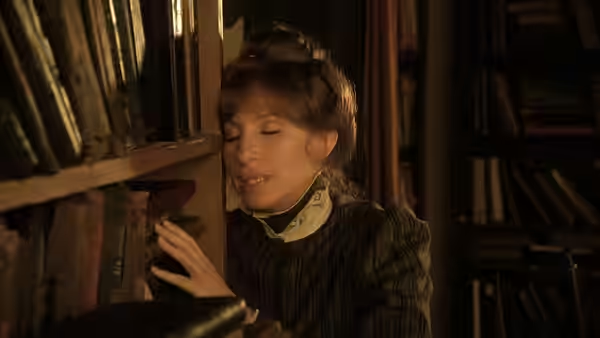
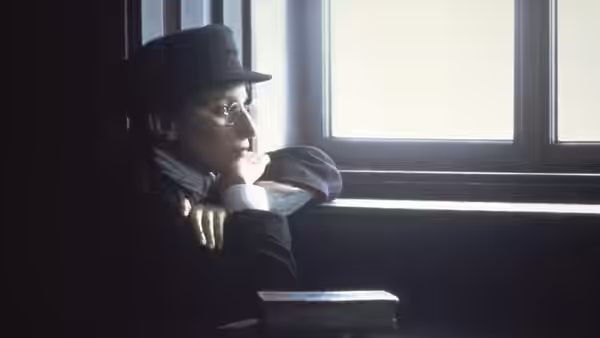
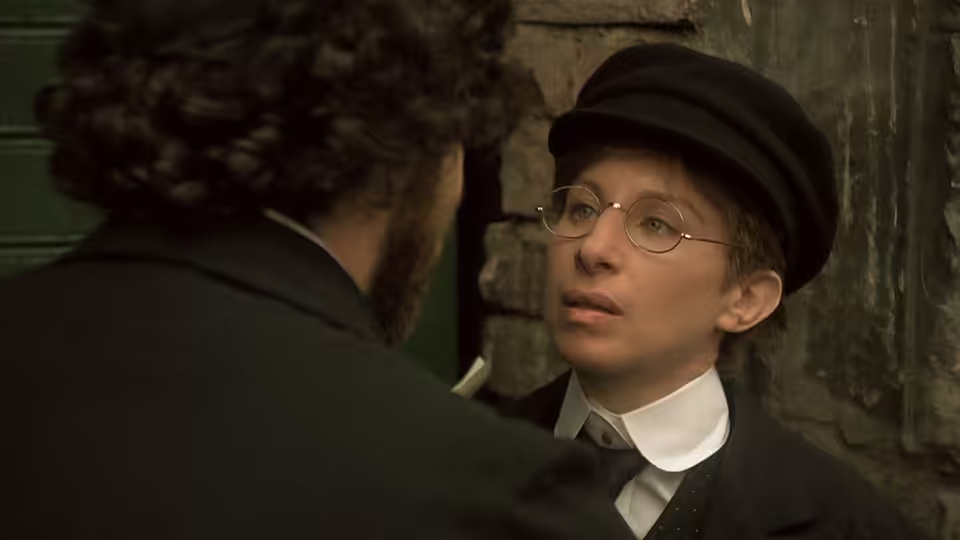
Yentl, dressed as a young man, speaks with a bearded man beside a doorway
Film review

Yentl

1983 · Directed by Barbra Streisand · 2h 12m · Kijkwijzer 14

In a sentenceA woman asks to be allowed to study, and the orchestra insists on having its say

Yentl (Barbra Streisand) wants to study in a society where learning belongs to men. Being a girl is considered reason enough to deny her the education she wants. Her questions challenge rules that the people around her accept as part of daily life. Avigdor (Mandy Patinkin) and Hadass (Amy Irving) belong to that same society, with its different expectations for men and women. Yentl wants to know why those expectations should determine what she is permitted to learn.

Fi1m review

Barbra Streisand makes Yentl’s hunger for learning matter, helped by Mandy Patinkin and Amy Irving. The period setting convinces, but awkward musical interruptions make this a qualified recommendation for patient romantics.

Barbra Streisand gives Yentl a clear, worthwhile concern: a woman wants to study, and a society organised around men tells her that she cannot. The film takes that desire seriously, without treating education as an unpromising subject for a musical. We wish the musical part served it more consistently. This is an affecting but uneven film, worth considering for the performances and the period setting, though its songs too often slow a drama that needs little additional explanation.

Streisand is persuasive as Yentl because she makes the desire to learn feel urgent, even when the film risks explaining it too carefully. Mandy Patinkin brings an answering warmth to Avigdor, allowing their shared scenes some ease. We were moved by the affection between them; Yentl’s need to be understood becomes clear without further explanation. Amy Irving is warmly sympathetic as Hadass, and helps keep the romantic drama from feeling like a diversion from the serious business of education. These are people whose feelings merit the attention the film gives them.

David Watkin’s cinematography gives the period setting much of its appeal. The surroundings have enough conviction to help us believe in a society that considers its arrangements permanent, however unreasonable they look to us. Production designers Leslie Tomkins and Roy Walker contribute to that impression of an established, settled world, making Yentl’s dissatisfaction easier to understand. The care taken over the setting also gives the actors somewhere credible to belong, and remains a pleasure when the storytelling becomes less assured.

Michel Legrand’s music presents the central difficulty. The songs have feeling, but they too often insist on an emotion the performances have already made clear. A musical can afford to suspend a conversation when the song takes it somewhere; here we are sometimes impatient to get back to the people talking. Terry Rawlings’s editing does not consistently make those changes of pace feel natural, leaving the drama to recover its momentum. There is good songwriting here, but appreciating a song is not always enough to make us welcome its arrival.

The screenplay, by Barbra Streisand and Jack Rosenthal, is clearest when it stays with Yentl’s desire to learn. That is a strong enough reason to follow her, and the romantic material benefits from actors capable of conveying affection without making it seem trivial. What is missing is enough variation in how the film asks us to respond: the prevailing earnestness gradually makes scenes feel less distinct. At 132 minutes, it has room to let feelings develop, yet too often seems anxious to ensure that we have understood them.

The musical offers opportunities to make a character’s longing felt without explaining it, and Yentl takes too few of them. Streisand’s directing is attentive to her actors, but less sure about when the music can do their work for them. The sincerity remains persuasive, even when the repetition becomes tiring. Give it an evening if the hunger for education and the warmth of these performances appeal; bring some patience for the songs.

Critical consensus AI synthesised

51
Positive
2
Mixed
1
Negative
3

The reviews lean towards disappointment, though praise clusters around the period setting, cinematography and warmth of the performances. Variety admires the film’s appearance and Streisand’s work in creating its period setting, while Empire finds it earnest and heartfelt, singling out the songwriting and the performances of Mandy Patinkin and Amy Irving. Even among the less enthusiastic responses, there is some appreciation of Streisand’s sincerity and the feeling she brings to the film.

The sharpest disagreement concerns the music: Empire praises the songwriting, but The New York Times finds the songs awkward and considers the musical numbers and technical flaws damaging, despite some affecting moments. The spread is wide, with two positive assessments outweighed by three negative ones rather than a settled middle ground. That picture needs qualification: one verdict cannot be verified from the available page, and two negative reviews are only partially available.

Empire
1 January 2000 · empire
70*

The review calls the film earnest and heartfelt, though it may not appeal to everyone. It praises the songwriting, cinematography, and warm performances by Mandy Patinkin and Amy Irving.

Read the full review →
Variety
31 December 1982 · Variety Staff
70*

The review is positive, describing the film as a fine-looking period piece. It especially praises the cinematography and Streisand’s work creating the period setting.

Read the full review →
RogerEbert.com
65*

The page is blocked by a browser check, so the critic’s verdict cannot be verified. The review’s specific praise or complaint is also unavailable.

Read the full review →
Radio Times
★★ · Adrian Turner
40

Turner gives the film two stars, signaling a negative verdict. He singles out Streisand's legendary perfectionism, though the supplied text is truncated.

Read the full review →
The New York Times
18 November 1983 · Janet Maslin
30*

Maslin finds the film earnest and occasionally affecting, but says its musical numbers and technical flaws undermine it. She praises Streisand’s sincere performance and the warmth shared by Streisand and Mandy Patinkin, while criticizing the awkward songs and ending.

Read the full review →
Time Out
· JP
30*

The available description signals skepticism toward the critical praise for Streisand’s film. It questions whether her popular appeal justifies that praise.

Read the full review →

Straight answers AI written, from our review

Is Yentl worth watching?
Yentl is worth considering for patient romantics who value warm performances and a convincing period setting; we score it 65 out of 100. Barbra Streisand makes the hunger for education matter, with sympathetic support from Mandy Patinkin and Amy Irving, but the songs repeatedly slow the drama and underline feelings the actors already convey.
How long is Yentl, and what is it rated?
Yentl runs 2h 12m and is rated 14 by the Kijkwijzer in the Netherlands. It is a music and drama film.
Where can I watch Yentl in the Netherlands?
Yentl is streaming on Amazon Prime Video in the Netherlands, and it is also available to rent from Amazon Prime Video and Apple TV from €3.99. Availability is checked daily; the links above go straight to each service.
How does Yentl compare to Educating Rita?
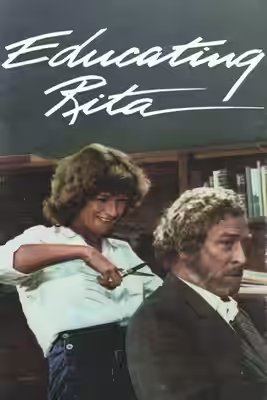
Yentl treats a woman’s determination to learn with musical earnestness, while Educating Rita gives a similar concern more room for jokes. We favour Educating Rita for a lighter evening, helped by Julie Walters and Michael Caine, though its direction can plod. Yentl suits patient romantics better, but its songs interrupt the drama too often.
What should I watch after Yentl?
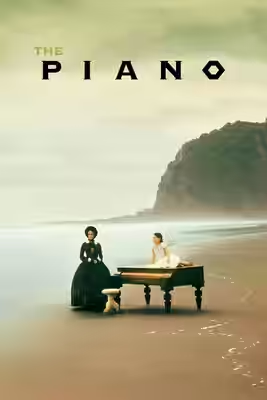
After Yentl, try Educating Rita (1983, Fi1m 71): Another woman insists on learning, with more room for jokes. Then Orlando (1992, Fi1m 81): For another challenge to gender rules, told with cooler, stranger humour; and The Piano (1993, Fi1m 88): Desire and self-expression become difficult business in another restrictive period setting.

Cast

Awards

Academy Awards, 1984

Nominated
Best Production Design
Nominated
Best Supporting Actress
Won
Best Original Song Score

Golden Raspberry Award for Worst Actor, 1984

Nominated
Golden Raspberry Award for Worst Actor

Golden Raspberry Award for Worst Musical Score, 1984

Nominated
Golden Raspberry Award for Worst Musical Score

Golden Raspberry Award for Worst Supporting Actress, 1984

Nominated
Golden Raspberry Award for Worst Supporting Actress

If you liked this, try…

  1. Educating Rita (1983, Fi1m 71)Another woman insists on learning, with more room for jokes.

  2. Orlando (1992, Fi1m 81)For another challenge to gender rules, told with cooler, stranger humour.

  3. The Piano (1993, Fi1m 88)Desire and self-expression become difficult business in another restrictive period setting.

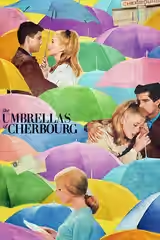
  4. The Umbrellas of Cherbourg (1964, Fi1m 88)For romantic feeling carried through music with greater formal confidence.

  5. Wadjda (2012, Fi1m 80)A girl’s modest ambition exposes the rules adults prefer not to question.

Free account

Know what to watch tonight

Two lists that know where things are streaming, collections you can share, your own score beside ours, and Discover that remembers what you have seen.

  • Want to see, sorted by what is streaming now
  • Seen, with your score out of ten
  • No adverts, ever