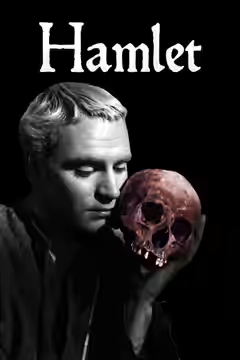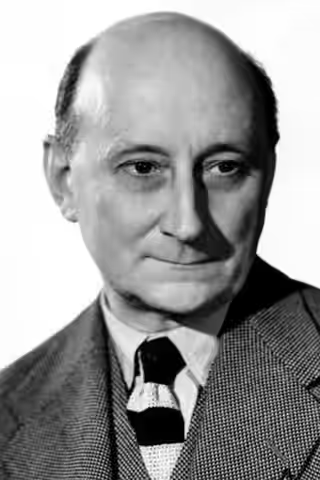
Felix Aylmer played bishops, judges and chamberlains for forty years, straight enough to be believed and slow enough to be laughed at. In Olivier's Henry V and Hamlet he is the old man who turns out to be funnier than anyone expected.
Fi1m perspective
Watch the start of Henry V (1944). Two bishops shuffle onto the Globe stage to explain the king's claim to France, and they cannot find the right page. Felix Aylmer and Robert Helpmann play the muddle without a wink, and the groundlings on screen laugh at them, which is Olivier's way of telling us we may. That is Aylmer's method, there and for the rest of his career: a man of authority played exactly as such men are, certain of his position, precise in his speech, and a little behind the conversation. He does not send the part up. He lets it be what it is and trusts us to notice.
He had been on stage since 1911, when he made his debut at the London Coliseum, and did not come to films until 1930, already past forty. From then on he worked steadily as a character actor, and the parts sorted themselves quickly: clerics, judges, chamberlains, men with a seal of office and a grievance. He made five films with Laurence Olivier. The two we have reviewed, Henry V and Hamlet (1948), are where a reader should start. The 1950s and 1960s brought Merlin in Knights of the Round Table (1953), Stephen Banning in The Mummy (1959) and a second go at the Archbishop of Canterbury in Becket (1964), and he was still working in television into the 1970s.
Polonius is the performance to see. The part is usually a bore who takes ten lines to say four, and directors either cut him or let him drone. Aylmer takes the speeches at a clip, so the tedium belongs to the character rather than the audience, and he is quicker and funnier than the part has any right to be. We went in braced to endure the advice to Laertes and found ourselves smiling through it, because Aylmer plays a man who enjoys the sound of his own good sense and is faintly puzzled that nobody else does. In a film that is otherwise chilling and holds its breath for two hours, he is one of the few people allowed to be warm.
The limit is plain, and he never got past it. He played the Archbishop of Canterbury twice, twenty years apart, and most of what came between was a variation on the same robed elder. We have not reviewed Becket or The Mummy and will not pretend to judge them. Typecasting is the price of doing one thing well, and Aylmer paid it for four decades. If you want him at his best, take the Olivier films, and watch the bishop lose his place.
Biography
Felix Aylmer was an English stage and film actor. Born Felix Edward Aylmer Jones, he was educated at Oxford and made his stage debut at the London Coliseum in 1911. He served as a junior officer in the Royal Naval Volunteer Reserve during the First World War and resumed his stage career afterwards.
Aylmer entered films in 1930 and appeared in numerous productions over the following decades, often in roles as elderly or clerical figures. He played the Archbishop of Canterbury in Laurence Olivier’s Henry V (1944) and again in Becket (1964). Other notable screen roles include Polonius in Hamlet (1948) and appearances in Quo Vadis (1951), Ivanhoe (1952) and The Mummy (1959).
He was appointed an OBE in 1950 and knighted in 1965 for services to drama. Aylmer served as president of the actors’ union Equity from 1950 to 1969.