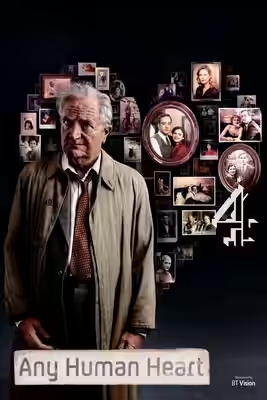
William Boyd’s four-part adaptation of his own novel gives one man’s life to three good actors and most of a century to get through. It is warm, witty and often moving, and it hurries where it should linger. Broadbent is the reason to stay.
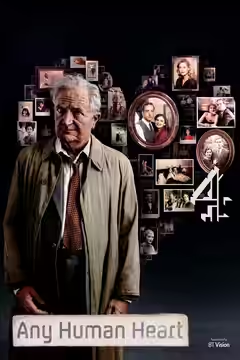
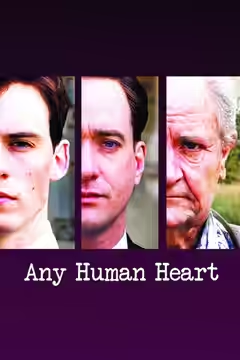
William Boyd has adapted his own novel into four episodes, directed by Michael Samuels, and the idea is simple and large: one Englishman’s life, from Oxford in the 1920s to old age, told from the journals he kept all the way through. Logan Mountstuart is played by Sam Claflin as a young man, Matthew Macfadyen in middle age and Jim Broadbent at the end. It is a generous, likeable piece of television, and it works more often than not; it also has a great deal of life to get through, and it often hurries.
Claflin plays the young Logan as pleased with himself in the way clever boys are before anything has happened to them. He makes a bet about his virginity, cycles out to a farm to win it, goes to Paris, publishes, and treats his own talent as settled fact. Tim Murrell keeps cutting back to Broadbent at a table with the notebooks, so that every youthful blunder is watched by the man who has to live with it. Samuels sometimes puts two Logans in the same frame, one looking at the other. It should be twee and it is not; it is the series’ best idea.
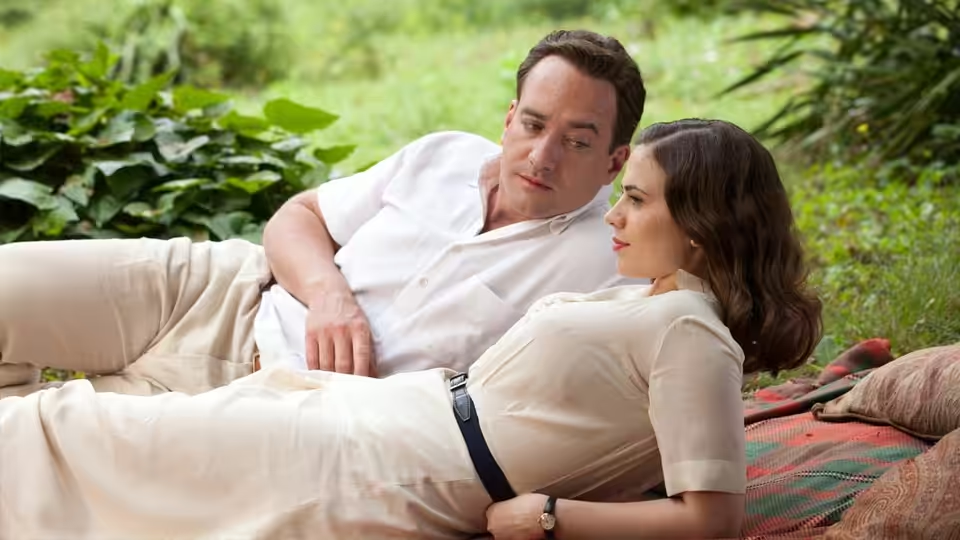
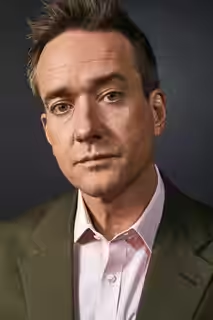
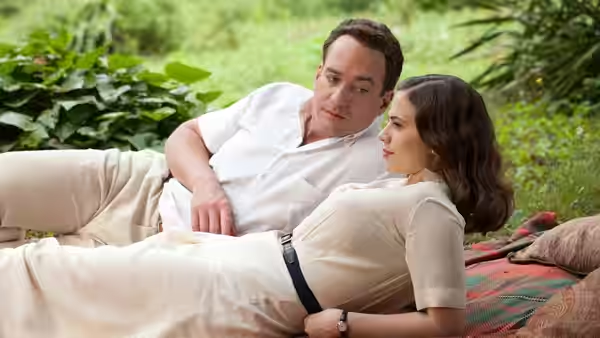
Macfadyen has the hardest job, because the middle of a life is where things go wrong slowly, and he is good at slow. He plays Logan as a man who has noticed he is not the writer he expected to be and has decided not to mention it. Hayley Atwell’s Freya is the person he should have met first, and their scenes together have an ease the rest of the series lacks. We were caught off guard in the war years by how much we minded what happened to these two; nothing is forced, Atwell simply looks at him as if he were worth the trouble, and we believed her.
The famous people are more of a problem. Boyd’s conceit is that Logan is present at the century without ever being important to it, so he drinks with Ernest Hemingway (Julian Ovenden) and falls in with the Duke and Duchess of Windsor. Gillian Anderson plays the Duchess with a dry, brittle amusement and a stare that could price a room, and she is fun. But every time a name arrives the series goes slightly stiff, as if Logan had been handed a tour and the camera had to show us the sights. The structure is episodic and the tone wanders; so does a life. The episodes, though, do feel like beads on a string rather than a single pull.
Wojciech Szepel shoots the early decades in warm, late-afternoon light, lawns and river and Paris stone, and lets the colour drain out as the years pass, so that by the time Broadbent takes over the frame is mostly grey and brown. Stevie Herbert’s rooms do a lot of the dating, from an undergraduate’s cluttered digs to flats that get smaller and emptier. Charlotte Holdich’s costumes carry the ages better than the make-up does; Macfadyen’s suits sit on him like a man who stopped buying new ones. Dan Jones’s score is the weak department. The strings rise under nearly every goodbye to tell us what we already felt; the series is better when it trusts a face than when it trusts the orchestra.
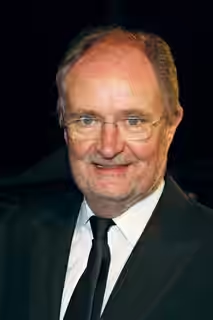
Then there is Broadbent. The last episode belongs to him, and we will say only that he is alone a great deal and the series stops hurrying. He plays old age as a practical business, shopping and dogs and small indignities, with the past arriving uninvited. It moved us more than we expected, and it did it with almost nothing: a man at a table, a notebook, the light going.
Among British novel adaptations this sits in the respectable middle: better acted than most, never quite settled in shape. Boyd’s novel could let the dull years be dull; four episodes cannot, and the series pays for that in montage. See it for the three Logans and for the way they become one man, and forgive it the parties. First shown on 20 November 2010, it has worn well.