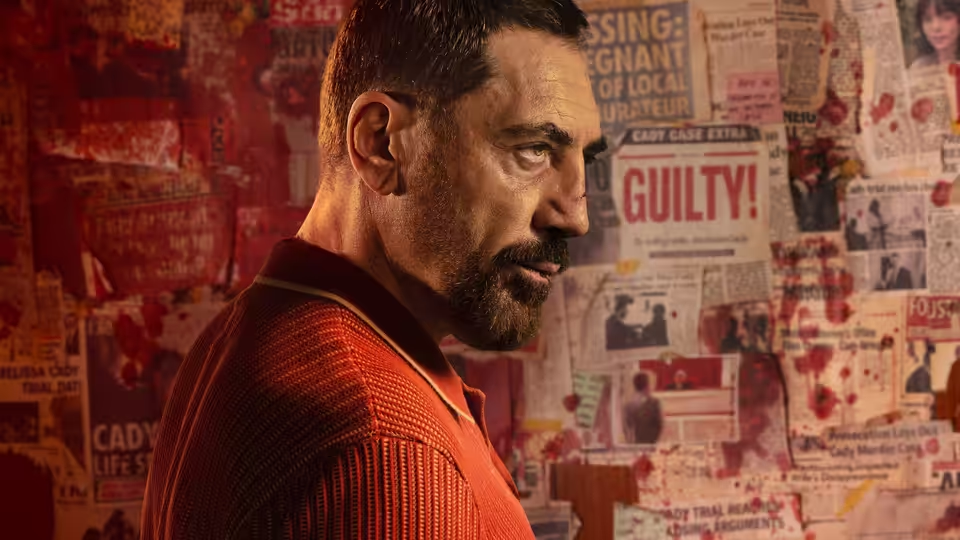
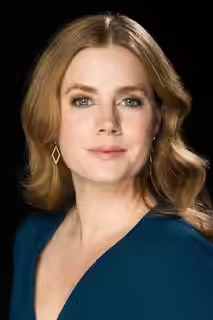
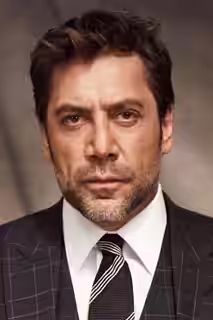
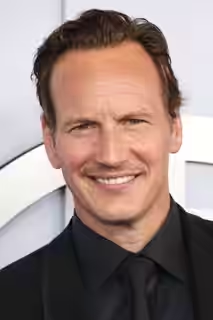
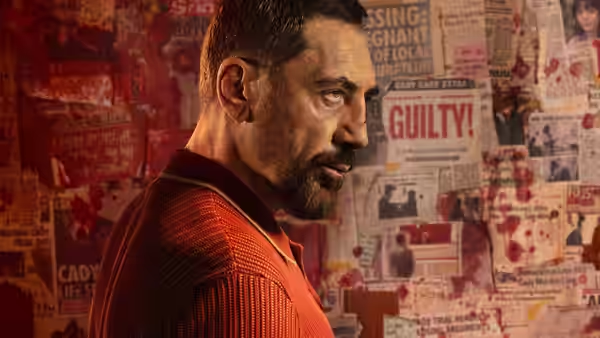
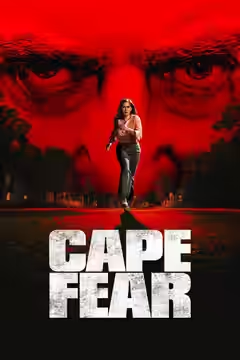
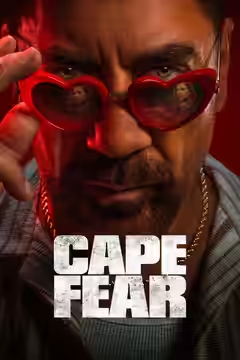
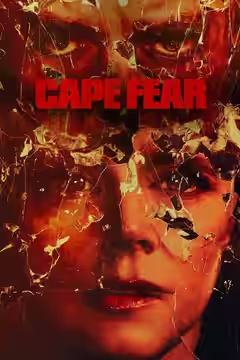
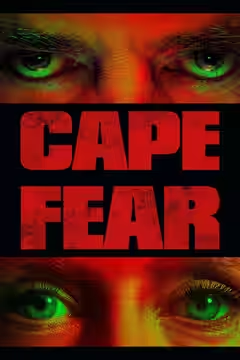
Javier Bardem gives his Cady a courtesy that curdles, and Amy Adams matches him scene for scene. Around them, ten episodes, nine directors and Bernard Herrmann’s old strings have been asked to stretch a short, mean novel a good deal further than it will go.
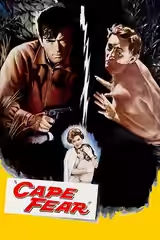
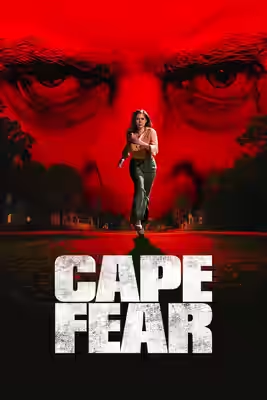
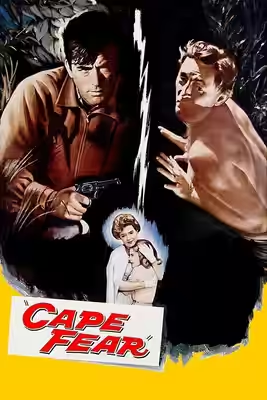
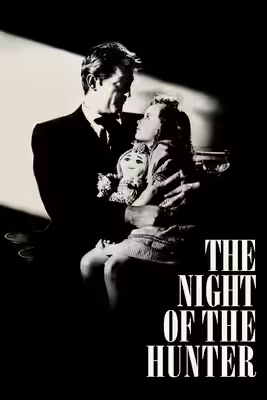
John D. MacDonald’s novel has been filmed twice before, both times as a film: J. Lee Thompson’s in 1962, with Gregory Peck and Robert Mitchum, and Martin Scorsese’s in 1991, with Nick Nolte and Robert De Niro. Each got the job done in a single sitting. This version, first shown on 4 June 2026, takes ten episodes to tell the same story, and the story has not grown to fit. Anna Bowden (Amy Adams) and Tom Bowden (Patrick Wilson) are lawyers; Maximiliano Cady (Javier Bardem) is out of prison and blames them for his time inside. What follows is often good and always too long.
Bardem is the reason to watch. He plays Cady quietly, as a man who has learned in prison that waiting is a weapon, and he is courteous to everyone in a way that makes them want to check the locks. Mitchum played the part with lazy contempt and De Niro with tattoos and scripture; Bardem does neither. We were frightened of him, properly, and it took us a while to work out why: he never raises his voice, and for a long stretch nobody on screen can prove he has done anything at all. The series is at its best whenever it lets that be enough.
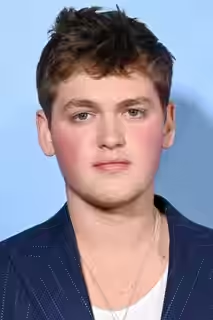
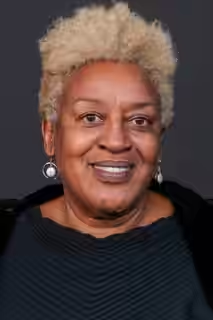
Adams gives Anna the watchfulness of someone who knows the family’s version of events is not the whole of it, and the series is built around her guilt rather than Tom’s, which is the one structural change we admired. Wilson plays Tom as a decent man who has decided to stop asking questions, and he is good at the small dishonesties of a marriage. Lily Collias, as Natalie, is the one Cady looks at longest, and she plays the teenager’s mixture of alarm and curiosity without a false note. Joe Anders has less to do as Zack. CCH Pounder, as Noa Toussaint, brings her usual weight to every scene she is given.
Eben Bolter and Celiana Cárdenas shoot the whole thing in heat. Skin shines, rooms are dim against the glare outside, and the Bowden house, from Jamie Walker McCall’s production design, is the kind of place that looks secure until you count the doors. There are stretches where the colour drains from the image and what we are watching stops being reliable, to tell us that a character is no longer seeing straight. Done once it would have been a fine idea. Done as often as it is here, it becomes another thing to wait through.
The music is a problem of a particular kind. Jeff Russo’s own cues are perfectly serviceable, but the credits also list Bernard Herrmann and Elmer Bernstein, because the series leans on Herrmann’s 1962 score, which Bernstein reworked for Scorsese in 1991. Those strings are magnificent and they are borrowed, and every time they swell under a scene of moderate tension, the series is reminding us of two tighter versions of itself. Herrmann wrote for a film that ran under two hours. Spread across ten hours, his alarm starts to sound like a smoke detector with a low battery.
Then there is the committee. Nine directors are credited across the ten episodes, five editors, and a writers’ room of eight working from a story by Maria Jacquemetton, André Jacquemetton and Gregory Goetz. The joins show. Episodes have different ideas about how frightening Cady should be and how much we should be watching the Bowdens’ money instead. The modern additions, online impersonation, artificial intelligence, a general mistrust of anything on a screen, are reasonable ways to update a story about a man who is hard to pin down, but each gets an episode’s worth of business it does not need. Somewhere in the middle third we noticed we had stopped being frightened and started counting how many episodes remained, and we were annoyed about it, because the man who had frightened us was still on the porch.
The last stretch takes a turn we will not describe, and the series is honest enough not to let anyone off lightly. That honesty is worth something. So is Adams, who is doing her best work here, and Bardem, who is doing something nobody has done with Cady before.
Watch it for the two of them, and take it slowly, two episodes at a sitting, with the option of leaving a week between them. It is a 15, and it earns the certificate. It is also proof that a novel which fits in a hand does not become larger by being read aloud over ten evenings.