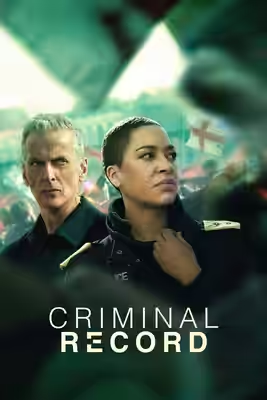
Peter Capaldi and Cush Jumbo make Criminal Record a tense, absorbing police drama with something worth saying about institutional racism. Some secondary stories weaken the pressure, but the central contest is worth staying for.
Criminal Record is a good police thriller made considerably better by Peter Capaldi and Cush Jumbo. It takes the familiar contest between an established detective and a challenger and gives both enough weight that we cannot settle down to cheering for a side. DCI Daniel Hegarty and DS June Lenker disagree about policing, but the series keeps asking how much freedom either has to do the job differently. The tension between them is reason enough to watch.
Capaldi makes Hegarty’s seniority feel like an advantage in every encounter. We are left wondering how much of his authority comes from experience and how much comes from being accustomed to getting his way. Jumbo gives Lenker the determination to challenge him without making her seem immune to the strain of it. We felt uneasy watching them together, because her challenges and his resistance never seem to carry equal professional risk.
The writing, credited to Paul Rutman, Thomas Eccleshare, Natasha Narayan and Ameir Brown, is strongest when race and gender affect the detectives’ dealings with each other. Institutional racism can become a topic that a crime series mentions and then leaves alone while the chase resumes. Here it affects our judgement of the officers and of the organisation behind them. Hegarty remains difficult to assess even when Capaldi is at his most compelling, and the series is careful about how much reassurance it offers through Lenker.
London has a useful prominence here. Cinematographers Ben Wheeler, Laurent Barès and Jan Jonaeus give the city enough presence to keep the detectives from seeming like the only people who matter. Matthew Button’s production design supports that impression of a place with more going on than the current investigation. It works because a drama about institutional failure needs us to feel that people live with its consequences, even when we are absorbed by a dispute between two officers.
The pace is less dependable. Editors Mark Davis, Sacha Szwarc, Mark Trend, Matthew Tabern and Alex Kalmakrian sustain the friction between the leads, but the less involving subplots make stretches away from them feel longer than they should. Neil Davidge and Michael Asante’s music helps maintain the unease, though it cannot make every strand equally absorbing. We kept wanting to return to Hegarty and Lenker, whose encounters require so little encouragement to hold our attention.
Police dramas often make institutional failure easier to accept by supplying one officer whose decency can settle every doubt. Criminal Record is more interesting when it makes that reassurance difficult. Its characters’ differing experiences shape what they notice, what they defend and what they are prepared to question. That gives the familiar business of professional rivalry enough substance to sustain attention beyond the immediate mystery. Settle in for the confrontations, and be prepared to wait through some lesser stories between them.