Tom Hiddleston and Owen Wilson make a proper double act in a time-police office designed like a 1970s tax department. The show explains its rules in nearly every episode, and by the second season the explaining has taken over.
Michael Waldron’s series picks Loki up at the moment he slipped away with the Tesseract in Avengers: Endgame (2019), drops him in the Gobi Desert and has him arrested within minutes by the Time Variance Authority, a department that prunes any history it has not approved. The idea is to take the franchise’s best villain, remove his powers, his brother and his audience, and see what is left. What is left, for most of twelve episodes, is Tom Hiddleston talking to Owen Wilson. That is the good news, and it is enough to carry a season.
Wilson plays Mobius M. Mobius, the analyst who wants Loki’s help catching a Variant, as a middle manager who has read the whole file and is not impressed by any of it. He interrogates the way other men talk about golf. Hiddleston, ten years into the part, plays the vanity as a nervous habit rather than a pose, and the scene in the first episode in which Mobius sits him down and shows him the rest of his own life on a projector moved us more than we expected a Marvel series to manage. It is one man watching a film about himself and forgetting his lines. Hiddleston does most of it with his mouth, which keeps starting sentences and giving up.
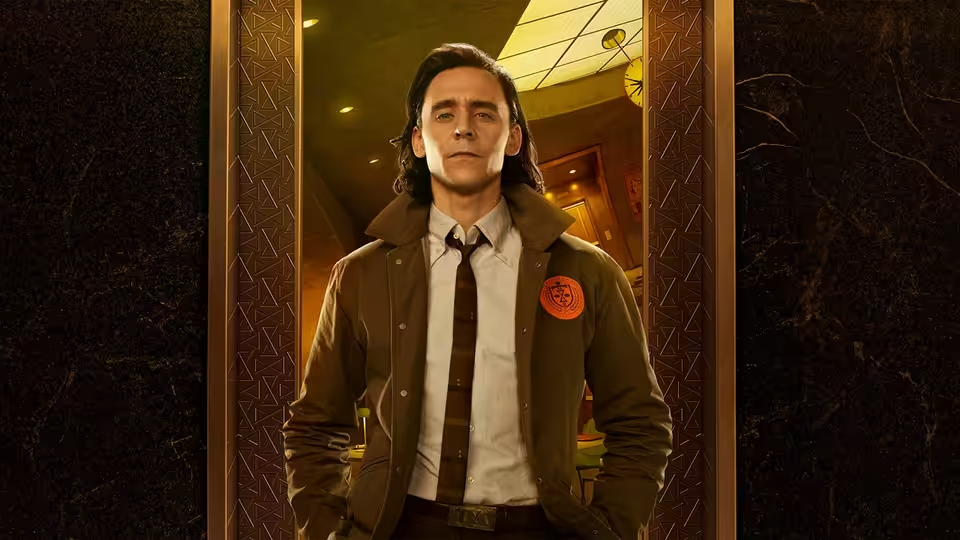
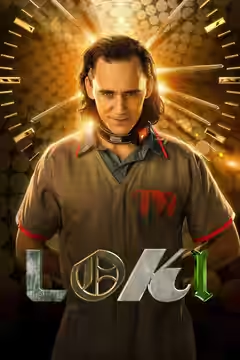
Kasra Farahani builds the TVA as a government office from about 1975: brown carpet, orange partitions, pneumatic tubes, a filing clerk (Eugene Cordero) who has never heard of a fish. Autumn Durald lights it in a warm amber that makes the place look cosy and slightly unwell at the same time. Tara Strong voices Miss Minutes, an animated orange clock who explains the Sacred Timeline with the good cheer of a public information film. Christine Wada puts Loki in a TVA-issue shirt and tie with VARIANT stamped across the back, which is the whole series in one costume. Natalie Holt’s score sets a wobbling electronic wail over the brass, so that even the office corridors sound haunted.
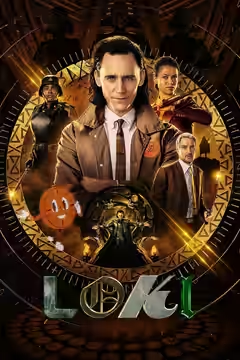
The trouble is the trouble everyone has noticed. Nearly every episode stops so that somebody can explain how time works this week: Miss Minutes, then Mobius, then Ravonna Renslayer (Gugu Mbatha-Raw), the judge who wants Loki erased, then in the second run Ke Huy Quan’s OB, a repairman in the basement whose job is to describe the machine the season depends on. Quan is a pleasure and the machine is not. Sophia Di Martino’s Sylvie, the Variant Loki is sent to catch, is the one person with no patience for anybody’s rules, and Di Martino gives her a flat, tired anger that suits the part; the writing gives her less to do each week than it gives Hiddleston. Wunmi Mosaku’s Hunter B-15 gets a change of heart the show handles better than most of its plotting.
The first season, directed throughout by Kate Herron, moves, and its middle stretch takes the pair to a doomed moon lit in purple where they have nothing to do but talk, which turns out to be what the show is for. The second, with Justin Benson and Aaron Moorhead directing most of it, is people running down corridors towards a gauge while the needle climbs. Around the fourth episode we were bored, and then cross about being bored, because the office was still lovely and the people in it were still worth an hour. Calum Ross, Emma McCleave and Paul Zucker cut the cross-timeline chases cleanly enough that we always knew where we were; the problem is that where we were was another room with a countdown in it.
Loki was always best when someone declined to take him seriously, and Wilson declines more entertainingly than anyone since Loki’s brother. Whenever the series remembers that, it is the most likeable thing Marvel has made for television. Whenever it forgets, it is a lecture with good lighting.
Watch the first six. Watch the second six if you need to know how it comes out, and feel free to make tea whenever anyone points at a machine. It carries a 12 certificate and each run is six episodes.