Series review

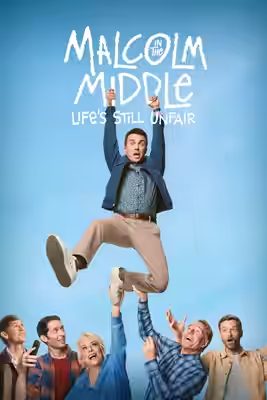
Malcolm in the Middle: Life's Still Unfair

2026 · Directed by Ken Kwapis · Series · 12

In a sentenceBryan Cranston makes a family reunion seem worth the risk

ComedyDrama

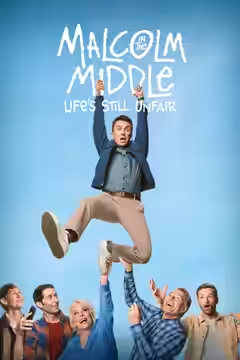
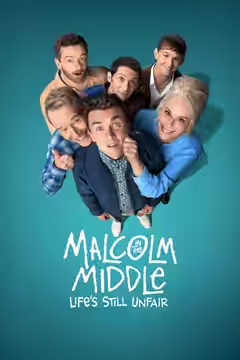
Malcolm in the Middle: Life’s Still Unfair brings Malcolm and his family back together in a four-episode comedy-drama. Frankie Muniz plays Malcolm, now revisiting the childhood experiences that continue to shape his dealings with the family. Bryan Cranston plays Hal and Jane Kaczmarek plays Lois, with Justin Berfield as Reese and Christopher Masterson as Francis. The ensemble also includes Keeley Karsten as Leah, Vaughan Murrae as Kelly and Kiana Madeira as Tristan. The reunion puts Malcolm’s attempts to make sense of his past alongside the family’s continuing capacity for chaos.

Plays from YouTube when you press play; nothing loads from them until then.

Fi1m review

Bryan Cranston and Jane Kaczmarek make this uneven family reunion worth watching. The four-episode run is crowded, and Malcolm spends too much of it explaining what his childhood has done to him.

The useful question for a television reunion is what has changed, beyond the cast getting older. Malcolm in the Middle: Life’s Still Unfair gives Malcolm some unfinished business with his childhood and brings the family together across four episodes. We find it funny enough to justify the visit, though its attempts to discuss the harm behind the comedy can become laborious. Director Ken Kwapis is most persuasive when he lets the performers get on with being difficult in one another’s company.

Frankie Muniz has the awkward task of making Malcolm’s reckoning with his childhood fit inside a family comedy that thrives on refusing to behave. He gives the material enough feeling to keep it from becoming merely a list of grievances. But the writing team, including Linwood Boomer and Matthew Carlson, sometimes seems more interested in explaining Malcolm than in finding something funny for him to do. We understand why the childhood matters; the time spent discussing it is still time during which the comedy has to wait.

Cranston, as Hal, makes the strongest case for coming back. We laughed at his physical comedy because he makes the family’s inability to behave look so effortful and so ridiculous. Jane Kaczmarek’s Lois gives the reunion much of its force, and she remains compelling even when the material around her is familiar. Cranston and Kaczmarek also make the warmth credible, which matters in a programme about people who can be exhausting to spend time with.

Michael Weaver’s cinematography keeps our attention on the cast, while David Willson’s production design never becomes the main attraction. That suits a comedy whose strongest resource is how these people behave around one another. Shane Eli Abrahams and Jonny Pakfar’s music makes less impression. Our response to Hal and Lois comes from the actors, without much need for musical encouragement.

The shortage of space is harder to overlook. Justin Berfield’s Reese and Christopher Masterson’s Francis are part of an ensemble that also has to accommodate Keeley Karsten’s Leah, Vaughan Murrae’s Kelly and Kiana Madeira’s Tristan. Four episodes are not much in which to make so many people count. Steve Welch’s editing cannot quite make the reunion feel like four comfortably shaped instalments, and the switches between family uproar and personal reflection expose the problem. Too often, another character gets an appearance when they need something substantial to do.

The reunion is at least interested in what it feels like to look back on a childhood everyone else remembers as entertaining. That is a worthwhile complication for a family sitcom, and Muniz gives it some weight. The problem is how often the writing treats explanation as sufficient in itself. Some familiar behaviour still produces a laugh, but the weaker jokes depend too heavily on our pleasure at seeing these people again.

Existing affection for this family will help, especially when the programme asks for patience with another explanation. Anyone arriving without it may find the crowded ensemble harder to take to. Come back for Cranston and Kaczmarek, and accept that the family now expects a little too much credit for talking things through.

Critical consensus AI synthesised

5 of 6
Positive
3
Mixed
0
Negative
2
The Guardian
10 April 2026 · Stuart Heritage
90*

The critic praises the revival as miraculously funny and authentic to the original, highlighting Bryan Cranston's standout performance in a drug-induced scene and the emotional depth from the cast.

Read the full review →
The Telegraph
10 April 2026
40*

The reboot is described as decidedly middling, with too much focus on Malcolm wrestling childhood trauma turning the series into a therapy session rather than the chaotic fun of the original.

Read the full review →
Vulture
10 April 2026
40*

The critic argues there’s no reason for the new Malcolm in the Middle to exist, as the characters and arcs feel familiar after seven seasons of the original. It intermittently echoes the show’s comedic strengths, particularly in physical comedy from Bryan Cranston, but the jokes tire quickly.

Read the full review →
IndieWire
10 April 2026 · Ben Travers

The critic calls it a rare revival that provides something new. Returning creator Linwood Boomer does more than make a sweet epilogue; he reminds audiences of the kind of shows that used to thrive on TV.

Read the full review →
Consequence
9 April 2026 · B+
83

The review calls the four-episode reunion a solid, chaotic love letter to fans that recaptures the family's singular dynamics and features top-form performances, particularly from Cranston and Kaczmarek. It notes structural oddness in presenting episodes as a short movie-like binge but praises the singular flavor of family chaos.

Read the full review →
Collider
9 April 2026 · 8/10 · Aidan Kelley
80

The critic praises the revival for balancing hilarious and emotional moments, with strong performances from the returning cast especially Muniz, Kaczmarek and Cranston, and a standout finale that delivers heartfelt payoff. It notes the short length limits character development for the large ensemble but calls it a worthy, charming return.

Read the full review →

Cast

Stills

If you liked this, try…

Parenthood poster

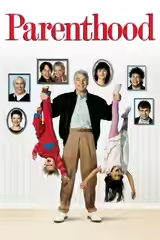
Parenthood

1989 · Another family comedy that understands how quickly parental worry becomes unreasonable behaviour.

The Royle Family poster

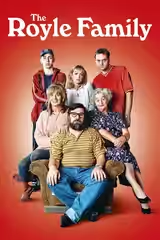
The Royle Family

1998 · For family affection expressed through irritation, with nobody required to improve.

Good Morning poster

Good Morning

1959 · Children’s stubbornness and adult pettiness make equally good material for domestic comedy.

Boy poster

Boy

2010 · A child’s admiration for an unreliable father makes the laughter hurt.

Better Things poster

Better Things

2016 · Parenting comedy with room for resentment, tenderness and children who answer back.