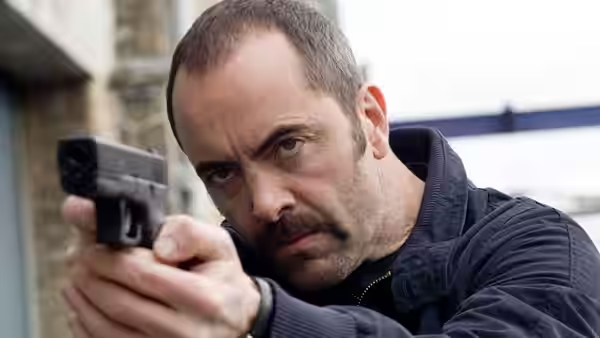
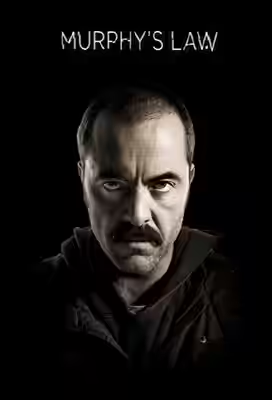
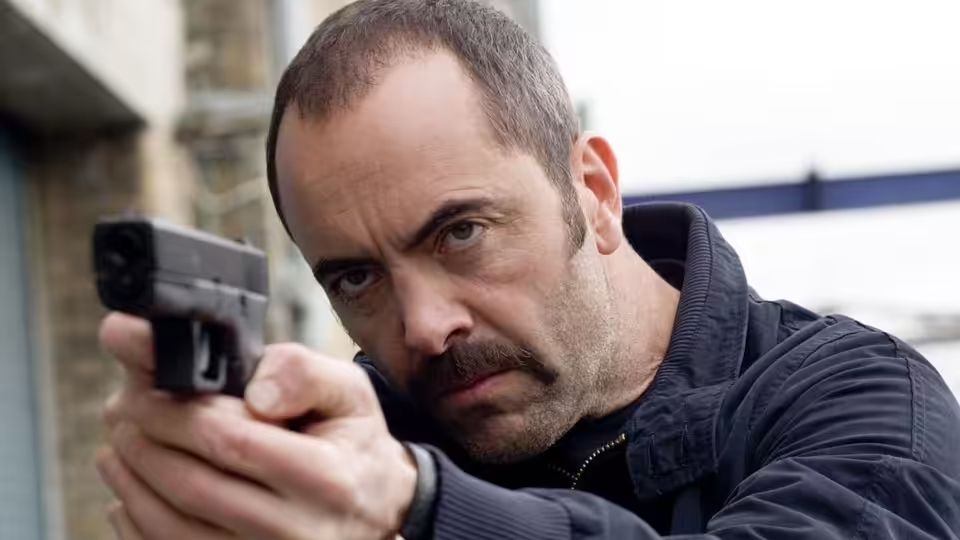
DS Tommy Murphy (James Nesbitt) aiming a handgun outdoors beside a brick building
Series review

Murphy's Law

2001 · Created by Colin Bateman · Series · 1h 00m

In a sentenceThe dialogue should have been arrested; Nesbitt talks his way past it every week

London, 2001. DS Tommy Murphy (James Nesbitt) is an Irish detective sergeant working for the London police, used for the jobs nobody else wants: going in alone, under another name, among people the force cannot otherwise reach. His superiors, DI Annie Guthrie (Claudia Harrison) and DCS Warren (Francis Magee), want results and would rather not know how he gets them. DC Alan Carter (Del Synnott) is the colleague who has to watch his back from the outside. The first case puts him alongside Drew Johnstone (Liam Cunningham), a man with money, muscle and good reason to check a stranger’s story, and Murphy has to keep the lie standing long enough to find what Johnstone is hiding. What he wants is the truth of one case. What stands in the way is that one wrong word ends him.

Fi1m review

James Nesbitt’s undercover Irish detective is the whole show, and he is good enough to be most of one. The cases hold, the London is drab in the right way, and the dialogue keeps saying what better scripts would let the faces say.

Colin Bateman created Murphy’s Law for James Nesbitt, and it shows in every scene. Nesbitt plays DS Tommy Murphy, an Irish detective in London who is sent in under a false name wherever a face the villains have not seen is needed. The tagline promises a maverick, and the show delivers one in the old sense: he drinks, he answers back, he gets results his superiors would rather not examine. Over five series of hour-long episodes between 2001 and 2007, that is the whole proposition. It is a decent one, carried by its lead a good deal further than the writing deserves.

Nesbitt is the reason to watch and the reason it works at all. He talks the way the character lives, fast and amused and half a step ahead, and when Murphy is bluffing a man who could kill him the grin is doing the work. We found ourselves grinning along with him in a scene we knew to be absurd, a hard man taking a stranger’s word on nothing but charm, and we were a little annoyed with ourselves afterwards. It is a star performance in a show that is otherwise a police procedural, and it exposes the procedural.

The dialogue is the fault, and it is not a small one. Ten writers are credited across the run, Bateman among them, with Tony McHale, Allan Cubitt and Russell Lewis also on the list, and they share a habit of having people say exactly what they are. Villains announce their intentions. Colleagues state the stakes. Claudia Harrison’s DI Annie Guthrie and Francis Magee’s DCS Warren exist mostly to send Murphy in and then tell him off for the manner in which he came out, and Del Synnott’s DC Alan Carter is the loyal one who worries. None of them is given a line we would repeat. The plots are better than the lines: tight, nasty and resolved on time, and we were caught by more than one of them while wincing at what was being said.

Nine directors share the episodes, Peter Lydon, Colm McCarthy and Brian Kirk among them, and the look stays consistent: lock-ups, pubs, flats with the curtains drawn, a London of grey afternoons rather than lit skylines. Edmund Butt’s music does a lot of pushing, a low pulse under anything that might be tense, and we wished more than once that it would trust the scene. Liam Cunningham, as Drew Johnstone, gives the first case a proper opponent, a man who listens before he speaks, which in this show makes him unusual. Owen Teale and Mark Womack, later on, do similar work in similar silences.

The show changes shape as it goes. The first series is five hours of cases; the second and third run to six each, and the fourth and fifth are down to three apiece. Murphy is a man who lies for a living, and the show is at its best when it lets a lie stand long enough to cost him something, rather than wrapping it up by the closing credits.

The only review we have read from its first broadcast was harsh, scoring it low and blaming the dialogue, which is fair, and finding Nesbitt watchable, which is also fair. We think it undervalued how much of the show he holds up on his own. The writing is tired; the man saying it is not.

If undercover cop stories are your genre, this is a decent one, and Nesbitt is worth the evening. If they are not, nothing here will change your mind, and the first episode will tell you so inside twenty minutes.

Critical consensus AI synthesised

1 of 6
Positive
0
Mixed
0
Negative
1
The Guardian
25 September 2001 · Gareth McLean
30*

McLean finds the drama ultimately unsuccessful, chiefly because its dialogue is so clichéd and alienating. He praises the gripping plot and James Nesbitt’s watchable central performance.

Read the full review →

Straight answers AI written, from our review

Is Murphy's Law worth watching?
Murphy's Law is worth watching if undercover police stories are your genre, and we scored it 63. James Nesbitt carries the series further than the writing deserves, fast and amused as a detective bluffing men who could kill him, while the dialogue keeps telling you what the faces already show. If the genre is not yours, the first episode will settle it inside twenty minutes.

How long is Murphy's Law, and what is it rated?
Murphy's Law has episodes of about 1h 00m. It is a crime and mystery series.
Where can I watch Murphy's Law in Thailand?
Murphy's Law is not on any streaming or rental service in Thailand at the moment. It is available in 6 other countries; change your country at the top of the page to see where. Availability is checked daily.
How violent or frightening is Murphy's Law, and is it suitable for children?
Murphy's Law carries a UK 15 certificate, so it is not for children and is best kept for older teenagers and adults. It is a crime series of lock-ups, pubs and villains with money and muscle, and the plots are tight and nasty rather than gory or frightening. The threat is mostly to Murphy himself, one wrong word under a false name, so tension rather than shock is the mode.
How does Murphy's Law compare to Cracker?
Murphy's Law and Cracker both rest on a damaged Celt talking his way through rooms full of police, but Cracker is the better written and the more uncomfortable of the two. Nesbitt is as watchable a centre as Robbie Coltrane, yet his scripts have people announce what they are, where Cracker has real teeth. Choose Murphy's Law for easier, case-of-the-week viewing and Cracker for the harder, richer drama.

Cast

If you liked this, try…

  1. The Fall (2013) · not reviewed yetAllan Cubitt again, with the dialogue pared back and the menace allowed to breathe.

  2. Cracker (1993, Fi1m 85)A damaged Celt talking his way through rooms full of police, written with real teeth.

  3. Between the Lines (1992) · not reviewed yetBritish police procedural where the villains and the superiors are often the same people.

  4. The Wire (2002) · not reviewed yetThe undercover game played slowly, from both sides, over a whole city.

  5. Spiral (2005) · not reviewed yetParis cops bending rules under tired light; nobody explains their plan to anyone.

Free account

Know what to watch tonight

Two lists that know where things are streaming, collections you can share, your own score beside ours, and Discover that remembers what you have seen.

  • Want to see, sorted by what is streaming now
  • Seen, with your score out of ten
  • No adverts, ever