Aaron Sorkin’s first newsroom is his best one: fast, funny and small enough to stay honest. Josh Charles and Peter Krause carry it, Robert Guillaume steadies it, and the only thing that dates it is the laughter track the first season did not need.
Before the White House there was a sports desk. Sports Night is Aaron Sorkin’s first television programme, and it is about the two anchors of a late-night cable highlights show and the control room that gets them on air. It ran for two seasons, 45 half-hour episodes, beginning on 22 September 1998, and it was cancelled while it was still improving. It is the best thing Sorkin has made for television, and the faults it has are the ones he has never shaken off.
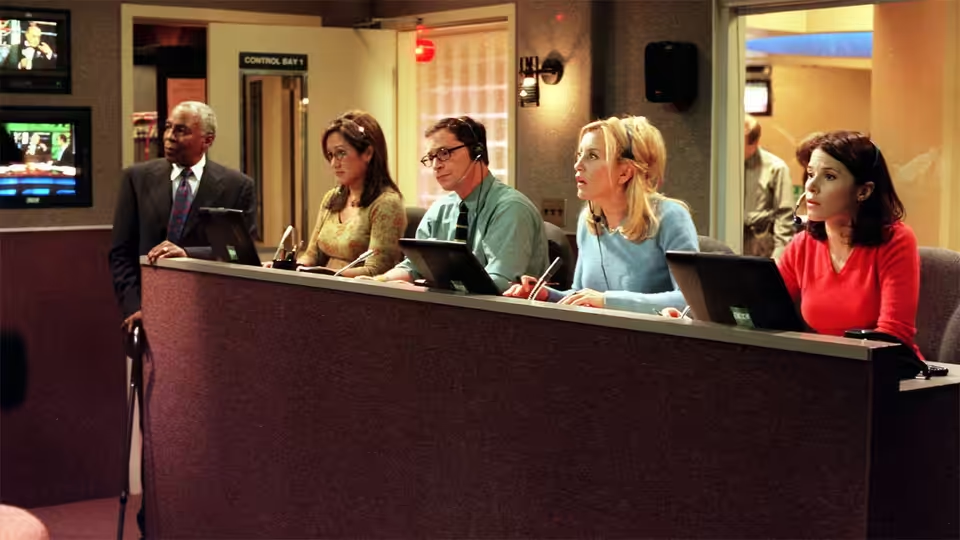
The premise is thin on purpose. Nobody watching cares about the show within the show; the games are invented and the scores are made up. What Sorkin wants is the control room. Dana Whitaker (Felicity Huffman) produces with a headset on and a hand in the air, Natalie Hurley (Sabrina Lloyd) counts down the seconds beside her, Jeremy Goodwin (Joshua Malina) arrives in the pilot as a nervous new researcher, and Isaac Jaffe (Robert Guillaume) runs the whole operation from an office upstairs. He is the only person in the building who ever sits down.
Thomas Schlamme directs the pilot and sets the manner for everything after it. Peter Smokler’s camera walks backwards through corridors ahead of people who are arguing, and the argument does not pause for the walk. Janet Ashikaga cuts to the rhythm of the lines rather than the pictures, so a scene ends the moment the joke lands and not a frame later. W.G. Snuffy Walden’s music is warm guitar and a few piano chords, the sound he would carry across to The West Wing a year later. At 22 minutes an episode, the speed is a gift: the show is over before it has time to repeat itself.
Josh Charles and Peter Krause are the reason to watch. Dan and Casey have been reading scores side by side for years, and Charles and Krause talk over and under each other the way people do who no longer need to look up. Charles plays Dan as the quicker and the sadder of the two; Krause gives Casey a decent man’s bafflement at his own bad temper. Huffman, in a headset for most of every episode, makes Dana’s competence funny, which is harder than making it admirable. Guillaume does almost nothing and is the centre of every scene he is in.
We did not expect a half-hour comedy about a sports desk to make us put the cup down, and it did, in a scene where Isaac tells Dana, after a bad night, that she made the right call. Guillaume says it sitting down, barely above a murmur, and Ashikaga holds on Huffman while she takes it in. It is the clearest sign of what the programme is about, which is people who are good at their jobs trying to be good to each other as well.
Now the faults. The first season carries a laughter track, and it is a mistake. The jokes come faster than the laughing can follow, so a line about a headset gets a chuckle that belongs to some slower show, and it is the one thing here that has aged badly. Sorkin’s habit of having characters lecture one another about ethics is already present, and by the second season the lectures are longer. Dana and Casey circle each other for more episodes than the question deserves, and the writers (Paul Redford, Kevin Falls, David Walpert and Bill Wrubel take turns with Sorkin, among others) are more at ease with the men than the women. Dana and Natalie are brilliant at work and written as fools the moment they leave the building.
Set against what Sorkin made later, this is smaller and better for it. The West Wing has more at stake and The Newsroom has more to say, and both are more pleased with themselves. Here the stakes are a rundown, a satellite feed and whether Casey will smile on air, and nobody is saving the republic. Most critics who have written about it since rate it about where we do.
Watch two at a time, in the evening, with the sound up so that you catch the lines and stop hearing the laughter. There are only 45 episodes, and they go quickly.