Owen Wilson is easy company as a washed-up golfer coaching a teenage prodigy, and the series around him is pleasant, safe and thin. It borrows the shape of Ted Lasso without the jokes, and it handles its grief plot clumsily.
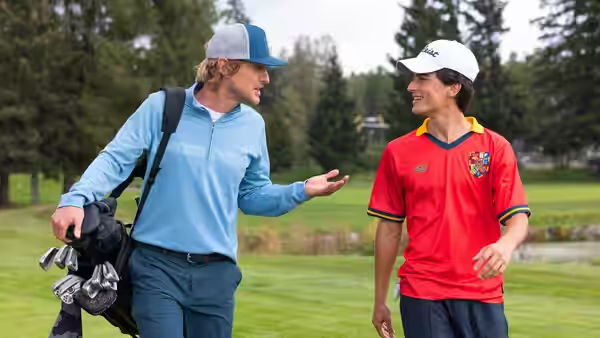
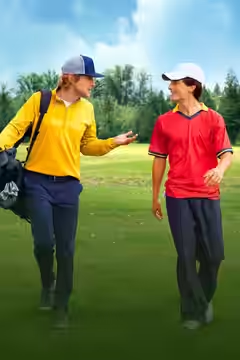
Jason Keller’s Stick runs ten episodes and has one idea, which is that Owen Wilson would be pleasant to spend them with. He is. Pryce Cahill is a golfer whose game and marriage went some time ago, until he sees a teenager called Santi (Peter Dager) hit a ball at a range and decides the boy is his way back. He talks round Elena (Mariana Treviño), collects Mitts (Marc Maron), picks up Zero (Lilli Kay), and the five of them go to work on Santi’s game. It is agreeable, it is familiar, and it is thin in the places a show like this needs to be thick.
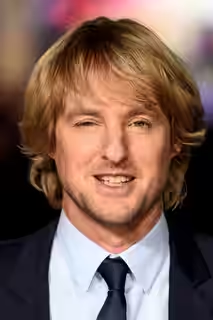
Wilson plays Pryce in the mode he has made his own: the drawl, the head tilt, the sentence that starts confident and ends somewhere else. It suits a man whose whole trade is talking people into things, and Wilson makes you see why Elena says yes against her better judgement. We liked him from the first scene and never stopped, which is the show’s great asset and its alibi. Whenever the writing runs out, and it runs out often, the camera goes back to Wilson looking rueful and the episode gets away with it.
The rest of the ensemble is unevenly served. Maron’s Mitts gets the laughs, because Maron has spent a career sounding like a man who has just been told the price of something, and every line of encouragement comes out as a complaint. Dager has an easy, unshowy way with Santi’s sulks and makes the boy’s talent believable without much help from the script. Treviño and Kay have the harder jobs. Elena is written as the one who worries and Zero as the one who explains the modern world to the older men, and both actors find more in the roles than is on the page; Kay in particular does the most with the least.
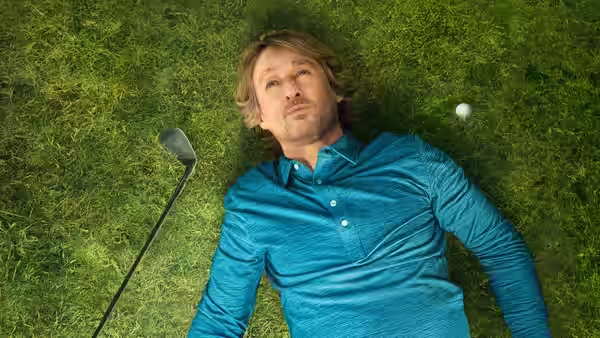
The golf is shot with more wit than it is written. Stephen Maier and Corey Walter send the camera up with the ball and hold on the top of the backswing, and the editors Ivan Victor, Melissa McCoy and Daniel Gabbe cut the rounds as short bursts of impact and reaction rather than the long quiet walks the real game consists of. It is lively the first three times. By the sixth it is the same shot, and we noticed we had stopped watching the ball. Diane Lederman’s production design keeps the interiors modest, more strip mall than country club, which suits the show’s idea of Pryce as a man past his best, and Christine Thomson dresses him as someone who last bought clothes around the time he last won anything.
Six directors are credited, among them Jonathan Dayton, Valerie Faris and David Dobkin, and the episodes all look and move the same way, which tells you the tone was set by the writers rather than on set. The writing plays safe. Conflict arrives, is talked over, and is over by the credits. The show also carries a loss in Pryce’s past that it keeps in a drawer and brings out whenever an episode needs weight. Here is where we were got at: there is a scene, around the midpoint, of Wilson alone with something from that past, and it moved us, and then we heard Zachary Dawes’s guitar come in a beat before Wilson’s face had finished, and the feeling turned into the sense of being managed. The score does this throughout. It is warm, it is acoustic, and it arrives early.
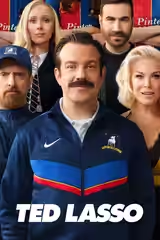
The comparison most critics have made is to Ted Lasso, and it is fair, since both are about a sad American man coaching people who did not ask for him. The difference is jokes. Lasso gave its bench players punchlines; Stick gives them positions to hold, and a comedy in which two of five characters are funny is running at less than half power.
It gets better as it goes, oddly, by giving up. The later episodes stop pushing the tournament and let the five of them sit around and bicker, and that is the show we would have watched ten of. Take it one episode at a time, in the evening, with someone who is fond of Owen Wilson; it does not reward being watched in a run, and it does not need to be.