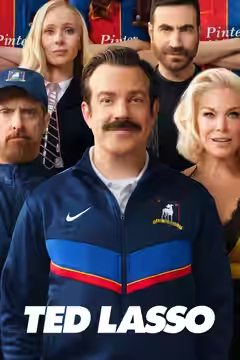
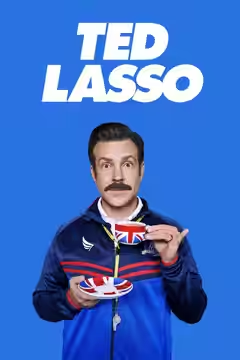
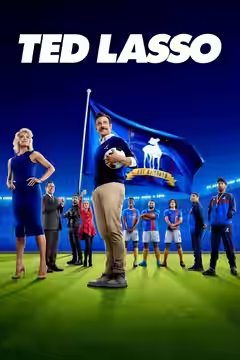
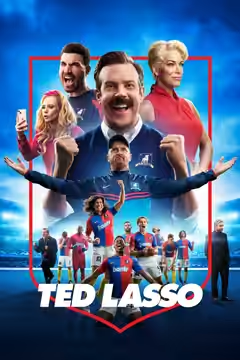
Ted Lasso is a warm, well-played sports comedy with an uneven supply of jokes. Jason Sudeikis and a responsive ensemble make it worth the patience, though the cultural clashes can feel laboured.
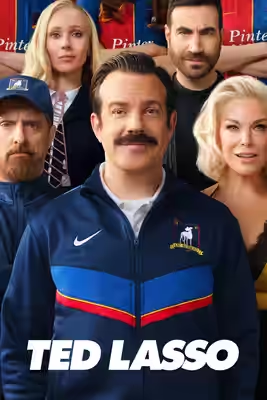
Ted Lasso is good company, provided we allow for some fairly ordinary jokes. Jason Sudeikis plays the American coach working in England with an enthusiasm that could easily become exhausting, and sometimes does. The programme asks a familiar sports-comedy question: can an unlikely coach make people believe in themselves? It takes his decency seriously, and finds enough comedy in it to justify returning to a setup that hardly promises many surprises.
There is an obvious risk in giving this much space to a man with an encouraging saying for everything. Sudeikis plays Ted as someone who believes his own advice, with no apparent embarrassment about saying it aloud. We laughed at the earnestness of his delivery even when the adage itself was hardly a joke. That sincerity gives the other actors something to react to, and stops the central performance becoming a succession of cheerful catchphrases delivered for our approval.
Hannah Waddingham’s Rebecca Welton and Brett Goldstein’s Roy Kent are important to that balance, giving Ted’s buoyancy something firmer to meet. Waddingham understands how much comedy can sit in a withheld response, while Goldstein makes bluntness worth waiting for. Jeremy Swift, as Leslie Higgins, helps keep the ensemble from feeling like a queue of people waiting to deliver a line. The supporting actors give us reasons to stay when Ted’s cheerfulness starts to wear.
The cinematography credits include Bella Gonzales, David Rom, John Sorapure, Vanessa Whyte and Ryan Kernaghan, and the unfussy images suit a comedy that depends on actors sharing space. Paul Cripps’s production design gives the programme a welcoming neatness, though we could do with less reassurance from the surroundings. The camera rarely competes with the performances, which is the right decision. The neatness is less helpful when the dialogue is already struggling to sound spontaneous.
The editing has a similar willingness to give everyone time, with Melissa McCoy and A.J. Catoline among those credited. That patience helps a supporting performance register, but it cannot rescue a joke whose destination is obvious well before the speaker gets there. The music by Marcus Mumford and Tom Howe is agreeable in itself; its encouragement can feel unnecessary when Sudeikis is already doing so much of that work. At those points, the performances would have been enough.
The persistent weakness is the cultural-clash material. The writing team, which includes Bill Lawrence, Joe Kelly and Brendan Hunt, too often treats the distance between American enthusiasm and British reserve as a ready-made joke. Familiarity need not be fatal to a sitcom, but here it sometimes saves the writers the trouble of finding a more particular surprise. Anyone unmoved by Ted’s manner will have longer stretches to sit through, because the programme does not always supply a strong enough comic alternative.
As an underdog sports comedy, it respects the pleasures of a familiar story and gives its supporting cast enough room to matter. We would still prefer fewer lessons and a sharper sense of when a scene has made its point. But Sudeikis and the ensemble earn the affection the script sometimes asks for too freely. Try it for their company, and allow for a few jokes that deserve less indulgence than the people telling them.