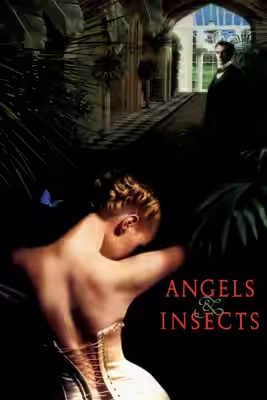
Marc Munden shoots Victorian London as a fever, and for two episodes it is the most alive period drama British television has made in years. Romola Garai is remarkable throughout; the story around her thins before the end.
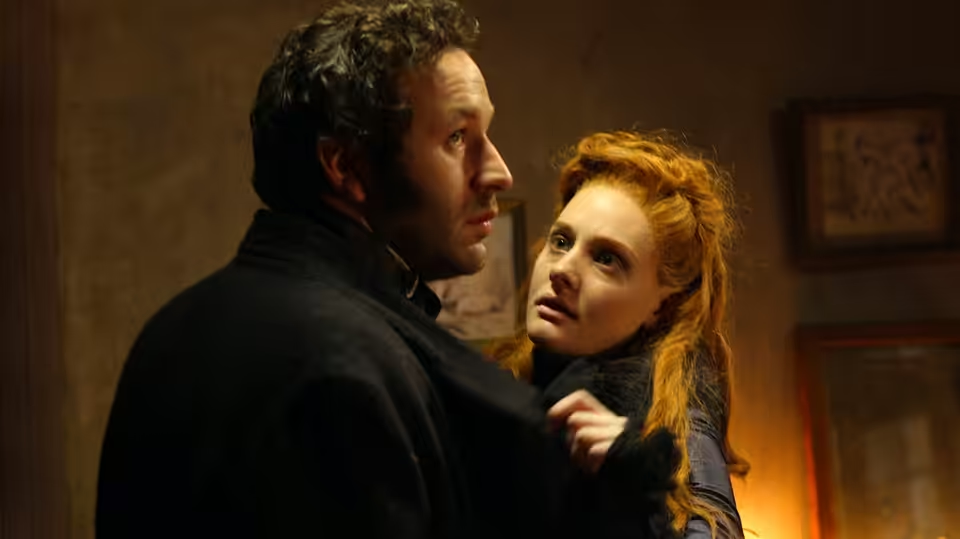
Michel Faber’s novel, published in 2002, is long and filthy and furious, and Lucinda Coxon’s adaptation gets it into four hours by cutting hard and trusting the pictures. Sugar (Romola Garai) is a prostitute at Mrs. Castaway’s who writes revenge fiction between clients. William Rackham (Chris O’Dowd) is a perfume heir who would rather be a poet and is not good enough to be either. He buys her, and the series is about what each of them thinks they have bought. It is good, often better than good, and it is worth your evening if you can take grime with your corsets. It does not quite hold to the end.
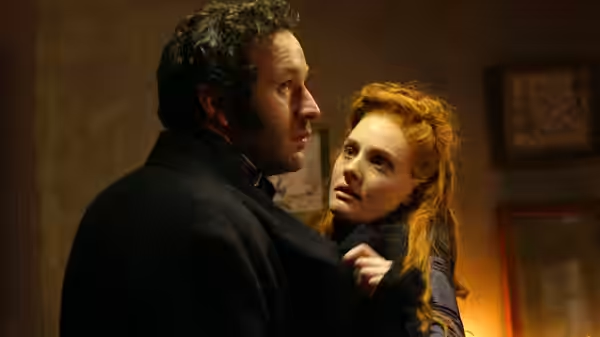
The look is the first thing and for a while the whole thing. Lol Crawley shoots with lenses so wide that faces bulge toward us and the backgrounds fall away, and he lights almost everything from candles and gas, so the edges of the frame go to brown soup. Grant Montgomery’s brothel has wallpaper coming off in strips and a staircase that seems to lean. The Rackham house is the opposite, pale and tidy and freezing. Annie Symons dresses Sugar in a deep green that nobody else in the series is allowed, so we can find her in any crowd. Cristóbal Tapia de Veer’s score is plucked strings, breath, something scraped, and a woman’s voice that sounds like it has been slowed down. It is the least period score imaginable and it is exactly right.
Garai plays Sugar as a woman who is always working, even when she is lying still. She watches William the way a card player watches a table, and the series gives her a narration, flat and amused, that tells us what she is thinking while her face tells him something else. The scenes where she coaxes his terrible poems out of him and praises them are small masterclasses in professional lying. When the mask does slip, it slips for a second and she puts it back, and Garai makes us feel the cost of that each time.
O’Dowd is the surprise. William is weak, vain and easily flattered, and O’Dowd plays him without a wink, so that we see why Sugar can manage him and also why she might not. Amanda Hale’s Agnes is the other performance we kept thinking about afterwards: a woman told so often that she is ill that she has started to agree, and Hale gives her moments of sharp, frightened sense that nobody in the house wants to hear. Richard E. Grant’s Doctor Curlew bleeds her with a bedside manner that made our skin crawl. Gillian Anderson’s Mrs. Castaway, white-faced and whispering, is a creature from a different and more frightening programme, and we would have taken more of her. Mark Gatiss and Shirley Henderson, as Henry and Mrs Fox, do delicate work in a subplot the adaptation has starved.
That is the trouble. The first two episodes move with a horrible energy, Luke Dunkley cutting from brothel to parlour and back so that the two worlds keep bleeding into each other. By the third the series has made its point about who owns whom and starts making it again. Henry’s crisis of faith, which in the book has room to breathe, is a few scenes here and then over. We found ourselves checking how much was left, which we had not done in the first hour, and we were cross about it, because the people on screen were still so good.
We were properly unsettled early on, and it was Crawley who did it: a shot of Sugar walking us through the street at night, the lens stretching the passers-by into leering shapes, her voice telling us calmly where we were going. It felt like being led somewhere by someone who had decided not to tell us why. Nothing later matched it, though Hale came close in a bedroom scene we will not describe.
The last episode takes a turn, and then it stops rather than finishes. Faber’s readers will know roughly what to expect; others may feel the floor go. Most Victorian dramas on television are about manners. This one is about money and bodies and what a clever woman can do with the small amount of each she is given, and it says so in every frame of its first half. Watch it over two nights rather than four, and forgive it the last twenty minutes for the sake of the first two hours.