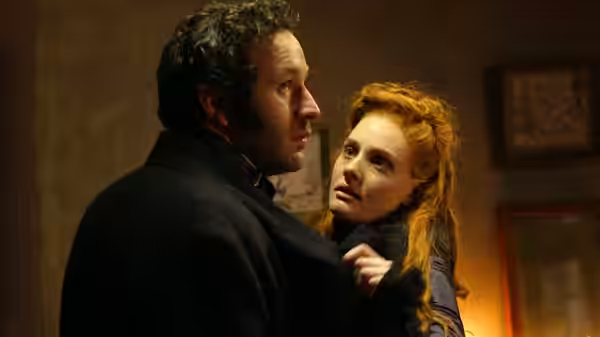
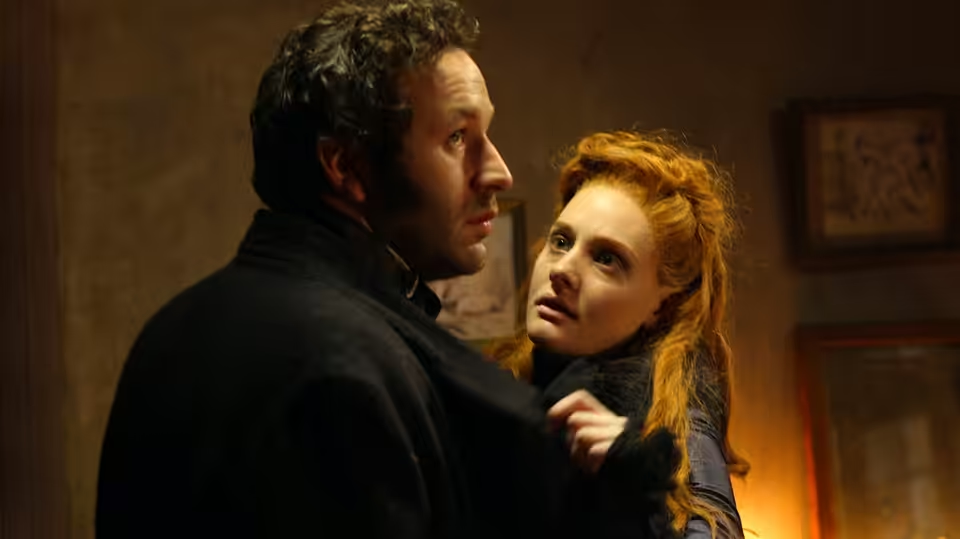
William Rackham (Chris O'Dowd) stands close with Sugar (Romola Garai) in a dimly lit room
Series review

The Crimson Petal and the White

2011 · Created by Lucinda Coxon, Michel Faber · Series · 1h 00m

In a sentenceDickens with the lamps out and the walls sweating, and a heroine who takes notes

London, the 1870s. Sugar (Romola Garai) is the most talked-about prostitute at Mrs. Castaway’s (Gillian Anderson), a brothel of damp walls and red lamps, and she spends her free hours writing a novel in which men die slowly. William Rackham (Chris O’Dowd), the idle heir to a perfume business he refuses to run, hears of her and goes looking. At home his wife Agnes (Amanda Hale) is kept upstairs, dosed and bled by Doctor Curlew (Richard E. Grant), and does not know she has a daughter, Sophie (Isla Watt). William’s pious brother Henry (Mark Gatiss) wants the church and the widow Mrs Emmeline Fox (Shirley Henderson), and is ashamed of wanting either. Sugar wants out of Mrs. Castaway’s house, and William is the door she chooses.

Fi1m review

Marc Munden shoots Victorian London as a fever, and for two episodes it is the most alive period drama British television has made in years. Romola Garai is remarkable throughout; the story around her thins before the end.

Michel Faber’s novel, published in 2002, is long and filthy and furious, and Lucinda Coxon’s adaptation gets it into four hours by cutting hard and trusting the pictures. Sugar (Romola Garai) is a prostitute at Mrs. Castaway’s who writes revenge fiction between clients. William Rackham (Chris O’Dowd) is a perfume heir who would rather be a poet and is not good enough to be either. He buys her, and the series is about what each of them thinks they have bought. It is good, often better than good, and it is worth your evening if you can take grime with your corsets. It does not quite hold to the end.

The look is the first thing and for a while the whole thing. Lol Crawley shoots with lenses so wide that faces bulge toward us and the backgrounds fall away, and he lights almost everything from candles and gas, so the edges of the frame go to brown soup. Grant Montgomery’s brothel has wallpaper coming off in strips and a staircase that seems to lean. The Rackham house is the opposite, pale and tidy and freezing. Annie Symons dresses Sugar in a deep green that nobody else in the series is allowed, so we can find her in any crowd. Cristóbal Tapia de Veer’s score is plucked strings, breath, something scraped, and a woman’s voice that sounds like it has been slowed down. It is the least period score imaginable and it is exactly right.

Garai plays Sugar as a woman who is always working, even when she is lying still. She watches William the way a card player watches a table, and the series gives her a narration, flat and amused, that tells us what she is thinking while her face tells him something else. The scenes where she coaxes his terrible poems out of him and praises them are small masterclasses in professional lying. When the mask does slip, it slips for a second and she puts it back, and Garai makes us feel the cost of that each time.

O’Dowd is the surprise. William is weak, vain and easily flattered, and O’Dowd plays him without a wink, so that we see why Sugar can manage him and also why she might not. Amanda Hale’s Agnes is the other performance we kept thinking about afterwards: a woman told so often that she is ill that she has started to agree, and Hale gives her moments of sharp, frightened sense that nobody in the house wants to hear. Richard E. Grant’s Doctor Curlew bleeds her with a bedside manner that made our skin crawl. Gillian Anderson’s Mrs. Castaway, white-faced and whispering, is a creature from a different and more frightening programme, and we would have taken more of her. Mark Gatiss and Shirley Henderson, as Henry and Mrs Fox, do delicate work in a subplot the adaptation has starved.

That is the trouble. The first two episodes move with a horrible energy, Luke Dunkley cutting from brothel to parlour and back so that the two worlds keep bleeding into each other. By the third the series has made its point about who owns whom and starts making it again. Henry’s crisis of faith, which in the book has room to breathe, is a few scenes here and then over. We found ourselves checking how much was left, which we had not done in the first hour, and we were cross about it, because the people on screen were still so good.

We were properly unsettled early on, and it was Crawley who did it: a shot of Sugar walking us through the street at night, the lens stretching the passers-by into leering shapes, her voice telling us calmly where we were going. It felt like being led somewhere by someone who had decided not to tell us why. Nothing later matched it, though Hale came close in a bedroom scene we will not describe.

The last episode takes a turn, and then it stops rather than finishes. Faber’s readers will know roughly what to expect; others may feel the floor go. Most Victorian dramas on television are about manners. This one is about money and bodies and what a clever woman can do with the small amount of each she is given, and it says so in every frame of its first half. Watch it over two nights rather than four, and forgive it the last twenty minutes for the sake of the first two hours.

Critical consensus AI synthesised

60
Positive
2
Mixed
1
Negative
1
The Guardian
7 April 2011 · Lucy Mangan
75*

Mangan finds the series a compelling, off-kilter melodrama that refreshes familiar Victorian tropes with a postmodern edge. She praises its nightmarish glamour and the scenes showing prostitutes focused on survival and revenge.

Read the full review →
The AV Club
10 September 2012 · Phil Dyess-Nugent
70*

The critic finds the miniseries compelling despite its uneven dialogue and subplot. Romola Garai’s daring, watchful performance is singled out for praise.

Read the full review →
IndieWire
10 September 2012 · Alison Willmore
65*

Willmore finds the ambitious period drama intriguing but uneven, with its treatment of women’s constrained lives sometimes overdrawn. She especially praises the woozy cinematography and the strong performances by Romola Garai and Amanda Hale, while noting Chris O’Dowd as a surprising standout.

Read the full review →
Variety
6 September 2012 · Brian Lowry
30*

Lowry finds the series intriguing and beautifully filmed but ultimately unsatisfying. He singles out its failure to deliver the payoff its premise promises, with Romola Garai’s captivating performance unable to make up for the underdeveloped story.

Read the full review →

Straight answers AI written, from our review

Is The Crimson Petal and the White worth watching?
The Crimson Petal and the White is worth watching for anyone who can take grime with their corsets, and we scored it 68. Romola Garai is remarkable throughout and the first two episodes are as alive as any period drama British television has made in years. The story thins in the second half, so watch it over two nights and forgive the last twenty minutes.
How long is The Crimson Petal and the White, and what is it rated?
The Crimson Petal and the White has episodes of about 1h 00m. It is a drama series.
Where can I watch The Crimson Petal and the White in Ukraine?
The Crimson Petal and the White is not on any streaming or rental service in Ukraine at the moment. It is available in 3 other countries; change your country at the top of the page to see where. Availability is checked daily.
How violent or frightening is The Crimson Petal and the White, and is it suitable for children?
The Crimson Petal and the White carries a TV-MA rating in America and has no UK certificate, and it is not for children. It is set largely in a brothel, with sex and prostitution central to the story, and a doctor who bleeds and doses a wife kept upstairs. The unease comes from atmosphere and cruelty rather than gore, but the squeamish should know the walls sweat.
How does The Crimson Petal and the White compare to The Handmaiden?
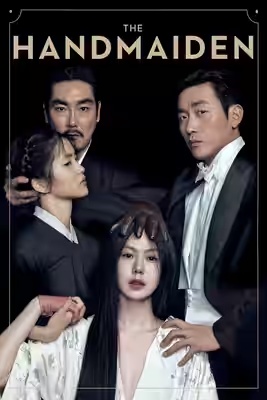
The Crimson Petal and the White is the darker and more serious of the two, while The Handmaiden takes the same Victorian con and makes it funnier, crueller and stranger. Park Chan-wook's film is a clever erotic thriller whose romance survives all the plotting; the British series is about money and bodies, and it does not quite hold to the end. For a complete, satisfying evening, the film is the better choice.
What should I watch after The Crimson Petal and the White?
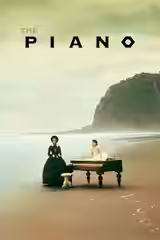
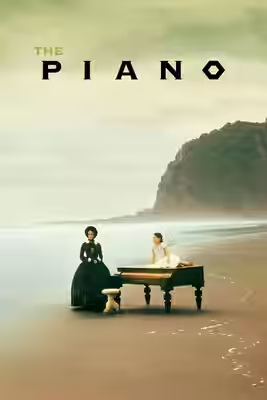
After The Crimson Petal and the White, try The Handmaiden (2016, Fi1m 85): Korea borrows the English Victorian con and makes it funnier, crueller and stranger. Then The Piano (1993, Fi1m 88): A woman bought and shipped, a bargain struck over a body, mud everywhere.

Cast

If you liked this, try…

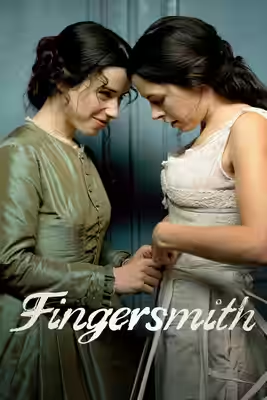
  1. Fingersmith (2005) · not reviewed yetAnother Victorian underworld, another clever woman with a plan, and twists that still hold up.

  2. Utopia (2013) · not reviewed yetMunden and Tapia de Veer again, with the same colours turned up to a scream.

  3. The Handmaiden (2016, Fi1m 85)Korea borrows the English Victorian con and makes it funnier, crueller and stranger.

  4. The Piano (1993, Fi1m 88)A woman bought and shipped, a bargain struck over a body, mud everywhere.

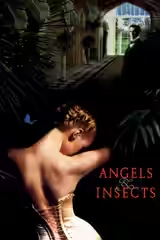
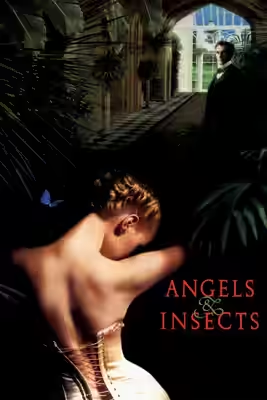
  5. Angels and Insects (1995) · not reviewed yetA country house, a respectable marriage, and something rotten under the specimen cabinets.

Free account

Know what to watch tonight

Two lists that know where things are streaming, collections you can share, your own score beside ours, and Discover that remembers what you have seen.

  • Want to see, sorted by what is streaming now
  • Seen, with your score out of ten
  • No adverts, ever