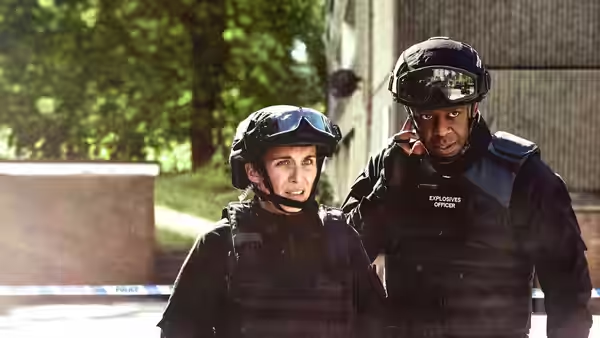
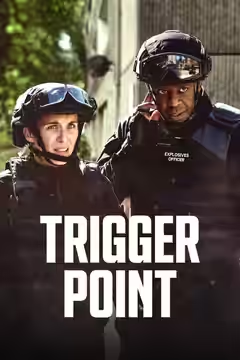
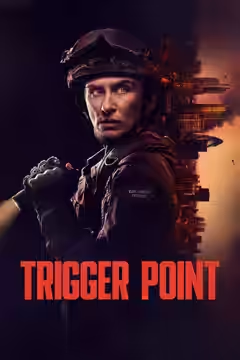
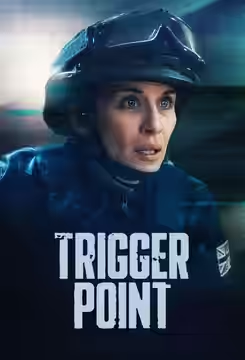
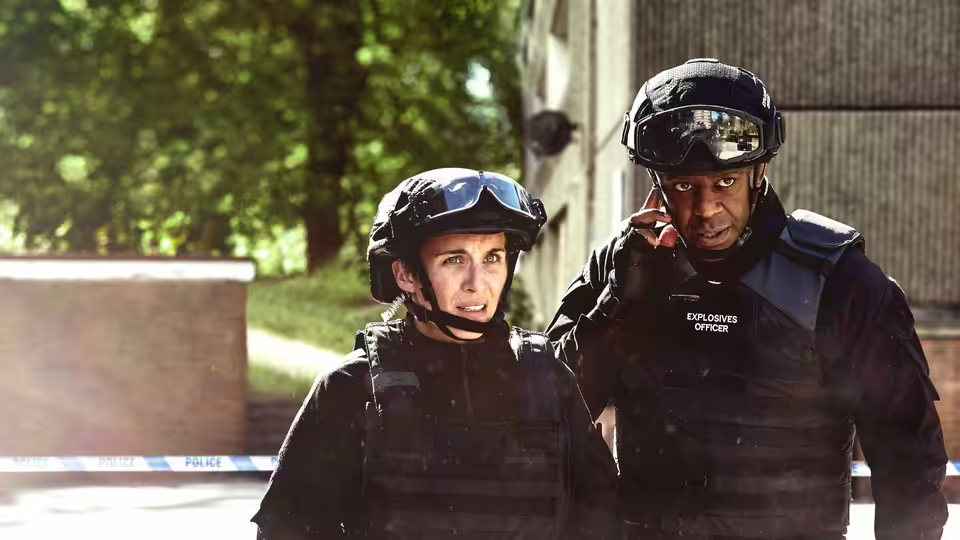
Explosives officer on phone beside colleague in tactical gear outside building
Series review

Trigger Point

2022 · Created by Daniel Brierley · Series

In a sentenceVicky McClure has never looked more competent, and nobody standing near her has ever looked less

London, the present day. Lana Washington (Vicky McClure) is an explosives officer with the Metropolitan Police, a former soldier who now spends her working life kneeling in front of devices other people have built. Her boss, Inspector Lee Robins (Cal MacAninch), runs the bomb squad; DI Thom Youngblood (Mark Stanley) runs the counter-terrorism investigation that starts to circle it. The first episode sends Lana to a flat on a housing estate where a suspected bomb-maker has left something behind, and a man inside is wired to it. She wants to cut the right wire and go home. What stands in the way is a device, a hostage, a crowd of onlookers and a growing sense that whoever built it knows how the squad works. Each of the six hours brings a new device and a new part of the city.

Plays from YouTube when you press play; nothing loads from them until then.

Fi1m review

Daniel Brierley’s bomb squad series does one thing superbly: it puts Vicky McClure in front of a device and makes us hold our breath. The plot that joins those scenes together is daft in the first hour and dafter by the last.

Daniel Brierley’s series puts Vicky McClure in the London bomb squad and gives her, roughly, one device an hour for six hours. She plays Lana Washington, an explosives officer with the Metropolitan Police, and the show arrives with the Line of Duty connection attached, both through McClure herself and through the team behind it. The pitch is plain: a procedural about the people who walk towards the thing everyone else is running from. When Trigger Point is doing that, it is as tense as anything on British television. When it is doing anything else, it is nonsense, and it does a great deal else.

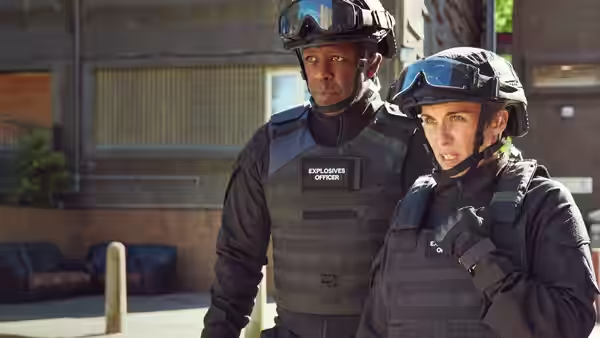
The defusals are the point and they are properly built. Nick Gillespie and Alfie Biddle shoot them close and low, mostly at the height of a kneeling woman, so that a car boot or a stairwell fills the frame and the rest of London disappears. The editors, David I’Anson and Peggy Koretzky, are disciplined enough to hold on a hand and a pair of pliers for longer than most television would dare, and to cut away only when something changes. Anna Pritchard designs the devices as ugly, homemade things, tape and nails and a phone, which is far more frightening than anything with a blinking countdown. The first episode’s opening half-hour had us sitting forward, tense and slightly cross with ourselves for it, because we knew exactly what was being done to us and it worked anyway.

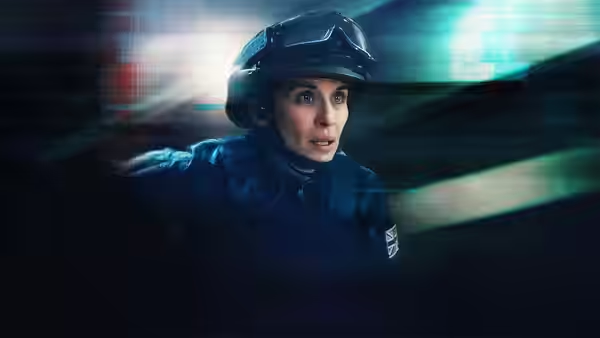
McClure is the reason it works. She plays Lana as someone who has done this so often that the fear has gone somewhere behind her eyes, and the performance is almost entirely in stillness: a breath held, a jaw set, a glance at a wire and back again. Cal MacAninch’s Robins gives her a boss who trusts her and worries about her in roughly equal measure and says little about either. Mark Stanley’s Youngblood is the detective who has to make the wider plot happen, and Stanley does what he can with a man whose function is to walk into rooms and demand updates. Manjinder Virk’s DI Samira Desai has the sharpest lines of the supporting cast and is given the least to do with them.

The trouble is everything between the bombs. Brierley writes the investigation as a chain of suspects, and the series has a habit of pointing at each one in turn as if the camera were a finger. A character will say something faintly odd, the score will note it, and three episodes later the oddness will be explained at length by another character to a third. We laughed, more than once, at scenes in which police officers told each other things they both already knew, and by the fifth hour we were laughing at moments that were meant to be grave. The first episode ends with a turn we will not describe, and most critics rightly admired its nerve; nothing afterwards is as bold, and the final hour tries to tie up its clues in a way that made us check whether we had missed an episode. We had not.

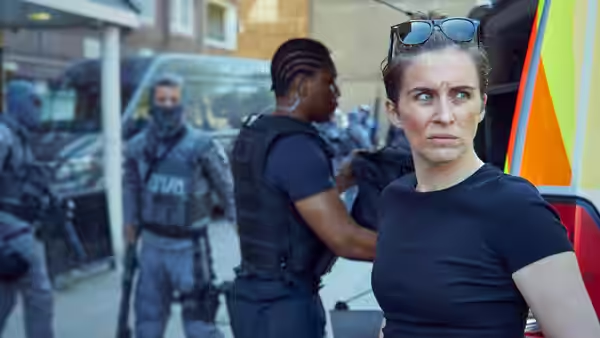
The directors, five of them across six hours including Gilles Bannier and Jennie Darnell, keep the look consistent, which is no small thing on a series made this way. Rosalind Ebbutt’s costumes do quiet work too: Lana in the same heavy kit and hi-vis for scene after scene, the detectives in suits that have been sat in too long. The city itself, estates and A-roads and car parks, is shot without glamour, and that plainness suits the show far better than the plot does.

Line of Duty earned its silliness by making the interviews as gripping as the shootouts; here the equivalent scenes are the ones you talk over. The consensus among critics is warmer than we are, and we understand why, because most of the reviews were written after the first episode, which is the best one. Watched to the end, the shape is clearer: a set of first-rate set pieces hung on a story that would not survive a second viewing. It carries a 15 certificate, runs to six episodes, and three further series have followed, which tells you the set pieces were enough for a great many people. Watch the first hour with the lights off and decide for yourself whether the rest is worth the shouting.

Critical consensus AI synthesised

68
Positive
6
Mixed
1
Negative
1

Most critics lean positive on the opening episodes, and the praise clusters in two places: the bomb disposal set pieces, which several reviews find properly stressful, and Vicky McClure, whose composed, tough-but-sensitive lead is credited with holding the show together even where the writing does not. Reviews of the premiere call it tense, slick and diverting, and more than one admits it is preposterous while conceding it is good fun. The Line of Duty connection is mentioned throughout, usually as a promise the series is expected to keep.

The reservations gather around the script and the ending. Early reviews already note predictability and a slow first half. The two finale reviews, from The i Paper and The Telegraph, are the coolest, finding the resolution rushed and implausible, with The Telegraph judging that the series lapses into self-parody after a strong start. The spread is wide, from warm to disappointed, and it tracks closely with when each review was written.

Radio Times
24 January 2022 · David Craig
81*

The critic praises the suspense-laden first episode and the bold decision to kill off a main character early, noting it fundamentally changes the series dynamic. It delivers on expectations from a Jed Mercurio-produced show.

Read the full review →
The Guardian
23 January 2022
76*

The critic finds the series utterly preposterous but great fun as slick entertainment, likening it to CSI: Peckham or Line of Bomb Duty. They single out the escalating bomb disposal sequences and banter between leads Vicky McClure and Adrian Lester for keeping viewers engaged despite the implausibility.

Read the full review →
The Times
23 January 2022 · ★★★☆☆ · Carol Midgley
73*

The opening episode review notes it was a drama of two halves, boring at first but improving, with enough to keep watching thanks to Vicky McClure. The critic singles out McClure's central performance and the show's position as from the makers of Line of Duty as reasons it might hold attention despite predictability.

Read the full review →
Evening Standard
23 January 2022
70*

The first-episode review finds it a stress-inducing bomb squad thriller with evisceratingly tense moments and forensic bomb disposal sequences. The critic singles out the gripping, high-stakes set pieces and strong lead performance by Vicky McClure as raw material for a solid hit, while noting a need for more intrigue beyond the opener.

Read the full review →
The Independent
23 January 2022
70*

The review describes the series as derivative narrative junk food that is tasty and watchable while it lasts, thanks to tense bomb disposal scenes. The critic singles out Vicky McClure's strong screen presence in a tough-yet-sensitive professional role and the gripping jeopardy of the set pieces.

Read the full review →
The i Paper
27 February 2022 · Rachael Sigee
62*

The critic finds the finale stressful yet silly, with an implausible resolution to the clues and rushed mechanics around the villain's plot. McClure's performance elevates the clunky script and tense action set-pieces.

Read the full review →

Straight answers AI written, from our review

Is Trigger Point worth watching?
Trigger Point is worth watching for the defusal scenes alone, and we scored it 60. Vicky McClure is superb kneeling in front of a homemade device, and the first episode is as tense as anything on British television. The investigation joining those scenes together is daft, and grows dafter, so it suits viewers who want set pieces more than a story.
Where can I watch Trigger Point in Bulgaria?
Trigger Point is not on any streaming or rental service in Bulgaria at the moment. It is available in 7 other countries; change your country at the top of the page to see where. Availability is checked daily.
How violent or frightening is Trigger Point, and is it suitable for children?
Trigger Point carries a 15 certificate in the UK and is too tense and too adult for children. The threat is sustained rather than gory: ugly homemade bombs, hostages wired to them, long silent minutes with a pair of pliers. Older teenagers who can take that kind of dread will manage; the squeamish or anxious may find the defusals hard going.
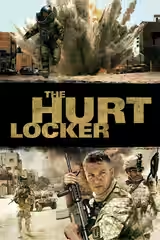
How does Trigger Point compare to The Hurt Locker?
Trigger Point and The Hurt Locker both put bomb disposal close enough to see the wire, but Kathryn Bigelow's film is the better work by a clear margin. The film holds together as a story; the series is six hours of first-rate defusals hung on an investigation that would not survive a second viewing. Choose the series for McClure and the London procedural, the film for something that stays gripping between the bombs.
What should I watch after Trigger Point?
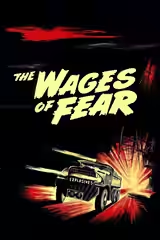
After Trigger Point, try The Hurt Locker (2008, Fi1m 86): Bomb disposal in Iraq, shot so close you can smell the wire cutters. Then The Wages of Fear (1953, Fi1m 90): Two lorries of nitroglycerine, one mountain road, and no music to help you.

Cast

If you liked this, try…

  1. Line of Duty (2012) · not on Fi1m yetMcClure’s other police series, where the interview rooms are as tense as the streets.

  2. The Hurt Locker (2008, Fi1m 86)Bomb disposal in Iraq, shot so close you can smell the wire cutters.

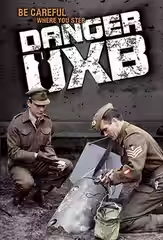
  3. Danger UXB (1979) · not on Fi1m yetWartime London, unexploded bombs, and a patience modern television has largely lost.

  4. Juggernaut (1974) · not on Fi1m yetRichard Harris defuses bombs on a liner; Richard Lester keeps the humour dry.

  5. The Wages of Fear (1953, Fi1m 90)Two lorries of nitroglycerine, one mountain road, and no music to help you.