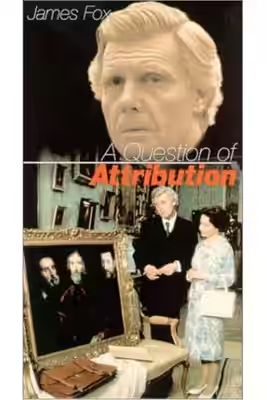
Alan Bennett’s dry hour on Anthony Blunt is a chamber piece that knows exactly what it is about and says it quietly. The scene with the Queen is worth the evening alone; the rest is talk, well made and a little airless.
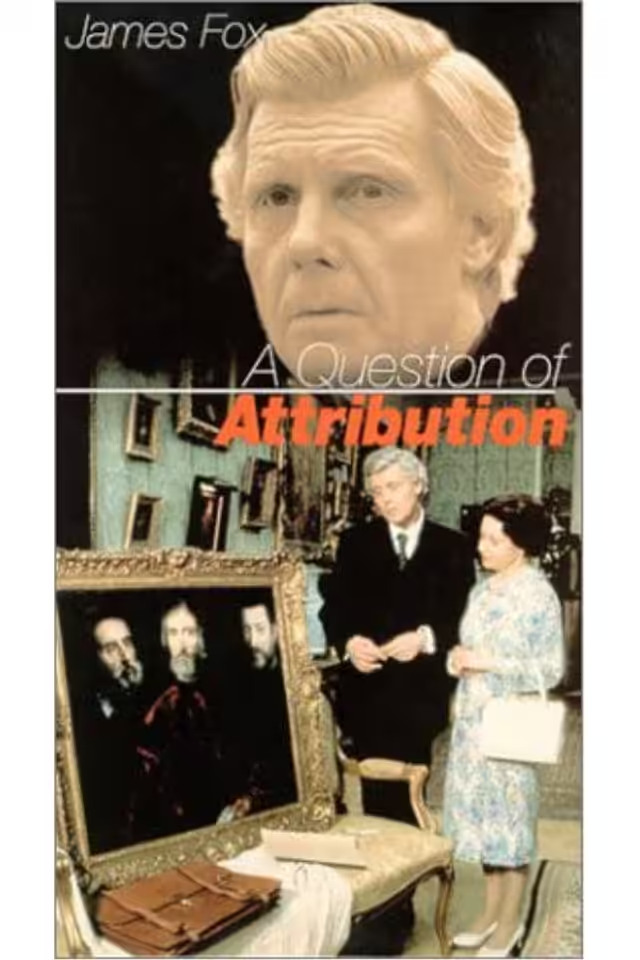
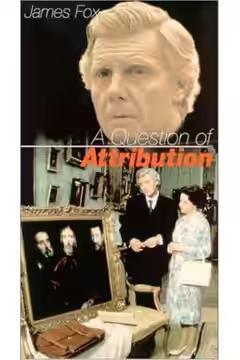
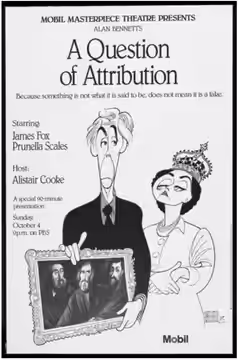
Alan Bennett wrote A Question of Attribution for the stage, as half of Single Spies, and John Schlesinger has filmed it at 71 minutes without pretending it is anything other than a play with the walls taken down. Sir Anthony Blunt (James Fox) has been found out and forgiven, or at least not prosecuted, and spends his week between the Palace, where he looks after the Queen’s pictures, and a bare room where Chubb (David Calder) asks him the same questions in slightly different orders. The idea is plain and Bennett does not hide it: a painting that may not be what it says it is, cleaned and X-rayed by a man who is not what he says he is.
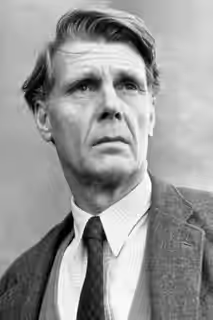
Fox is the right casting and he knows it. He plays Blunt as a man who has been elegant for so long that it has become a kind of absence; he is never caught, because there is nothing to catch, only manners. He lectures, he corrects, he drops the name of a painter the way other people drop a hint. We liked him and did not trust him, which is what the part needs. Calder’s Chubb is the better surprise, a policeman who starts off taking notes and ends up asking about brushwork, and the film is at its most alive when the two of them forget which of them is being interviewed.
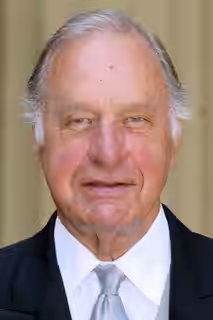
Geoffrey Palmer, as Donleavy, has a handful of scenes of departmental weariness and makes each of them count. Ann Beach, as Mrs Chubb, is given the thankless job of being at home when her husband gets in, and the scenes between them are the ones we would have cut. John Cater’s restorer and Gregory Floy’s radiologist are each on screen for minutes and give the film its two concrete objects: a canvas on an easel and a plate held up to the light.
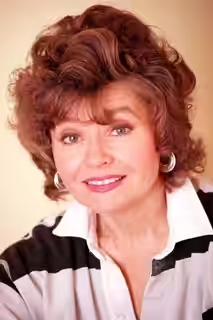
Then there is the Queen. Prunella Scales is credited as H.M.Q. and plays her as a woman who has been shown a great many pictures by a great many clever men and has drawn her own conclusions. Her conversation with Blunt, in a corridor, about forgery and what happens to a fake once everyone knows it is one, is a long scene by any standard, and one of the two reviews we have read calls it painfully prolonged. We laughed through most of it, at the small evasions and the way she keeps returning to the point like a dog to a bone, and then, somewhere near the end, stopped laughing, because we realised she had been talking about him for ten minutes and he had let her. Bennett writes it so that neither can say what they mean, and Scales and Fox play it so that both plainly do.
The craft is modest and mostly right. John Hooper lights the interrogation room flat and the Palace in long, even daylight, so that nothing is dramatised and the words have to do the work. Barbara Gosnold’s rooms are full of gilt frames and empty of people. Amy Roberts keeps everyone in grey and brown except the Queen, who gets colour, which is a small joke that lands. Gerald Gouriet’s music is sparing to the point of hardly being there, and Mark Day cuts the whole thing as a series of conversations rather than a story, which is honest about the material and also its limit.
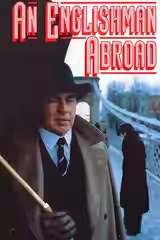
That limit is real. Nothing happens here that is not said, and for stretches the film is two men in a room agreeing to disagree about a painting. Schlesinger made An Englishman Abroad with Bennett a few years earlier, and that film had Moscow and a man falling apart in it; this one has Kensington and a man holding together, which is the quieter and the harder subject, and also the less watchable. We were never bored, but we were aware of being asked to admire.
The reviews so far split down the middle, one calling it first-class entertainment and one finding it lifeless, and we are nearer the first. See it if you like Bennett and can sit still for an hour. At home it is right-sized: a play on a screen, which is what it was meant to be.