Film review

All Quiet on the Western Front

2022 · Directed by Edward Berger · 2h 27m · MPA R

In a sentenceThree blaring notes, two hours of mud and one general who wants the war to outlast his breakfast

WarDrama

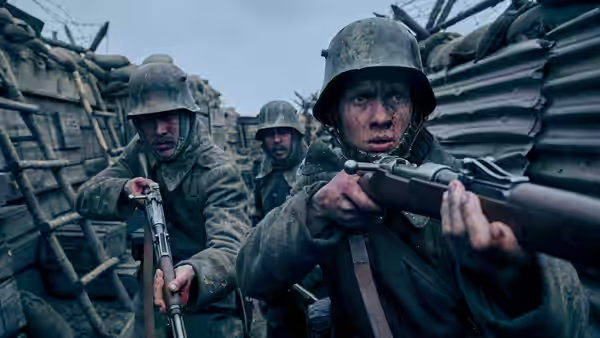
Northern Germany, spring 1917. Paul Bäumer (Felix Kammerer), seventeen, forges his parents’ signature to enlist with his schoolfriends Albert Kropp (Aaron Hilmer), Franz Müller (Moritz Klaus) and Ludwig Behm (Adrian Grünewald), sent off by a headmaster who promises them Paris within weeks. The uniform Paul is handed has another boy’s name tag stitched inside the collar. Within days the four are in a flooded trench in northern France, bailing water with their helmets while the first shells come in, and there they meet Stanislaus Katczinsky (Albrecht Schuch), an older soldier who knows where to find food and when to keep his head down. Eighteen months later, in November 1918, the politician Matthias Erzberger (Daniel Brühl) boards a train to seek an armistice while the fighting goes on.

Plays from YouTube when you press play; nothing loads from them until then.

Fi1m review

Edward Berger’s German-language version of Remarque is superbly made and hard to watch, with a three-note score that sounds like a siren going wrong. It is also a film that keeps explaining what its own trenches have already shown us.

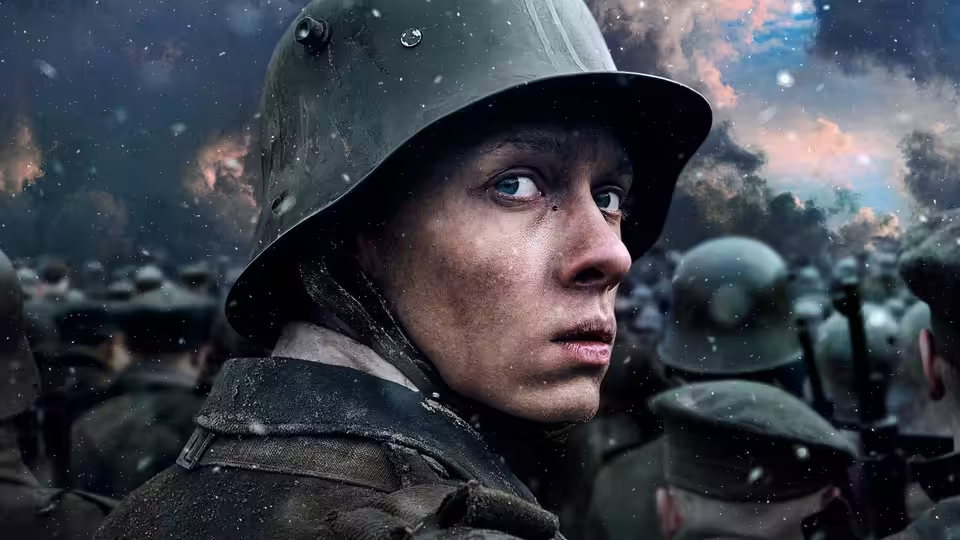
Erich Maria Remarque’s novel came out in 1929 and Hollywood filmed it the following year. It has taken until now for Germans to film it in German. Edward Berger, directing from a screenplay he wrote with Lesley Paterson and Ian Stokell, decides what the book is about before anyone has spoken. A soldier dies in a charge across the mud. His uniform is stripped, laundered with hundreds of others, patched at a sewing machine, folded and issued to Paul Bäumer (Felix Kammerer), who asks about the name inside the collar and is told the tunic was probably too small for its last owner. It is the best five minutes in the film. Everything the next two hours say, they say here first.

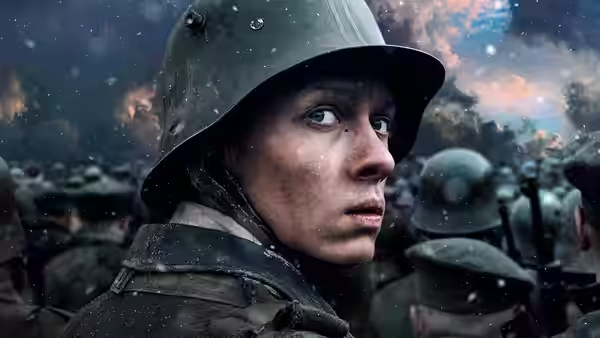
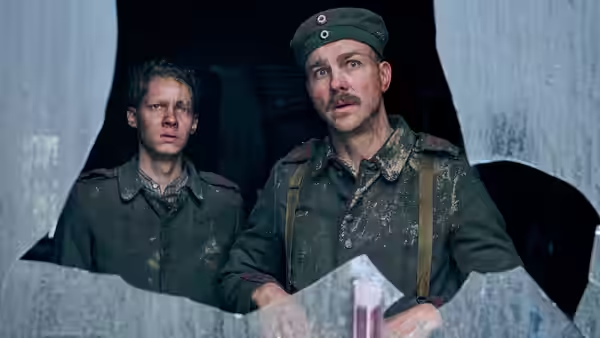
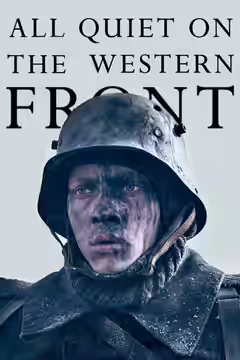
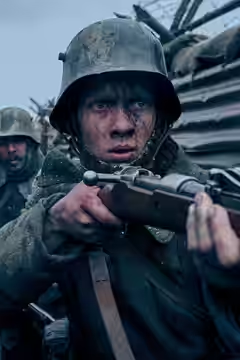
Kammerer has not made a film before this one, and it shows in the right way. His Paul begins with a round, eager face and Berger spends 147 minutes emptying it. He barely speaks. Remarque wrote in the first person; this Paul has no narration and no home leave, so he cannot tell us what he thinks and has nowhere to set the front against. What he has is Kat. Albrecht Schuch plays Stanislaus Katczinsky, an older cobbler who cannot read and has his letters read to him, and the scenes the two share, stealing a goose from a farmyard, eating it in a barn, are the only ones in which anyone smiles. Schuch does the most delicate work in the film, most of it with his shoulders.

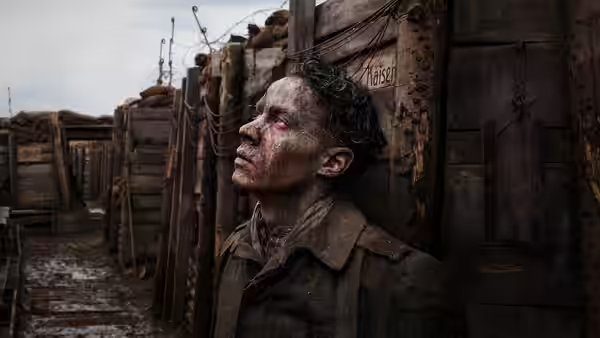
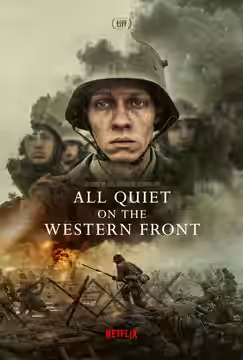
James Friend shoots it wide and cold, blue-grey in the trenches, brown in the mud, and keeps cutting back to the woods: a fox with her cubs, mist on a hillside, trees carrying on as if nothing were happening below them. Christian M. Goldbeck’s trenches are wet to the knee and his headquarters for General Friedrichs (Devid Striesow) has white tablecloths. Lisy Christl’s costumes carry the argument in cloth; the recycled tunics get shabbier as the boys inside them do. Then there is Hauschka’s score: three distorted notes, low and enormous, that arrive like a fault in the machinery whenever the film wants us afraid. They unsettled us more than any shell did, and they are the one thing here we had not heard before.

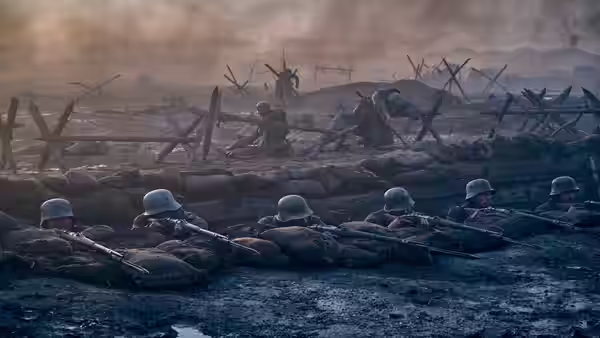
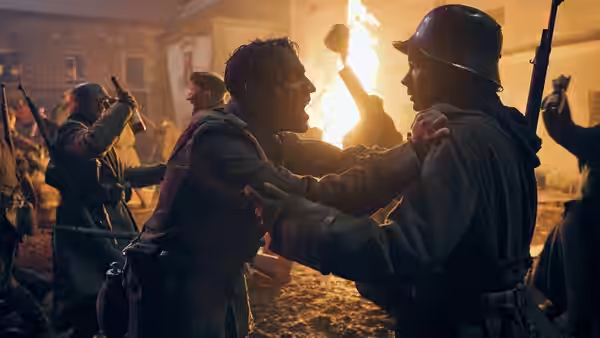
The set piece in the middle, when French tanks come out of the smoke, is where we were horrified. Berger and his editor Sven Budelmann hold on the machines for a long while before showing what they do, and then show it plainly: men under the tracks, men who cannot climb out of a shell hole in time, a flamethrower turned on a dugout. We looked away twice. We also noticed, by the film’s third assault, that we had stopped looking away at all, and we do not think that numbness was intended. Remarque’s point is that the fighting went on and on and changed nothing. Berger makes the point by making it three times.

The screenplay also adds a story the book does not have. Matthias Erzberger (Daniel Brühl) travels to a railway carriage in a forest to ask General Foch (Thibault de Montalembert) for an armistice, while Friedrichs eats well in his chateau and will not accept that the war is lost. Brühl is good, quiet and frightened; Striesow is sure of himself to the last. The point is clear: old men in warm rooms, boys in cold mud. But the trenches have already made it, and every cut to the carriage takes us away from Paul, who is the film. Several critics have made the same objection. We would add that Friedrichs is written as a monster, when an ordinary officer doing his job would have been more frightening.

Most critics have been warm and a few rapturous. The one dissent worth weighing says the film is handsome, competent and adds nothing to what war films have been saying since 1930. We are between the two. The uniform sequence, the score, Schuch and Kammerer are additions. The second half is not. Set against 1917 (2019), which several reviews reach for, this is less pleased with its own camera and more honest about what shrapnel does to a body. Set against the 1930 film it is louder, colder and shorter on the boys’ lives before the war, which is the part of the book that hurts.

See it, if the subject is yours, in the biggest room you can find with the sound up; Hauschka’s three notes need space. Certificate 15, 147 minutes, and both numbers are honest. Do not eat first.

Critical consensus AI synthesised

75
Positive
14
Mixed
3
Negative
1

Most critics are impressed. The reviews lean strongly positive, with fourteen of eighteen in favour, and the praise clusters on Berger’s battle scenes, which are found brutal, repetitive by design and free of heroics. Several single out the opening sequence following a dead soldier’s uniform as it is recycled, and the cutting between trench carnage and quiet, empty landscape. The photography, production design and sound are praised almost everywhere, and the German-language perspective is widely felt to reclaim the story for the country that produced the novel.

The reservations are about what Berger adds and what he leaves out. The Los Angeles Times finds the armistice negotiation subplot an unnecessary distraction from the soldiers; Time Out feels the adaptation cuts too deeply into the book’s characters. The Hollywood Reporter and IndieWire admire the craft but hear only a familiar reminder that war is hell. The spread is wide: Variety alone dismisses it as dull, competent and without emotional force.

Radio Times
★★★★★ · Stephen Applebaum
100

The critic praises this as a brutal adaptation that does justice to the classic novel, instantly establishing its anti-war message through the recycling of soldiers' uniforms and staging battle scenes that reach new levels of horror while also capturing beauty, comradeship and the tragic loss of a generation.

Read the full review →
The AV Club
26 October 2022 · A- · Matthew Jackson
90

Berger’s adaptation is a powerful, bleakly honest and visually poetic take on the novel, emphasizing the human cost of war through visceral battles and quiet landscape framing.

Read the full review →
Empire
12 October 2022 · John Nugent
85*

The critic praises Berger's visceral and hard-nosed direction, which depicts trench warfare as a futile, repetitive horror machine with stunning production values that rival 1917. The film is lauded as a doom-laden, epic adaptation that powerfully conveys the wretched pointlessness of war.

Read the full review →
The Guardian
12 October 2022 · Peter Bradshaw
80*

The critic finds it a powerful, eloquent and conscientiously impassioned German-language adaptation of the classic anti-war novel. The film is praised for its substantial, serious approach and expertly melded battlefield scenes, though noted as perhaps overly conscious of its own classic status.

Read the full review →
Time Out
30 September 2022 · ★★★★ · Phil de Semlyen
80

The critic calls it a jaw-dropping, brutal and brilliant vision that movingly captures humanity amid the horror of the Great War, a leaner and more savage beast than previous adaptations. Smart Spielbergian grace notes and strong craft elevate the battle scenes, though the adaptation cuts too deeply into the book's character elements.

Read the full review →
Los Angeles Times
27 October 2022 · Justin Chang
75*

The critic praises the film's visceral realism and the power of its German-language adaptation but criticizes the inclusion of a subplot about the armistice negotiations as unnecessary and a distraction from the soldiers' experiences.

Read the full review →

Cast

Awards

Academy Awards, 2023

Nominated
Best Picture
Nominated
Best Writing, Adapted Screenplay
Won
Best Cinematography
Won
Best International Feature Film
Won
Best Original Score
Won
Best Production Design

BAFTA Film Awards, 2023

Won
Best Film

Golden Globes, 2023

Nominated
Best Non-English Language Film

International Submission to the Academy Awards, 2023

Nominated
International Submission to the Academy Awards

European Film Award for Best Hair and Makeup Artist, 2022

Won
European Film Award for Best Hair and Makeup Artist

European Film Award for Best Visual Effects, 2022

Won
European Film Award for Best Visual Effects

If you liked this, try…

All Quiet on the Western Front poster

All Quiet on the Western Front

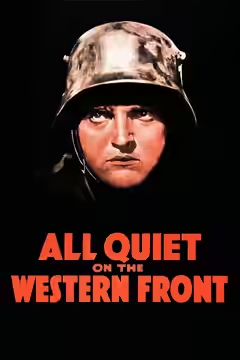
1930 · Lewis Milestone’s version keeps the boys’ lives before the war; see what Berger cut.

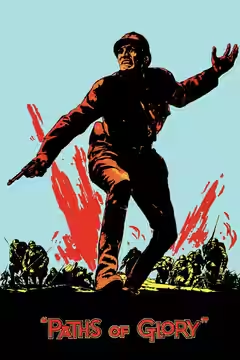
Paths of Glory poster93

Paths of Glory

1957 · Kubrick’s French generals send men to die and then court-martial the survivors.

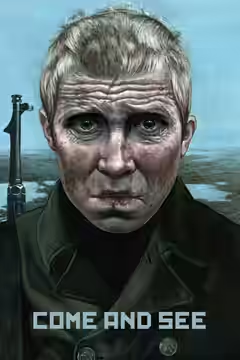
Come and See poster92

Come and See

1985 · Klimov’s Belarusian boy walks through the Eastern Front; the one war film we cannot rewatch.

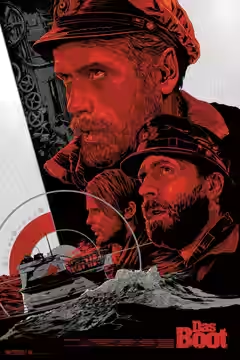
Das Boot poster89

Das Boot

1981 · Petersen’s submarine crew, Germans again, trapped in a tube and waiting for the depth charges.

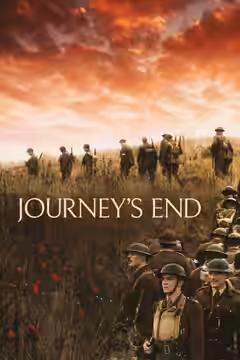
Journey's End poster

Journey's End

2017 · A British dugout in March 1918, four days, no battle scenes and no less dread.