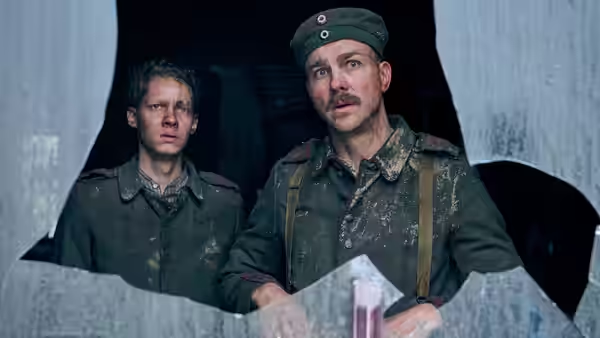
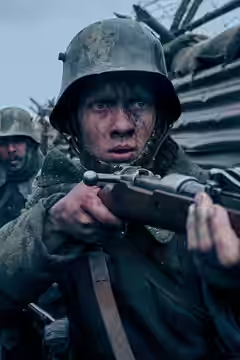
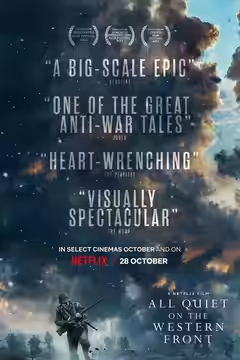
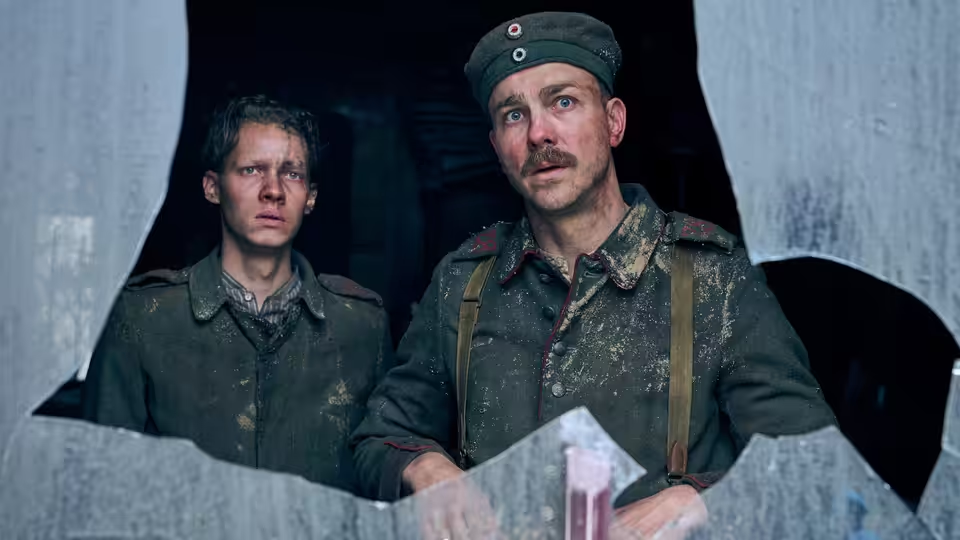
Two soldiers in muddy uniforms peer through a hole in a concrete wall
Film review

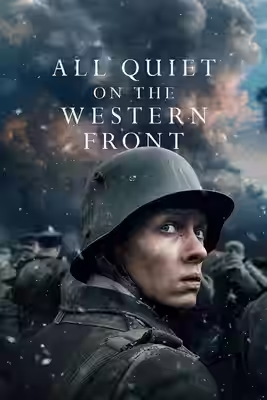
All Quiet on the Western Front

2022 · Directed by Edward Berger · 2h 27m

In a sentenceThe uniform gets more of a story than the boy wearing it

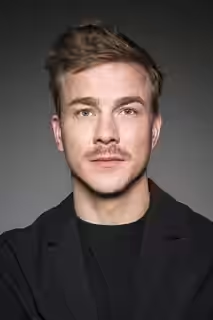
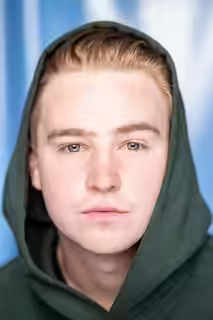
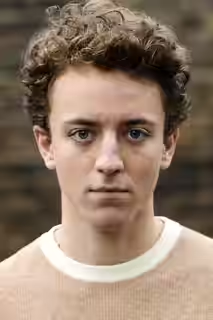
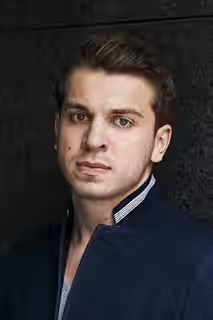
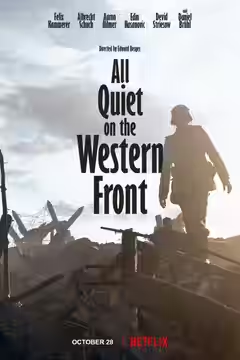
Northern France, spring 1917. A German soldier is killed going over the top, and his uniform is stripped, laundered, patched and reissued. It arrives at a recruiting hall in Germany, where Paul Bäumer (Felix Kammerer), seventeen and eager, has forged his parents’ signature to enlist alongside his school friends Albert Kropp (Aaron Hilmer), Franz Müller (Moritz Klaus) and Ludwig Behm (Adrian Grünewald). The boys expect Paris in a fortnight. They get a lorry to the front, a flooded trench, a first night of shelling that buries some of them alive, and the job of pulling identity tags from the dead. Under the wing of an older soldier, Stanislaus ‘Kat’ Katczinsky (Albrecht Schuch), and the joker Tjaden Stackfleet (Edin Hasanović), Paul learns how to stay wet, hungry and alive.

Plays from YouTube when you press play; nothing loads from them until then.

Fi1m review

Edward Berger’s German-language return to Remarque is superbly made and hard to sit through in the way it means to be. But it has cut the novel’s people down to bodies in mud and added a cabinet drama it did not need.

Erich Maria Remarque’s novel has been filmed in English twice and in German, until now, never. Edward Berger, who directs and shares the screenplay with Ian Stokell and Lesley Paterson, sends Paul Bäumer (Felix Kammerer) and his school friends to Northern France in 1917 and keeps them there for 147 minutes. It is a serious, punishing, handsomely built film. We recommend it, with reservations we will get to.

The opening is the best thing in it. A soldier we do not know climbs out of a trench and dies. His body goes onto a cart, his tunic goes into a laundry, women scrub the blood out and sew up the holes, a name tag is cut from the collar, and the tunic is handed across a counter to Paul, who finds the stranger’s name still inside and is told it was too small for its last owner. Sven Budelmann cuts this without a line of dialogue for several minutes and it made us cold before anyone we cared about had been shot at. The film has said everything it is going to say and it has taken six minutes.

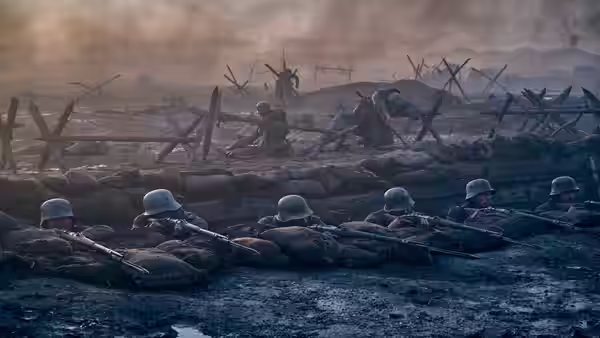
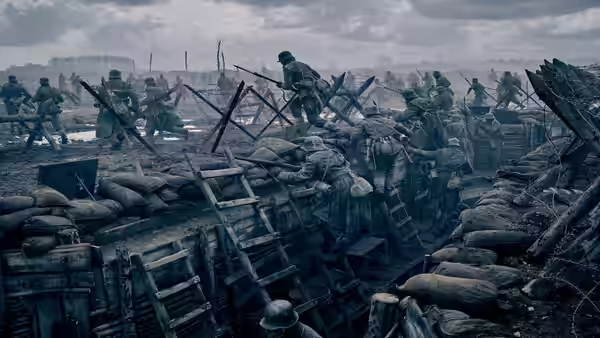
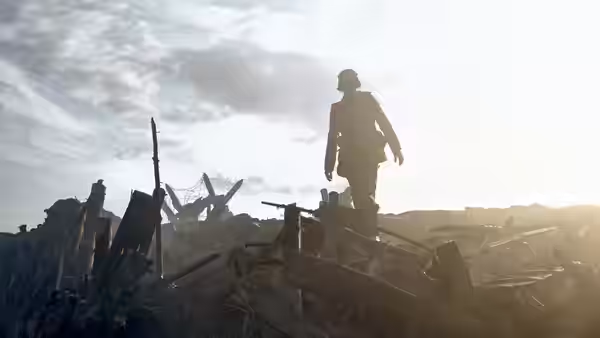
James Friend shoots the war in green-grey, from a long way up and a long way back, so that the men are small and the mud goes on to the horizon. Christian M. Goldbeck’s trenches are flooded to the knee and his dressing stations are barns with the roofs blown off. Lisy Christl puts the boys in uniforms a size wrong, which is right. Hauschka’s score is three notes on a distorted harmonium, like a door being forced, and the first time it comes in we sat up. By the tenth it is a cue for something terrible, and the film uses it as one.

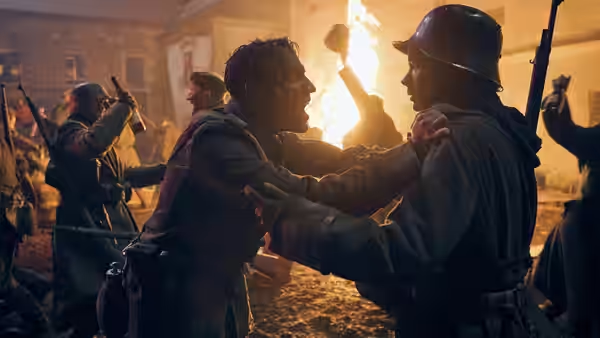
The terrible things arrive on schedule. In the film’s central assault, tanks come out of the fog with men in flame-throwers walking behind them, and Paul lies under a corpse while the ground around him burns. We were horrified. The sound department drops the music, the screams are close and the fire is closer, and Berger holds the wide shot long enough that we could see exactly how many were not getting up. It is as frightening a battle sequence as we have seen in some years and it does not flinch from what a shovel does to a face.

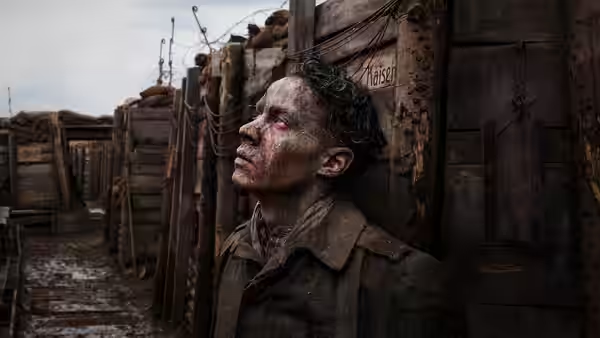
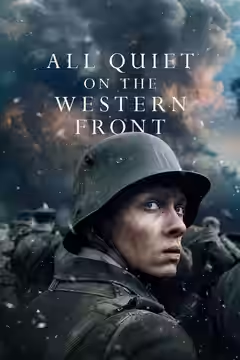
Kammerer is a round-faced, open boy at the start and Friend photographs him getting hollowed out, one close-up at a time. He is given almost nothing to say, which is the film’s choice and not his fault, and he manages a great deal with the way he looks at his own hands. Albrecht Schuch, as Kat, supplies what warmth there is: a cobbler who cannot read, steals a goose from a farmhouse in the dark and shares it out like a father at Christmas. Aaron Hilmer, Moritz Klaus and Edin Hasanović are good faces in the mud. They are not much more than faces, and that is the trouble.

Remarque’s book is full of people. It has a schoolmaster who talks the boys into the war, a drill sergeant they take revenge on, a spell of leave at home where Paul finds he cannot talk to his mother, a long stretch in a hospital. Berger has cut all of it. What is left is the front and the men dying on it, and by the second hour we had stopped being able to tell the friends apart except by who was still alive. Into the space the novel’s people used to fill, the film puts Daniel Brühl as Matthias Erzberger, riding to a railway carriage in a forest to ask Thibault de Montalembert’s General Foch for an armistice, and Devid Striesow as General Friedrichs, eating well in a château and talking about honour. These scenes are well played and they give the film a clock and a villain. The book refused to supply either. Its whole argument was that nobody in particular did this.

Set against the other trench films of the last few years, it is grimmer than 1917 and less inventive, and its long looks at trees and fog owe something to the older war pictures it plainly admires. Set against the 1930 Lewis Milestone version, which let its boys talk, it is far more brutal and a good deal less sad. Watch it on the largest screen in the house and not late at night, because it does not let go for some time afterwards. The 15 certificate is a kindness.
Critical consensus AI synthesised

75
Positive
14
Mixed
3
Negative
1

Most critics admire this German-language adaptation, and the praise gathers around the battle scenes, which several reviews find more brutal, and more deliberately repetitive, than any earlier version of the novel. The opening sequence, in which a dead soldier’s uniform is stripped, washed and reissued, is singled out repeatedly as the film’s message in miniature. Cinematography, sound design and production design draw steady approval, and Collider picks out Felix Kammerer’s performance as the young recruit.

The reviews part over whether any of this is new. The Hollywood Reporter and IndieWire find it handsome but familiar, restating that war is hell without adding to the case. The armistice subplot divides them: Sight and Sound thinks it deepens the book’s plea, the Los Angeles Times calls it a distraction. Little White Lies finds the result workmanlike, and Variety goes furthest, judging it dull and without emotional weight. The spread is wide, from outright raves to one plain dismissal.

Radio Times
★★★★★ · Stephen Applebaum
100

The critic praises this as a brutal adaptation that does justice to the classic novel, instantly establishing its anti-war message through the recycling of soldiers' uniforms and staging battle scenes that reach new levels of horror while also capturing beauty, comradeship and the tragic loss of a generation.

Read the full review →
The AV Club
26 October 2022 · A- · Matthew Jackson
90

Berger’s adaptation is a powerful, bleakly honest and visually poetic take on the novel, emphasizing the human cost of war through visceral battles and quiet landscape framing.

Read the full review →
Empire
12 October 2022 · John Nugent
85*

The critic praises Berger's visceral and hard-nosed direction, which depicts trench warfare as a futile, repetitive horror machine with stunning production values that rival 1917. The film is lauded as a doom-laden, epic adaptation that powerfully conveys the wretched pointlessness of war.

Read the full review →
The Guardian
12 October 2022 · Peter Bradshaw
80*

The critic finds it a powerful, eloquent and conscientiously impassioned German-language adaptation of the classic anti-war novel. The film is praised for its substantial, serious approach and expertly melded battlefield scenes, though noted as perhaps overly conscious of its own classic status.

Read the full review →
Time Out
30 September 2022 · ★★★★ · Phil de Semlyen
80

The critic calls it a jaw-dropping, brutal and brilliant vision that movingly captures humanity amid the horror of the Great War, a leaner and more savage beast than previous adaptations. Smart Spielbergian grace notes and strong craft elevate the battle scenes, though the adaptation cuts too deeply into the book's character elements.

Read the full review →
Los Angeles Times
27 October 2022 · Justin Chang
75*

The critic praises the film's visceral realism and the power of its German-language adaptation but criticizes the inclusion of a subplot about the armistice negotiations as unnecessary and a distraction from the soldiers' experiences.

Read the full review →

Straight answers AI written, from our review

Is All Quiet on the Western Front worth watching?
All Quiet on the Western Front is worth watching for anyone prepared for two and a half hours of trench warfare shown without mercy, and we scored it 71. It is superbly made and its central assault is as frightening as any we have seen in years. Its weakness is people: the boys are cut down to faces in the mud, and by the second hour we could barely tell them apart.
How long is All Quiet on the Western Front, and what is it rated?
All Quiet on the Western Front runs 2h 27m. It is a war and drama film.
Where can I watch All Quiet on the Western Front in Malaysia?
All Quiet on the Western Front is streaming on Netflix in Malaysia. Availability is checked daily; the links above go straight to each service.
How violent or frightening is All Quiet on the Western Front, and is it suitable for children?
All Quiet on the Western Front is a 15 certificate and earns it: sustained battlefield violence, men buried alive by shelling, flame-throwers, and a fight that does not flinch from what a shovel does to a face. It is not for children, and we would keep the squeamish away too. Older teenagers studying the war will cope, but not late at night.
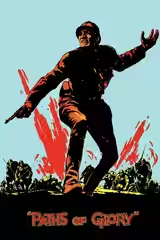
How does All Quiet on the Western Front compare to Paths of Glory?
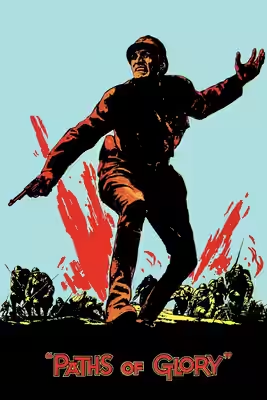
All Quiet on the Western Front is the more brutal film and Paths of Glory the better one. Kubrick puts the generals on trial while keeping his soldiers' faces and voices; Berger keeps the generals in a château and lets his soldiers become bodies. Choose the German film for the battles, Kubrick for the anger and the people it is spent on.
Is All Quiet on the Western Front based on a true story or a book?
All Quiet on the Western Front is based on Erich Maria Remarque's novel, filmed twice before in English and here for the first time in German. It is not faithful: Berger cuts the schoolmaster, the leave at home and the hospital, and adds armistice scenes the book never had. You need not know the novel, but readers will notice that its argument, that nobody in particular did this, has been given a villain.
What should I watch after All Quiet on the Western Front?
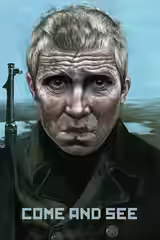
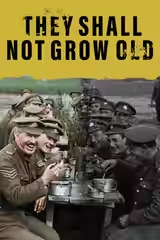
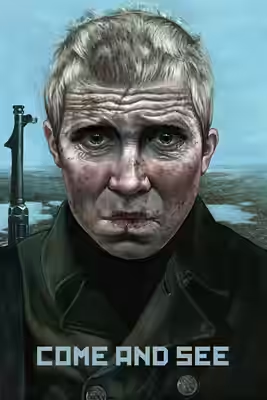
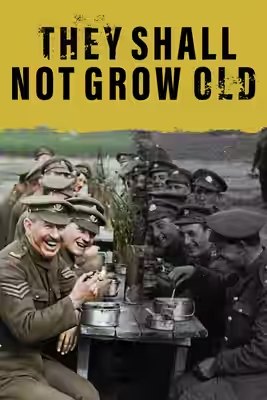
After All Quiet on the Western Front, try Paths of Glory (1957, Fi1m 93): Kubrick’s trench film puts the generals on trial and keeps the men’s faces. Then Come and See (1985, Fi1m 92): A boy in the war, filmed in Belarus, and the most frightening film we know; and They Shall Not Grow Old (2018, Fi1m 81): The real footage, restored and voiced by the men, for after the fiction.

Cast

Awards

Academy Awards, 2023

Nominated
Best Picture
Nominated
Best Writing, Adapted Screenplay
Won
Best Cinematography
Won
Best International Feature Film
Won
Best Original Score
Won
Best Production Design

BAFTA Film Awards, 2023

Won
Best Film

Golden Globes, 2023

Nominated
Best Non-English Language Film

International Submission to the Academy Awards, 2023

Nominated
International Submission to the Academy Awards

European Film Award for Best Hair and Makeup Artist, 2022

Won
European Film Award for Best Hair and Makeup Artist

European Film Award for Best Visual Effects, 2022

Won
European Film Award for Best Visual Effects

If you liked this, try…

  1. Paths of Glory (1957, Fi1m 93)Kubrick’s trench film puts the generals on trial and keeps the men’s faces.

  2. Come and See (1985, Fi1m 92)A boy in the war, filmed in Belarus, and the most frightening film we know.

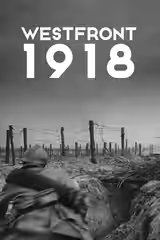
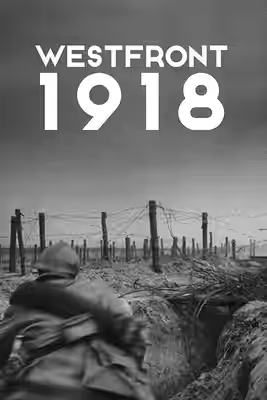
  3. Westfront 1918 (1930) · not reviewed yetPabst’s German Western Front, made by men who had been there a decade earlier.

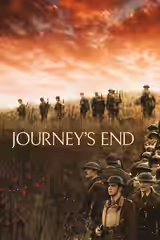
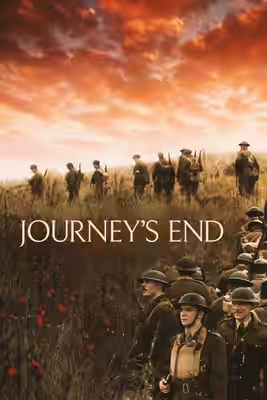
  4. Journey's End (2017) · not reviewed yetThe British dugout version: four days, one company, and the talk Berger cut.

  5. They Shall Not Grow Old (2018, Fi1m 81)The real footage, restored and voiced by the men, for after the fiction.

Free account

Know what to watch tonight

Two lists that know where things are streaming, collections you can share, your own score beside ours, and Discover that remembers what you have seen.

  • Want to see, sorted by what is streaming now
  • Seen, with your score out of ten
  • No adverts, ever