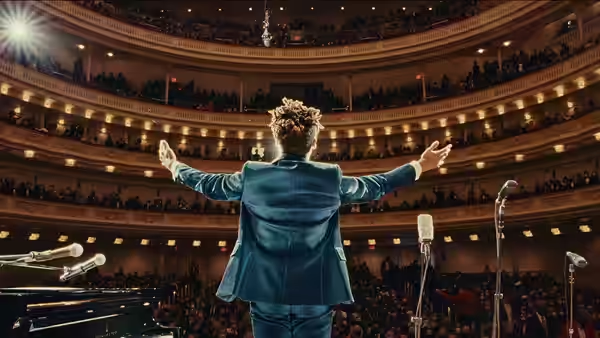
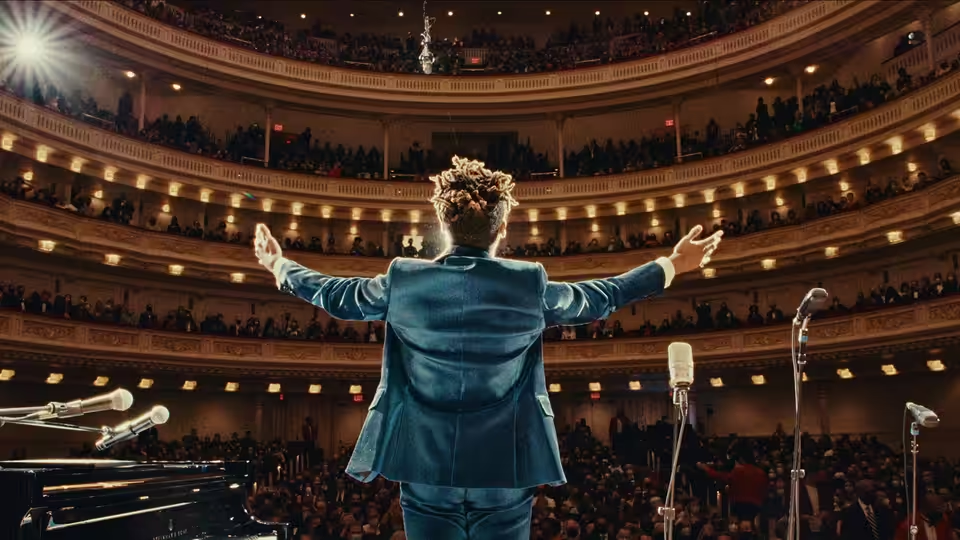
Jon Batiste stands with arms outstretched before a packed concert hall audience
Film review

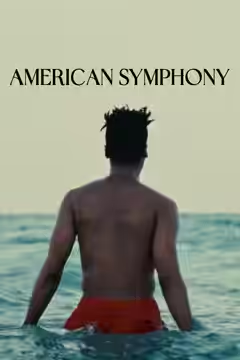
American Symphony

2023 · Directed by Matthew Heineman · 1h 44m

In a sentenceJon Batiste gets us interested in the piano just as the documentary remembers it has somewhere else to be

Jon Batiste works on his music while his partner, Suleika Jaouad, undergoes cancer treatment. Both appear as themselves in Matthew Heineman’s documentary, which also features Lindsey Byrnes as herself. Jon Batiste wants to continue creating while remaining close to Suleika Jaouad, and the film follows the demands of music-making alongside their life together. A piano-and-trombone exchange offers a view of musical ideas taking shape; an airport shoe-shine catches him away from performance. Between work and treatment, the couple share moments of humour and affection, while the camera stays with their ordinary exchanges.

Plays from YouTube when you press play; nothing loads from them until then.

Fi1m review

Matthew Heineman finds warmth and feeling in Jon Batiste and Suleika Jaouad’s shared life. The music-making gets less attention than it deserves, but their company makes this uneven documentary worth an evening.

Matthew Heineman’s American Symphony is a moving documentary with a frustratingly incomplete account of how its music gets made. It follows Jon Batiste’s creative work alongside Suleika Jaouad’s cancer treatment, allowing their affection and humour to matter as much as the difficulties they face. There is enough here to recommend, particularly for anyone interested in how a couple keeps living through illness. Those hoping to understand the decisions behind the music will have to accept quite a few gaps.

The couple’s scenes together are what hold our attention. Suleika Jaouad has humour and affection to offer alongside the demands of treatment, and Jon Batiste has someone to respond to without having to perform for an audience. These exchanges justify the time spent away from the music, because the relationship is interesting in its own right. The film is sensibly reluctant to make every shared pleasure an occasion for solemn reflection, and the warmth between them prevents the account of illness from becoming dutiful.

Cinematographers Thorsten Thielow, Matthew Heineman and Tony Hardmon make that closeness useful, giving small changes of mood enough attention to register. The airport shoe-shine scene is particularly welcome: Jon Batiste briefly becomes someone carrying on with an ordinary day, away from the demands of performance. We get a sense of a person whose company might be interesting even without the music. This is where the intimate camerawork does its job, allowing us to watch unguarded behaviour without insisting on its importance.

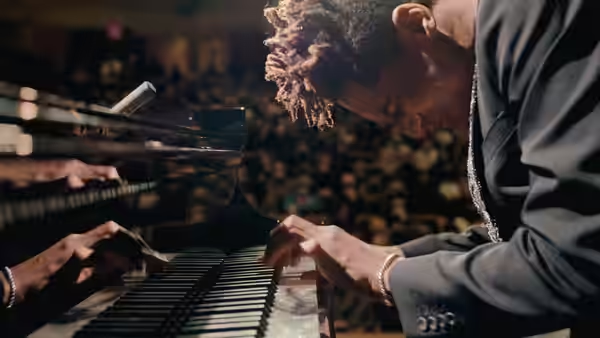
The music, by Jon Batiste, is strongest when the film lets us attend to its making. We were moved by the piano-and-trombone scene, which gives us time to hear a musical idea take shape. Watching that process is engaging without every technical choice being translated, and it briefly makes the film’s interest in creation feel properly earned. More attention of this kind would have helped, especially when the documentary asks us to care about the work as well as the person doing it.

The editing is shared by Matthew Heineman, Sammy Dane, Jim Hession and Fernando Villegas, who move between creative work and the experience of illness. That movement makes sense, but it repeatedly interrupts our chance to follow the music-making in any depth. The film raises our curiosity about the choices behind the music, then gives us too little to satisfy it. Across 104 minutes, there is room to give the compositions more attention without sacrificing the couple’s private moments.

That is a significant limitation in a documentary about a musician, though it does not undo the value of the time spent with this couple. The genre can become a dutiful tour through achievements, and this film is better when it stays with work, worry and ordinary conversation. We do not need a comprehensive career account, but a little more patience with a musical idea would help. The humour and affection are reason enough to stay. Choose it for a portrait of the relationship, with modest expectations of how much it will explain about composition.

Critical consensus AI synthesised

69
Positive
4
Mixed
7
Negative
0

The reviews lean towards qualified warmth, with mixed responses outnumbering positive ones and none registering as negative. Praise centres on the affectionate, candid relationship between Batiste and Jaouad, and on moments of humour and tenderness amid cancer treatment and music-making. Critics repeatedly find the documentary moving, even when they question its depth. Empire also singles out the textured cinematography and close observation of Batiste’s creative work.

The main disagreement concerns how much that intimacy reveals. The Wrap sees a convincing portrait of artistic creation under personal strain, while The Guardian and IndieWire find the film moving but scattered or unfocused. Several reviews argue that Batiste’s musical process receives too little attention; others find the balance between work and illness persuasive. The spread runs from appreciative to moderately disappointed rather than sharply hostile: the recurring reservation is that access to the couple does not always bring a fuller understanding of them.

Empire
27 November 2023 · John Nugent
80*

The critic finds the documentary moving and carefully crafted, though whether it fully gets under its subjects’ skin is left open. They praise the close-up view of Batiste’s creative process and the film’s textured cinematography.

Read the full review →
The Hollywood Reporter
1 September 2023 · festival review · Daniel Fienberg
75*

Fienberg finds the documentary joyful and emotionally resonant, with a nuanced portrait shaped by unexpected turns. He especially praises the intimate depiction of Batiste and Jaouad’s relationship, though he notes Batiste’s musical process gets sidelined.

Read the full review →
Variety
1 September 2023 · festival review · Chris Willman
75*

The critic calls the documentary warm and lovely, finding its portrait of illness and artistic triumph intimate and balanced. They praise the couple’s candid, affectionate relationship and the film’s ability to hold music-making alongside Jaouad’s cancer treatment.

Read the full review →
RogerEbert.com
65*

The page identifies a review of the specified film, but its content is inaccessible. The critic’s verdict and any specific praise or complaint cannot be verified.

Read the full review →
The New York Times
64*

The page is inaccessible, so the critic’s verdict cannot be established. No specific praise or complaint is available from the supplied text.

Read the full review →
IndieWire
4 September 2023 · C+ · Vikram Murthi
63

Murthi finds the documentary emotionally affecting but unfocused and frustratingly anonymous. He praises the candid airport shoe-shine moment as a rare glimpse of Batiste offstage.

Read the full review →

Straight answers AI written, from our review

Is American Symphony worth watching?
American Symphony is worth watching for its warm, moving portrait of Jon Batiste and Suleika Jaouad’s relationship through cancer treatment, and we score it 73. We recommend it for their humour, affection and ordinary exchanges, though anyone hoping for a detailed account of how Batiste makes music will find the repeated interruptions frustrating.
How long is American Symphony, and what is it rated?
American Symphony runs 1h 44m. It is a documentary and music film.
Where can I watch American Symphony in Portugal?
American Symphony is streaming on Netflix in Portugal. Availability is checked daily; the links above go straight to each service.
How violent or frightening is American Symphony, and is it suitable for children?
American Symphony has a UK 12A certificate, and its account of Suleika Jaouad’s cancer treatment is the main concern for younger or sensitive viewers. We find the couple’s humour and affection temper the difficult subject matter, but illness may still be upsetting; children under 12 require an accompanying adult at the cinema.
How does American Symphony compare to Buena Vista Social Club?
American Symphony is our choice for an intimate portrait of a couple, while we recommend Buena Vista Social Club more readily for time spent listening to musicians play together. The former repeatedly leaves its music-making unexplored; the latter gives the music ample room, though its circling camera and restless cutting sometimes get in the way.
What should I watch after American Symphony?
After American Symphony, try Buena Vista Social Club (1999, Fi1m 76): Musicians playing together become absorbing company, with ample room for the music itself. Then The Gleaners and I (2000, Fi1m 85): Patient attention to ordinary encounters gives this documentary its humour and warmth; and Once (2007, Fi1m 88): A smaller musical story, attentive to the intimacy that develops through making songs.

Cast

If you liked this, try…

  1. Buena Vista Social Club (1999, Fi1m 76)Musicians playing together become absorbing company, with ample room for the music itself.

  2. Ryuichi Sakamoto: Coda (2017) · not reviewed yetAnother musician facing illness, with closer attention to how sounds become compositions.

  3. The Gleaners and I (2000, Fi1m 85)Patient attention to ordinary encounters gives this documentary its humour and warmth.

  4. Once (2007, Fi1m 88)A smaller musical story, attentive to the intimacy that develops through making songs.

  5. 20 Feet from Stardom (2013, Fi1m 74)For the working musicians, shared effort and individual voices behind a public performance.